
November 26–29, 2025 — ICOMOS Philippines brought forward the country’s most urgent heritage concerns and innovative conservation approaches at the 2025 APRU Multi-Hazards (MH20) Conference, presenting a strong and unified call for disaster preparedness, cultural resilience, and risk-informed heritage governance. The annual conference, which gathers global experts across the Pacific Rim, served as a platform for Filipino scholars and practitioners to highlight groundbreaking work addressing the vulnerabilities of heritage sites in disaster- and conflict-prone areas.
Across various sessions—ranging from heritage environments to resilience-focused design—the ICOMOS Philippines delegation emphasized a central theme: heritage conservation must be rooted in risk awareness, scientific documentation, inclusivity, and community collaboration.
One of the key contributions was presented during Parallel Session 1B: Designing for Resilience, where Ar. Harvey Vasquez explored Fabulation and the Architecture of Survival: Speculative Fiction as Method in Maynila in Manila. His work offered a compelling narrative approach to envisioning adaptive urban futures in the face of climate and socio-environmental challenges.
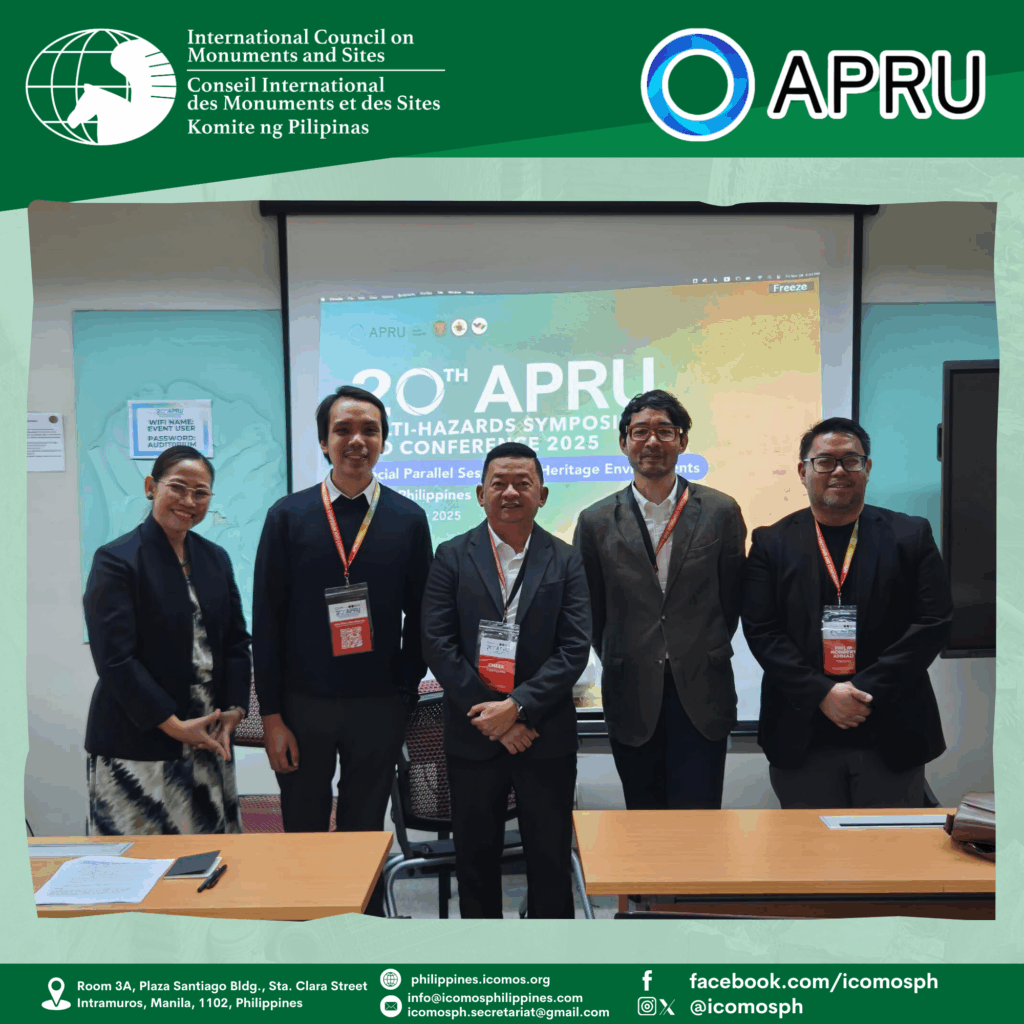
Meanwhile, during Special Parallel Session 6B: Heritage Environments, several noteworthy studies from the Philippine contingent deepened the conversation on resilience. The session opened with Heritage Conservation as a Driver of Post-disaster Sustainable Resilience: Case of the 2022 Mw 7.0 Northwestern Luzon Earthquake at the World Heritage City of Vigan, Philippines, authored by Dr. Cheek Fadriquela, Dr. Kenneth Javier Tua, Maria Cristina Paterno, and Anjelike Orui. Their research demonstrated how heritage spaces can become catalysts for sustainable recovery through multidisciplinary strategies.
Joselito Corpus, MHSP, strengthened the discourse on institutional preparedness through his presentation, Institutional Actions for Risk Preparedness, Response and Recovery, which drew from real post-disaster interventions and documented challenges following Typhoon Odette (rai) in December 2021. The typhoon brought widespread destruction across Eastern and Central Visayas, severely damaging historic churches, convents, and ecclesiastical structures in the Diocese of Maasin. Many of these Spanish colonial-era landmarks—long-standing symbols of cultural and religious continuity—revealed not only structural vulnerabilities but also the absence of a comprehensive Disaster Risk Management for Cultural Heritage (DRMCH) framework.
Another significant study, Heritage Preservation in Conflict-Affected Areas: The Case of Lanao del Sur, presented by Ruhollah Al-Husseini Javier Alonto with co-author Sittie Ayena H. Caye (BCPCH–Lanao del Sur), shed light on centuries of conflict that have shaped—and continue to threaten—the Meranaw cultural landscape. From the Spanish-Moro Wars to the 2017 Marawi Siege, the researchers revealed how cultural assets, such as the torogan, the okir, and the UNESCO-inscribed Darangen, persist despite historical upheavals. Their research underscored the need for intentional, structured programs that reinforce both tangible and intangible heritage preservation as pillars for future peacebuilding.
Complementing these heritage environment discussions was an in-depth study on Cavite’s Spanish colonial churches by Philip Lacson Medina, whose research featured prominently in the conference’s exploration of heritage risk. His project, Hazards to Heritage, emphasized lessons from past disasters—including the 2013 Bohol earthquake—and advocated for early institutional cooperation in documenting vulnerabilities through frameworks such as ISO 31000:2009. Initial collaboration with the Provincial Disaster Risk Reduction and Management Office (PDRRMO) of Cavite showcases a promising model for local government alignment in heritage risk governance.
Collectively, the Philippine studies painted a vivid and urgent picture: the country’s cultural heritage is at the crossroads of natural hazards, climate risks, conflict, and chronic neglect. Yet, they also showcased a future of possibility—rooted in scientific rigor, collaboration, and community-based resilience.
With ICOMOS Philippines President Dr. Cheek S. Fadriquela and Ar. Caryn Virginia Paredes-Santillan serving as session moderator, the organization reaffirmed its commitment to advancing evidence-driven, risk-based, and community-grounded conservation strategies. The diverse contributions from Filipino experts underscored a shared vision: strengthening the protection of the nation’s cultural legacy through informed research, proactive governance, and holistic resilience planning.