
𝗞𝗮𝗯𝗶𝗹𝗶𝗻 𝗧𝗲𝗮𝗺𝘀 𝗖𝗵𝗮𝗿𝘁 𝘁𝗵𝗲 𝗣𝗮𝘁𝗵 𝗙𝗼𝗿𝘄𝗮𝗿𝗱: 𝟮𝟬𝟮𝟲–𝟮𝟬𝟮𝟵 𝗣𝗹𝗮𝗻𝘀 𝗦𝗲𝘁 𝗶𝗻 𝗖𝗲𝗯𝘂

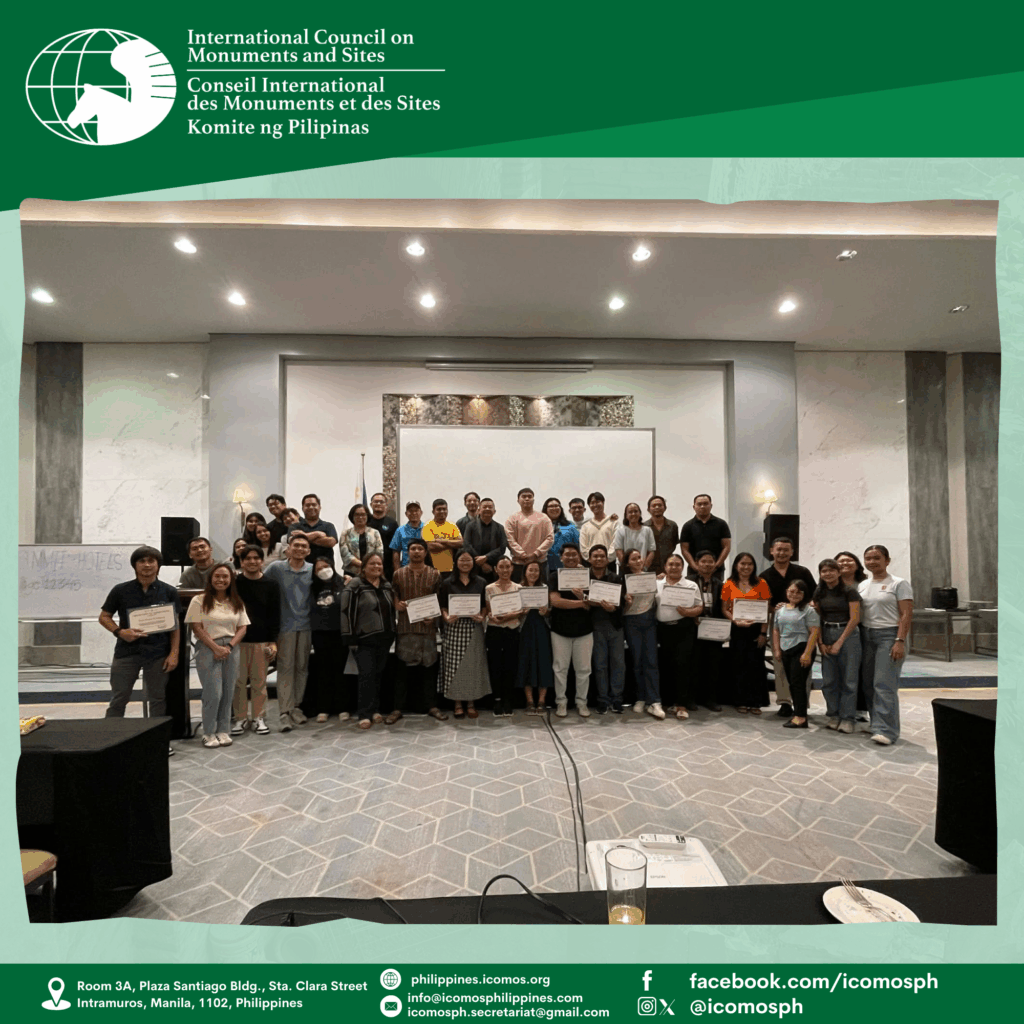
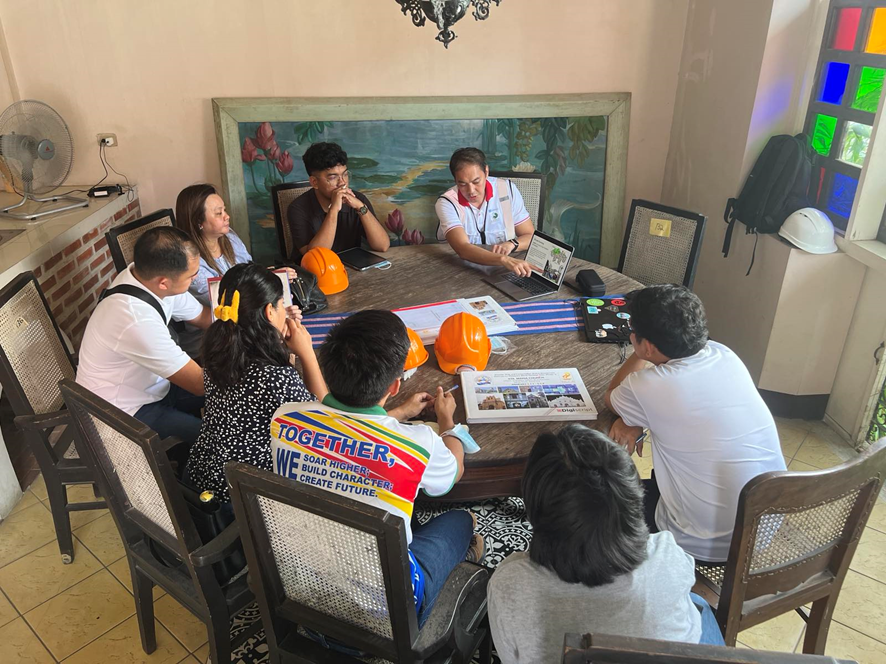
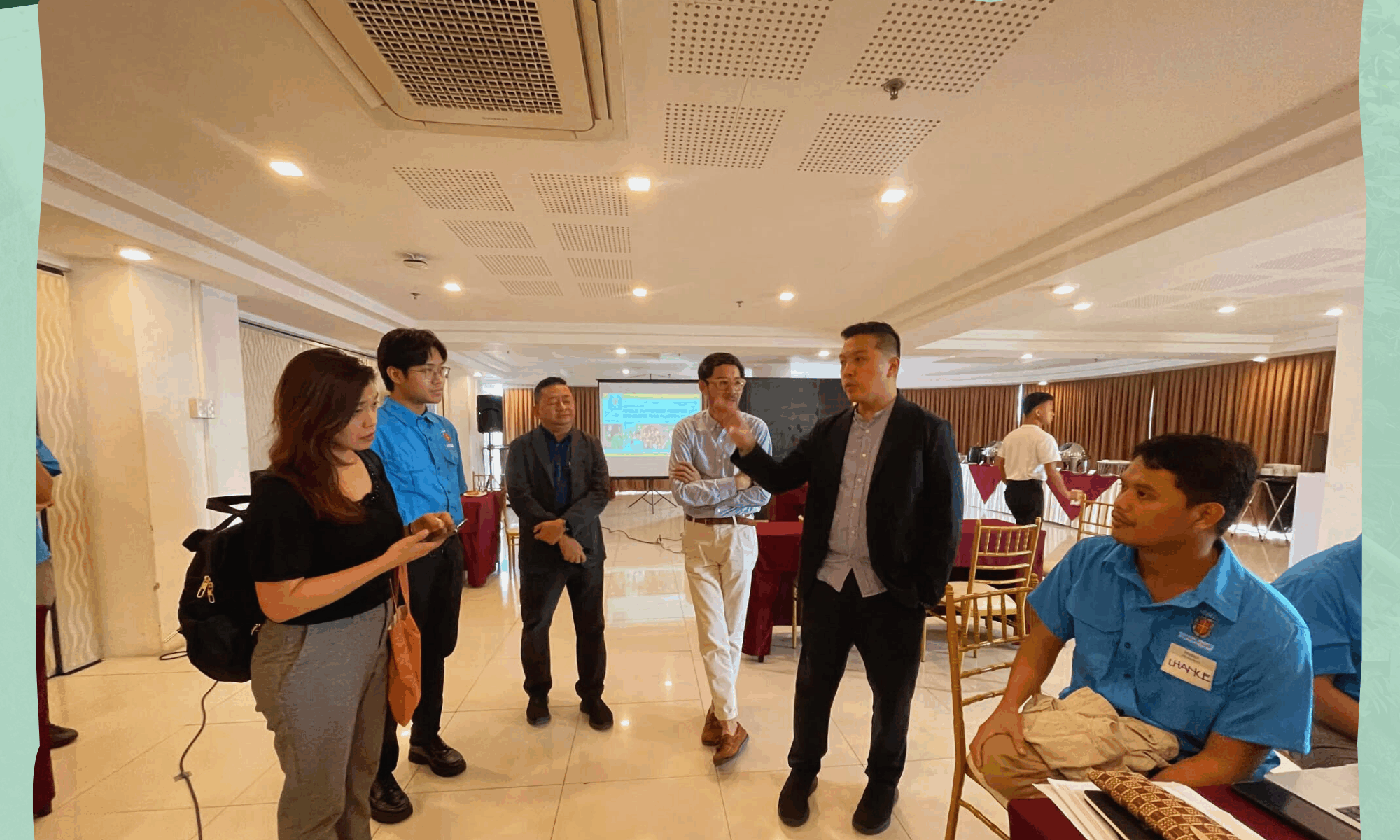
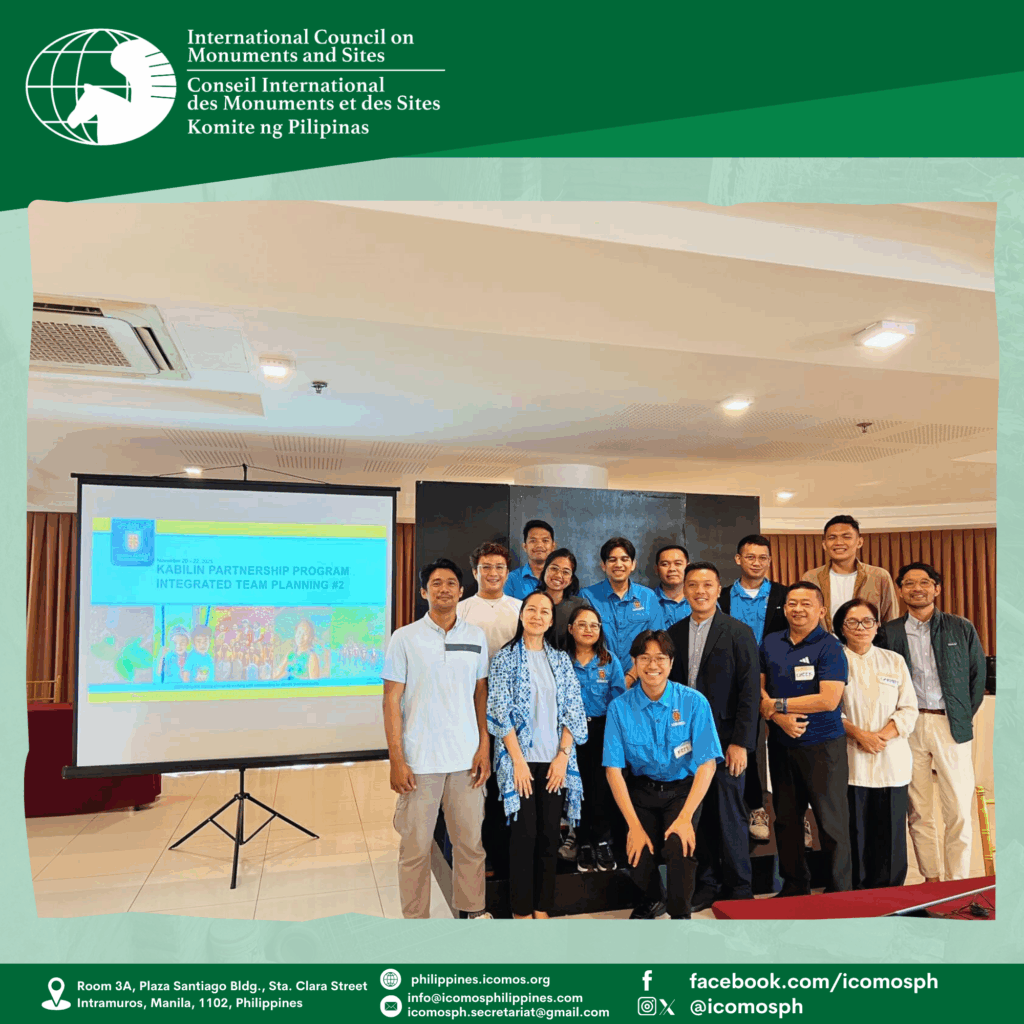
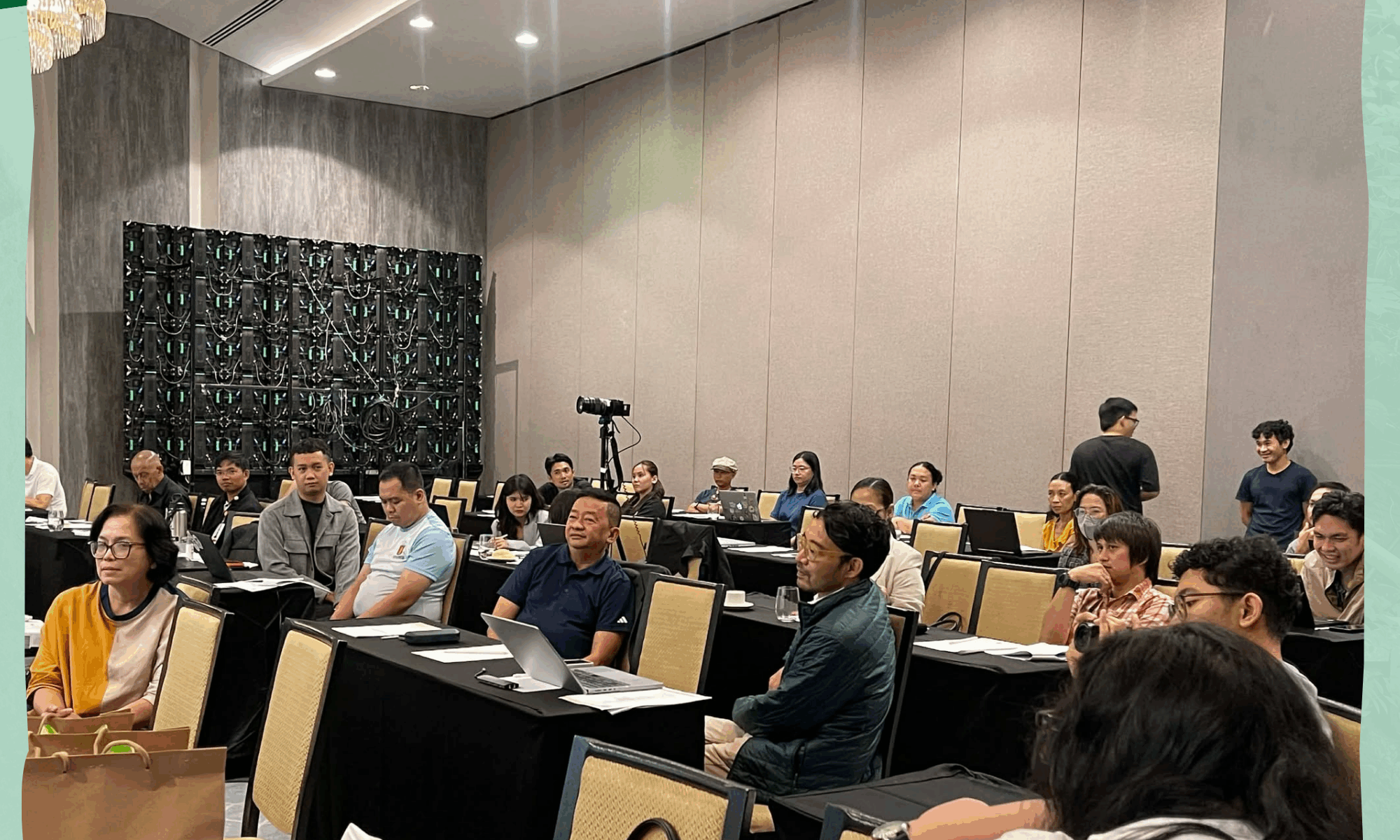
The Ramon Aboitiz Foundation Inc. (RAFI), together with ICOMOS Philippines, successfully concluded the Kabilin Partnership Program (KPP) Team Planning Sessions held from November 20 to 22, 2025 at One Central Hotel, Cebu City. The three-day planning activity brought together project directors, leads, technical specialists, and program staff to align priorities, finalize milestone calendars, and strengthen coordination across all KPP heritage initiatives for 2026–2029.

The sessions brought together program team members from both ICOMOS Philippines and RAFI. The ICOMOS Philippines delegation was led by Dr. Cheek Fadriquela, President, along with the Project Directors—Dr. Laya Gonzales for the Safeguarding of the Intangible Cultural Heritage of the Santo Niño Devotion (ICHSN); LAr. Gabriel Victor Caballero for PAMANA 2030’s Philippine Policy Guidance for Heritage and the Sustainable Development Goals (MPHSD); and Mr. Joselito Corpus, MHSP for the National Training Course on Disaster Risk Management of Cultural Heritage (DRMCH). They were joined by Mr. Abdulbasir Endong, Heritage Affairs Officer; Ms. Chelsea Kaye Cabahug, ICHSN Local Research Assistant; and Ar. Carmencita Solis, Cebu-based member and Ped Expert for DRMCH.

From RAFI, attendees included Marie Sol D. Gonzalvo, Executive Director for the North and Central Portfolio; Ar. Kenneth Tua, PhD, Kabilin Chief Project Officer; Ador Vincent Mayol, MPHSD Project Lead; King Rosales, DRMCH Project Lead; John Wesley Rocha, ICHSN Project Lead; Joworski Alipon; John Russel Bragat; Chelsea Kaye Cabahug, Local Research Assistant; Abigail Eugenio; John Russel Bragat; Marthel Jay Ubas; and Lhance Caratao.

The planning sessions formally opened with an orientation on the Kabilin Integrated Project Teams, focusing on changes to program initiation requirements, manpower updates, required planning outputs, and updated grants management procedures. Discussions ensured that all teams were aligned with improved processes for project charter preparation, disbursement protocols, and efficient budget utilization—key mechanisms supporting program implementation.

Participants then worked on refining the Work Breakdown Structures (WBS) of each project in relation to both the RAFI and ICOMOS Philippines calendars, producing a consolidated milestone roadmap covering 2026 to 2029, along with a detailed Year 2 (2026) implementation schedule. This allowed project teams from DRMCH, MPHSD, and ICHSN to synchronize their targets and identify strategic dependencies across initiatives.

A significant portion of the sessions was dedicated to reviewing and approving the summarized PIP–WBS–Milestones of each project cluster. Each team presented its four-year and Year 2 plans for validation, resolution, and approval, ensuring that all activities align with program goals, resource availability, and organizational priorities for heritage conservation and capacity-building.

The workshop continued with an in-depth planning session focused on crafting 2026 Activity Proposals, where teams underwent guided proposal development, internal discussions, and cross-team consultations. These proposals, once consolidated, will serve as the foundation for year-round implementation and interdepartmental coordination.

The Core Project Management Team also held specialized meetings to address year-specific planning, activity sequencing, and plotting of scheduled tasks into the unified MS Excel master calendar. Final presentations of the Activity Proposals for DRMCH, MPHSD, and ICHSN were conducted, followed by resolutions and approval motions to proceed with implementation preparations for 2026.

The planning concluded with a joint meeting between the Core Project Management and Grants Teams, focusing on validating aggregated disbursement requirements, clarifying budget utilization guidelines, and strengthening support mechanisms for the program’s expanding portfolio of heritage initiatives.

The Kabilin Partnership Program Team Planning Sessions reaffirmed the strong collaboration between RAFI and ICOMOS Philippines in advancing heritage conservation in the Visayas through aligned strategies, strengthened systems, and coordinated organizational direction. The outputs of the three-day activity will guide the next cycle of heritage programs and ensure that project teams remain equipped to deliver sustainable, community-centered, and well-coordinated heritage interventions.

#RAFI #ICOMOSPH #cebloom #parasaatongkabilin #CebuanoHeritage
𝗥𝗔𝗙𝗜 𝗮𝗻𝗱 𝗜𝗖𝗢𝗠𝗢𝗦 𝗣𝗵𝗶𝗹𝗶𝗽𝗽𝗶𝗻𝗲𝘀 𝗛𝗼𝗹𝗱 𝗦𝘂𝗰𝗰𝗲𝘀𝘀𝗳𝘂𝗹 𝗖𝗼𝗻𝘀𝗲𝗿𝘃𝗮𝘁𝗶𝗼𝗻 𝗠𝗮𝗻𝗮𝗴𝗲𝗺𝗲𝗻𝘁 𝗣𝗹𝗮𝗻 𝗪𝗼𝗿𝗸𝘀𝗵𝗼𝗽 𝗶𝗻 𝗖𝗲𝗯𝘂

CEBU CITY, Philippines — The Ramon Aboitiz Foundation Inc. (RAFI), in collaboration with ICOMOS Philippines, successfully conducted the Conservation Management Plan (CMP) Workshop on November 18–19, 2025 at Summit Galleria Cebu. The two-day workshop convened heritage practitioners, planners, and partner institutions to strengthen technical and institutional capacities in the preparation and implementation of Conservation Management Plans for significant cultural properties across the country.

Throughout the workshop, participants engaged in in-depth discussions on cultural significance assessments, architectural documentation, structural analysis, archaeology, material studies, and the development of informed conservation strategies tailored to heritage sites. The program also emphasized the practical integration of CMP principles into organizational policies and decision-making processes, promoting a sustainable and evidence-based approach to heritage management.

The workshop was enriched by a distinguished panel of experts from the fields of architecture, conservation, archaeology, and heritage science. Ar. Kenneth Javier Tua, PhD—an economic scientist and heritage conservation specialist with advanced degrees in cultural landscapes, diplomacy, and agricultural science— presented the Workshop Guidelines and Outline and explained the Conservation Management Plan (CMP) framework, highlighting its role in guiding stakeholders through a structured process of understanding, assessing, and managing heritage sites. He emphasized how the CMP supports national heritage laws, aligns with regional practices, strengthens UNESCO-related commitments, and fosters transparency, accountability, and collaboration among agencies, experts, and communities. 

Ar. Caryn Paredes-Santillan, PhD, an expert in architectural theory, modern Asian architecture, and conservation planning with doctoral credentials from the University of Tokyo, discussed the role of comparative studies in establishing cultural significance. Her wide-ranging work on CMPs for major Philippine heritage sites such as Intramuros, San Sebastian Basilica, the Manila Central Post Office, and the Cultural Center of the Philippines offered participants a strong foundation in methodological approaches to heritage evaluation.

Architectural conservator Joselito H. Corpus, MHSP, who specializes in stone conservation, disaster risk management, and heritage policy, contributed his extensive experience from both Philippine and international institutions, including his work with the Metropolitan Museum of Art’s Cloisters and the NYC Landmarks Preservation Commission. His leadership in heritage recovery efforts following major disasters in the Philippines provided participants with grounded, practical perspectives on structural assessment and conservation planning.

Cheek S. Fadriquela, PhD –  an Assistant Professor at the University of Santo Tomas Graduate School and Associate Professor at the University of the Philippines Los Baños, shared his expertise in the conservation of wooden built heritage. through the lens of the 7Ms of documentation. He is the current President of ICOMOS Philippines.

Archaeologist Dante Ricardo N. Manipon from the UP School of Archaeology expanded the discussion by introducing participants to the fundamentals of archaeology within development contexts. With ongoing research on Spanish-era forts and churches across the Philippines and experience in public archaeology, he guided participants in recognizing archaeological materials and understanding how discoveries can influence responsible project planning.

Ar. Carmencita Solis, a Cebuano expert in architecture, urban planning, and community-based conservation with graduate studies from the Asian Institute of Technology, discussed the critical role of architectural conditions assessment in the success of any conservation process. As a lecturer at the University of San Carlos and an active member of ICOMOS Philippines’ ICORP (International Committee on Risk Preparedness), she offered valuable insights into documentation methods and the importance of understanding a structure’s past, present, and future conditions.

Together, these experts provided an interdisciplinary and comprehensive learning experience that deepened participants’ understanding of heritage values, conservation processes, and management strategies. The collaborative effort between RAFI, ICOMOS Philippines, and the workshop participants marks a significant step toward strengthening heritage stewardship in the Visayas. The success of the workshop reinforces a shared commitment to preserving the cultural, historical, and architectural legacy of Philippine communities and highlights the importance of capacity-building in ensuring that heritage conservation remains informed, sustainable, and community-centered.

#ICOMOSPH #RAFI #CMPWorkshop #CulturalHeritage #ConservationManagement #CebuHeritage #Kabilin #CEBloom #HeritageConservation

Living History: ICOMOS Philippines Showcases Heritage at the 2nd GSIS Historians’ Fair 2025

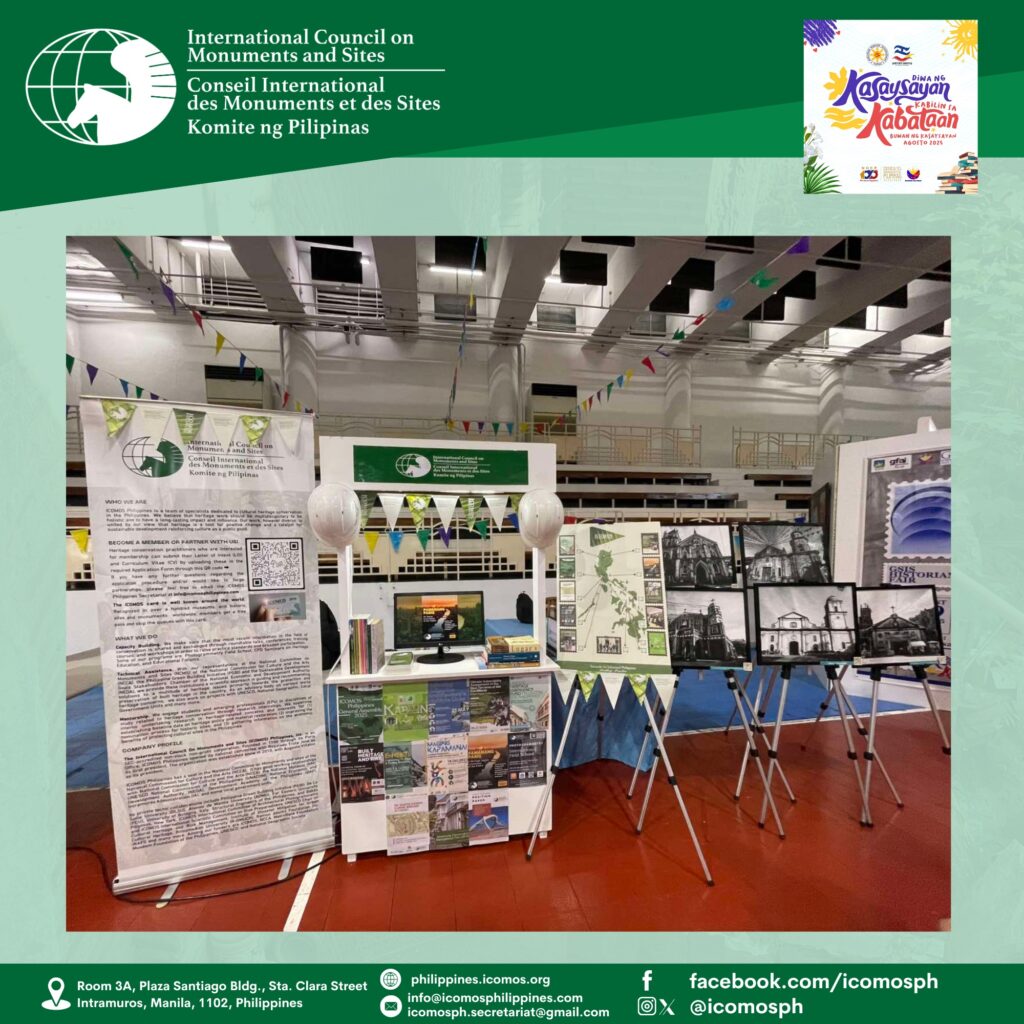
Pasay, Philippines — ICOMOS Philippines was proud to participate in the 2nd GSIS Historians’ Fair, held from August 7 to 9 at the GSIS Gymnasium in Pasay City, as a part of the nationwide celebration of History Month. Through exhibits, interactive booths, and lectures from various historians, historical institutions, and organizations in both the public and private sectors, they shared a singular objective, which is to celebrate the history and cultural heritage of the Filipinos.

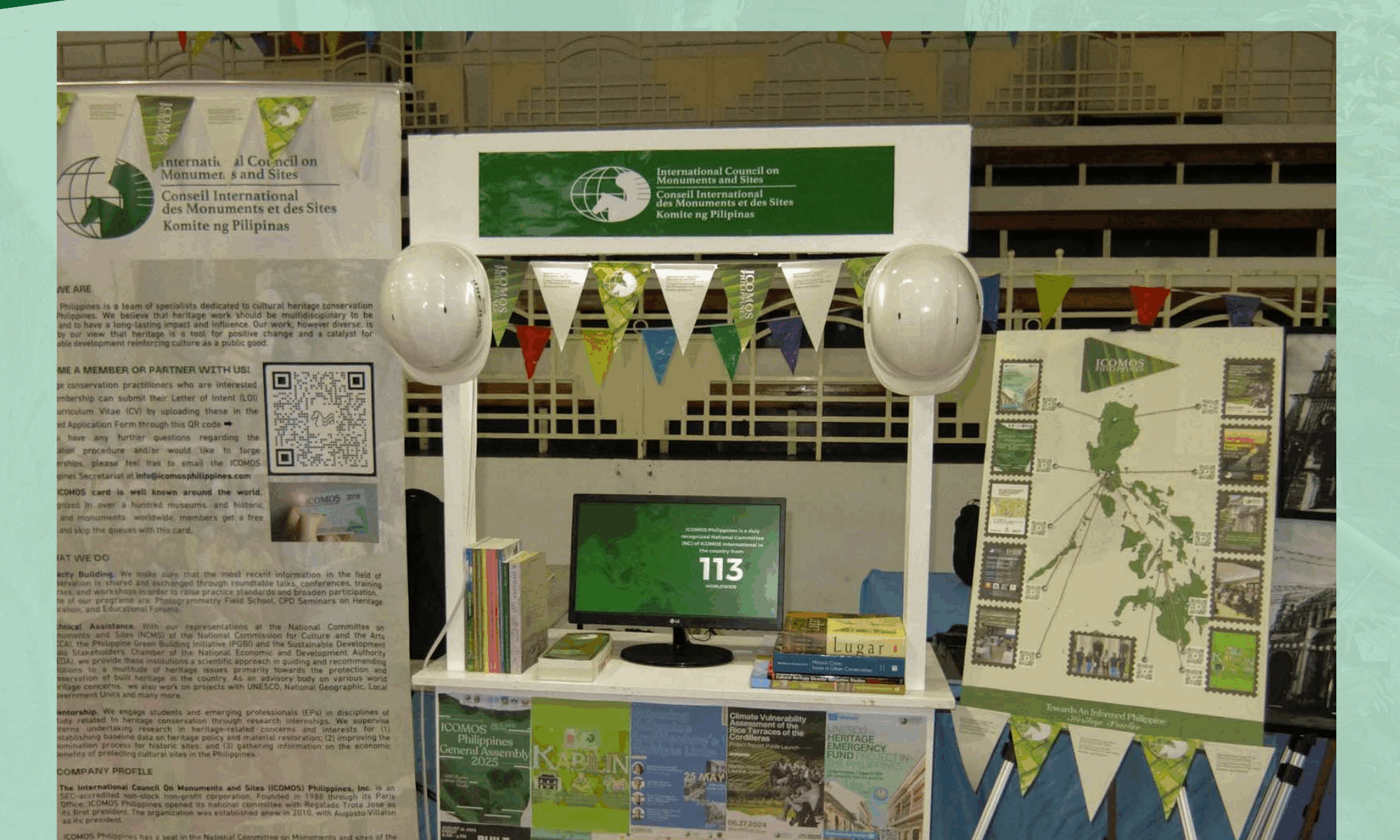
As visitors entered the venue, they were welcomed by a vibrant atmosphere brimming with engaging displays and lively music coming from different exhibitors. The ICOMOS Philippines booth attracted visitors, students, researchers, and history enthusiasts eager to explore the organization’s efforts in preserving the nation’s material and cultural heritage. During the fair, ICOMOS Philippines expressed its commitment through a booth display in safeguarding cultural heritage for future generations while also showcasing a selection of the organization’s projects from past years.

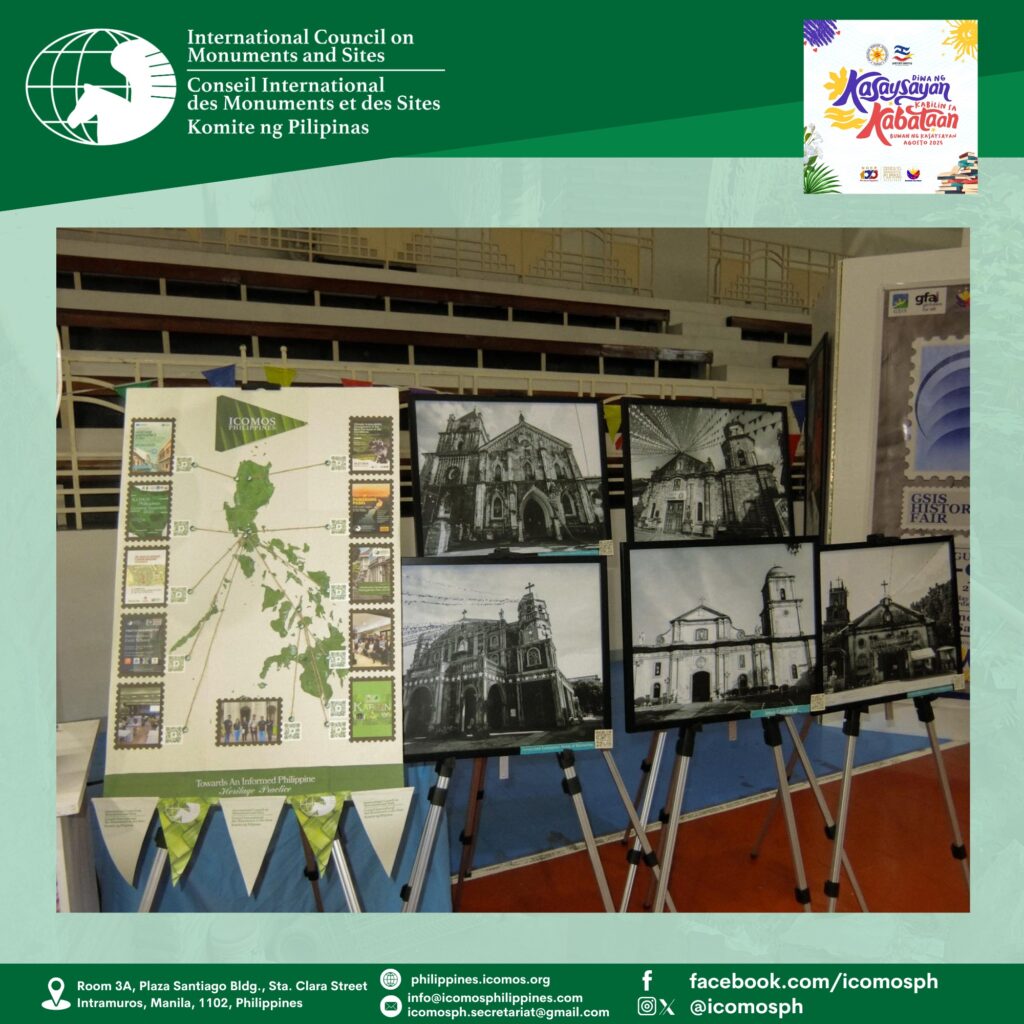
The ICOMOS PH exhibition offers an interactive map that enables visitors to conveniently scan the embedded QR code to explore the latest projects by ICOMOS Philippines. Provided also are pamphlets to offer further context about the organization. Furthermore, ICOMOS Philippines displayed five framed photographs of churches in Cavite, taken by Mr. Phillip Medina, which enhance the informative aspect of the overall booth.

In addition to the booths, the fair also features a special lecture by Prof. Ambeth Ocampo titled “Zooming in History: God is in the Details” on August 8. There is also a panel discussion on “Trajectories of Public History in the Philippines: Efforts of Professionals, Enthusiasts, and Advocates,” led by Prof. Lars Ubaldo, PhD, Prof. Ian Alfonso, PhD, and Mr. Stephen Pamorada. On Day 3 of the fair, August 9, Prof. Jose Victor Torres, PhD, presents “Knowing Aguinaldo: A Look into an Unknown Side of an Unknown Past.” The event concludes with a lecture by Ms. Mona Magno-Veluz, also known as Mighty Magulang, who addresses “How the Catálogo Alfabético de Apellidos Shaped Filipino Identity.”

Throughout the three-day event, the booth became a meeting place for ideas, where curious minds asked about the protection of historic sites, the importance of cultural conservation, and the role of communities in keeping the heritage alive. Beyond information, the booth offered an experience. Visitors were encouraged to reflect on the theme “Diwa ng Kasaysayan, Kabilin sa Kabataan”; it inspired the visitors to think about history not just as the record of what happened but as a living spirit passed down to future generations as a legacy. Young people who participated in the fair connected with this message, and many of them felt empowered to continue being involved in sustaining and preserving their local heritage after leaving the fair.

The 2nd GSIS Historians’ Fair 2025 transcended a mere exhibition of remembrance; it served as a vibrant celebration of our collective memory and shared identity. This event provided ICOMOS Philippines with an opportunity to engage actively with the community and foster awareness about heritage conservation. Additionally, it served as a reminder that the responsibility of protecting history lies with each of us.

NCCA Hosts International Conference on Competency Framework for Cultural Heritage Management 

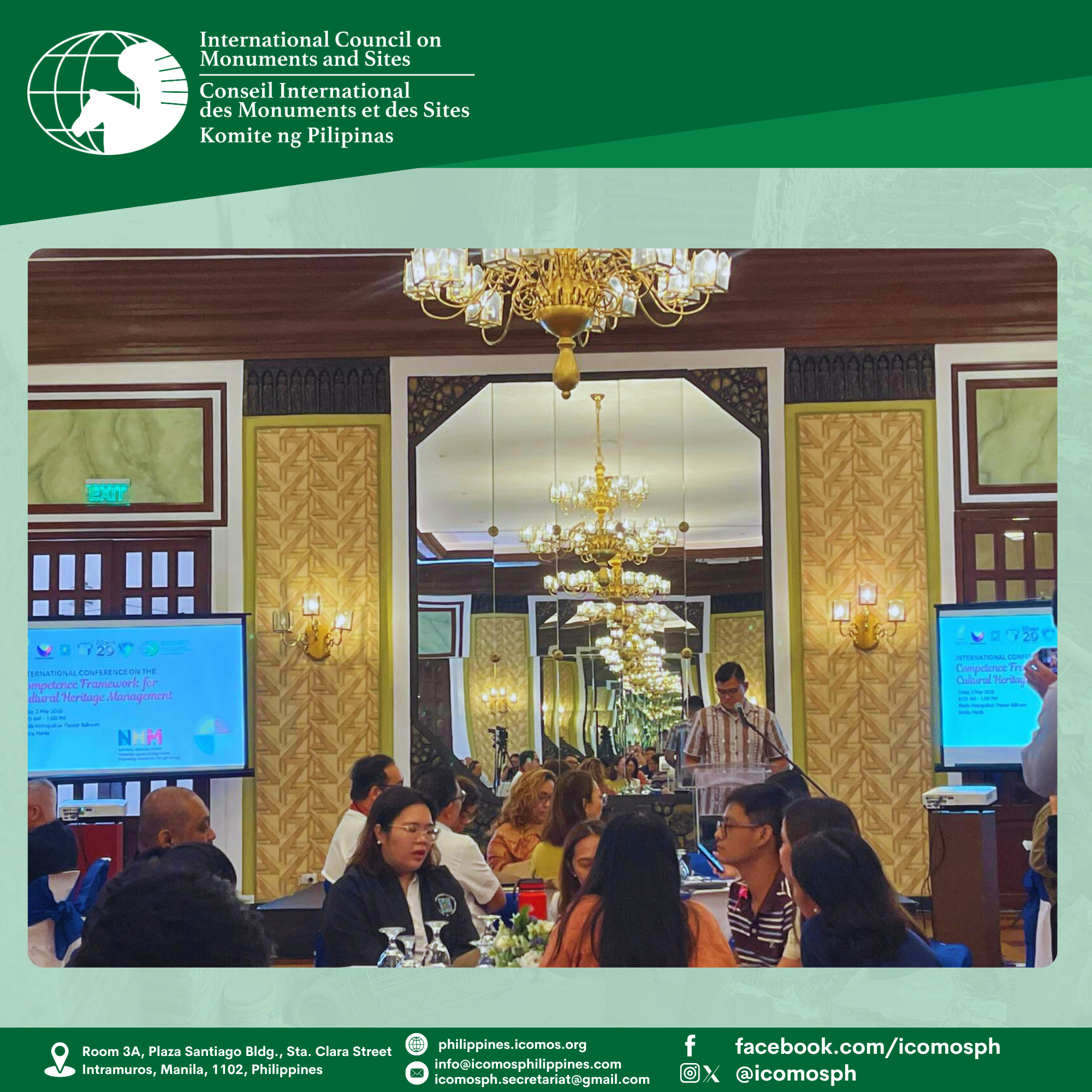
Manila, Philippines – May 2, 2025As part of its continuing efforts to professionalize and strengthen the cultural heritage sector, the National Commission for Culture and the Arts (NCCA) successfully hosted the International Conference on the Competency Framework for Cultural Heritage Management on May 2, 2025. The event, held at the Manila Metropolitan Theater Ballroom in Ermita, Manila, brought together experts, practitioners, and stakeholders in heritage conservation from across the country. This conference is in line with the month-long celebration of Heritage Month 2025, further highlighting the importance of advancing cultural heritage management in the Philippines.

Organized in partnership with the University of Santo Tomas Graduate School – Center for Conservation of Cultural Property and Environment in the Tropics (USTGS-CCCPET) and the International Council on Monuments and Sites Philippines (ICOMOS Philippines), the conference served as a significant platform for advancing the discussion on building a national competency framework aligned with global heritage management standards.

The event commenced with a warm welcome from Mr. Joseph Patrick V. Lee, Chief of the Cultural Properties Regulation Division at NCCA, who recognized all of the participating heritage workers coming from different agencies, organizations, and universities. This was followed by Ms. Beverly Macayan-Bautista, MAEd, Officer-in-Charge of USTGS-CCCPET, who articulated the rationale of the conference. She underscored the need for structured competency-based training programs that reflect the evolving demands of heritage work, especially in the face of climate change, urbanization, and cultural globalization.

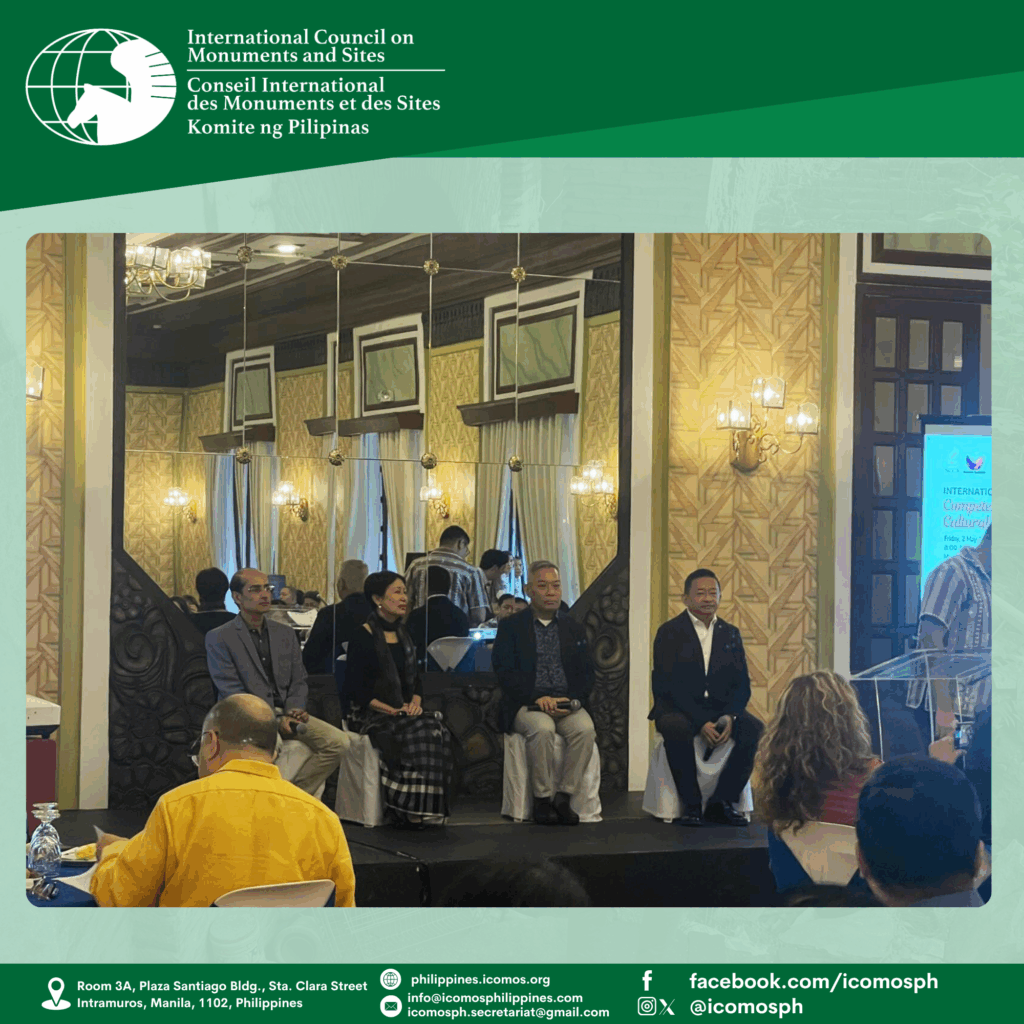
The conference featured an esteemed lineup of speakers who shared global and local perspectives on cultural heritage management:

  • Ms. Felicia Sta. Maria, an independent writer and researcher, delivered a compelling talk on Early Initiatives to Guide Cultural Workers in the Philippines, offering a historical overview of past capacity-building initiatives and highlighting the longstanding need for a unified professional framework in the field.
  • Prof. Neel Kamal Chapagain, PhD, a respected academic from Ahmedabad University, India, discussed Developing the Competency Framework for Cultural Heritage Management. He drew from his international experience and UNESCO-led frameworks to propose a structured skill set model that includes knowledge, abilities, and ethical values vital to safeguarding cultural heritage.
  • Assoc. Prof. Eric Babar Zerrudo, PhD, Executive Director of NCCA, presented Aligning Cultural Heritage Education in the Philippines to the UNESCO Competency Framework: The UST Graduate School Program Experience. His talk highlighted the importance of integrating heritage education into academic institutions and aligning curricula with global standards such as UNESCO’s “Competence Framework for Cultural Heritage Management” to ensure sustainability and excellence in the field.
  • Assoc. Prof. Cheek S. Fadriquela, PhD, President of ICOMOS Philippines, spoke on ICOMOS Philippines as a Driver of Informed Heritage Conservation Practice. He outlined the role of ICOMOS as an advocacy and technical body that bridges policy, research, and community-based conservation in the Philippine context.

An open forum followed the presentations, providing an opportunity for participants to engage directly with the speakers. Attendees raised valuable questions and shared their experiences from the field, enriching the discourse on localized application of competency-based heritage management practices.

To formally conclude the conference, NCCA Chairman Victorino Mapa Manalo shared closing remarks, acknowledging the importance of collective and sustained action in elevating the standards of cultural heritage management in the country.

ICOMOS Philippines Launches Local Chapter of ICORP: Building a Safer, Resilient Future for Cultural Heritage

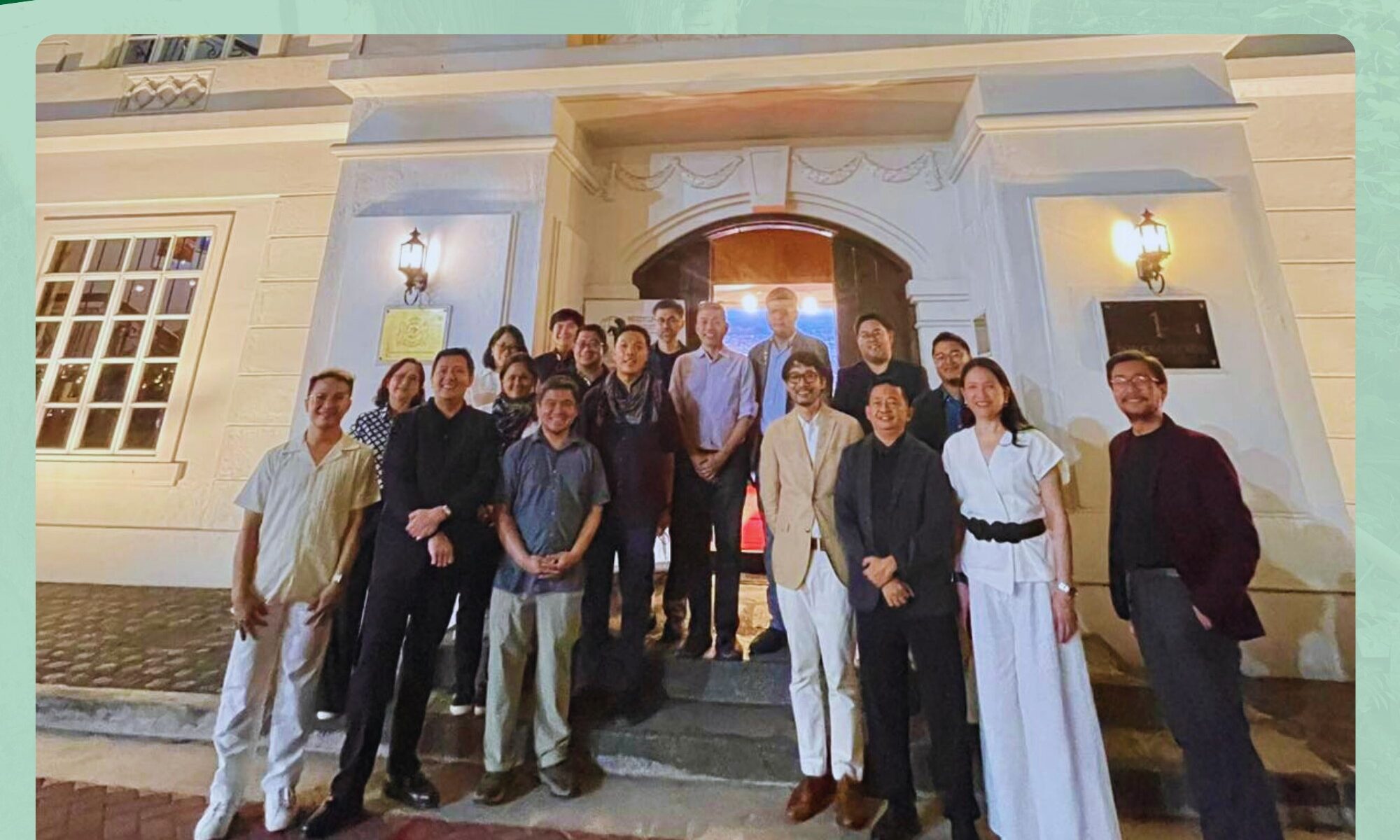
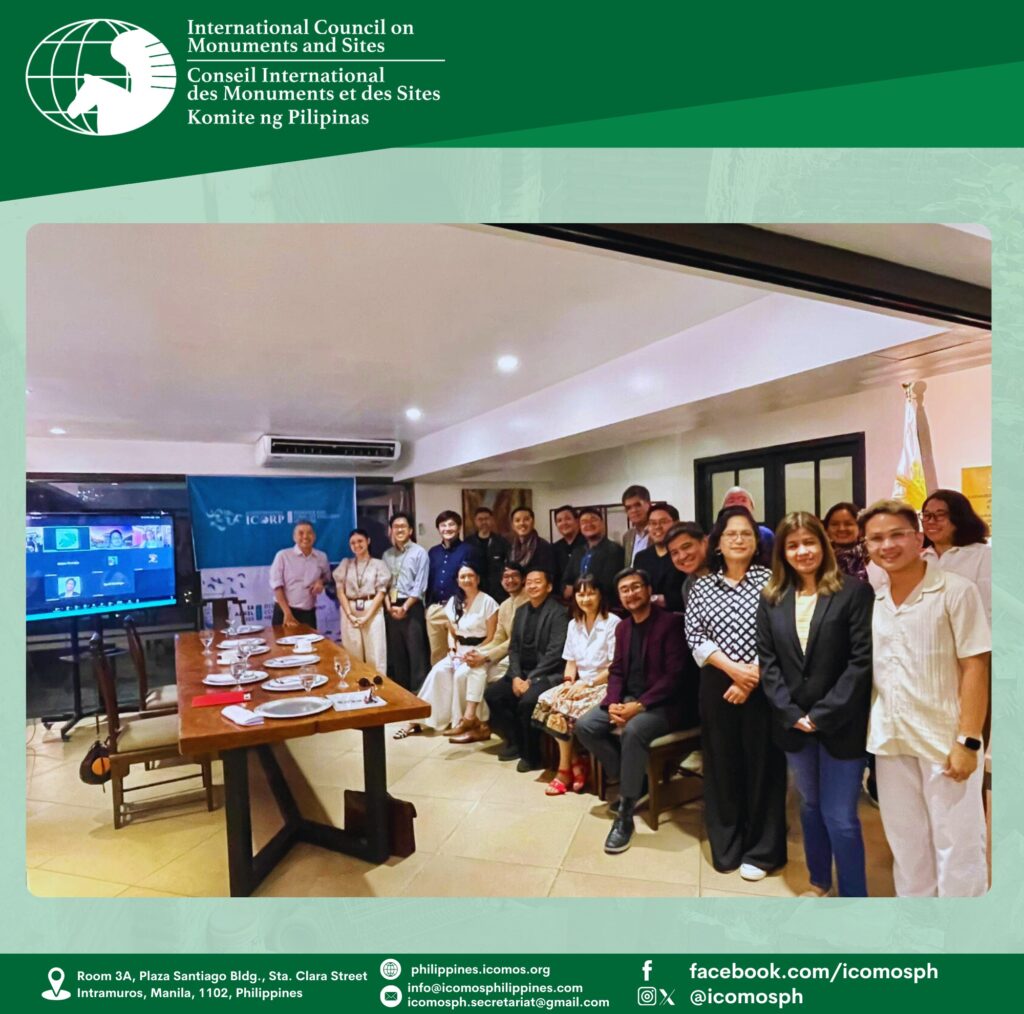
INTRAMUROS, MANILA — In a landmark step toward protecting the nation’s cultural heritage in the face of increasing climate and disaster risks, the International Council on Monuments and Sites (ICOMOS) Philippines officially launched its local chapter of the International Scientific Committee on Risk Preparedness (ICORP) on April 30, 2025. The hybrid event, held at the Honorary Consul of Georgia in Intramuros, Manila, convened stakeholders from the fields of heritage conservation, disaster risk reduction, climate action, and urban planning hosted by a Heritage Specialist, Mr. Ivan Man Dy. 

ICORP, established in 1990, is one of ICOMOS’ core scientific committees, focusing on advancing global efforts to safeguard cultural heritage from natural and human-induced hazards. The Philippine chapter’s launch reinforces the country’s commitment to proactive, science-based, and community-driven approaches to disaster preparedness—particularly for its rich yet vulnerable built heritage.

In her Opening Remarks, Dr. Zeynep Gul Unal, President of ICOMOS-ICORP, warmly welcomed the new chapter and emphasized the power of regional and local collaboration in safeguarding heritage assets:

“It’s truly encouraging to see the establishment of the National Committee in the Philippines—this is a significant and welcome step. I warmly invite you to engage with us, share your knowledge, participate in joint training programs, and help ensure that our cultural heritage is protected for generations to come.”

Dr. Cheek S. Fadriquela, President of ICOMOS Philippines, delivered the Welcoming Address, outlining how the country’s recent experiences with disasters underscored the need for structured heritage risk governance:

“The devastation brought by Typhoon Odette in 2021 reignited our sense of urgency. It led us to launch Tabang Bohol, mobilizing structural engineers and a conservation architect to assess the damages on the ancestral houses and churches in Bohol.”

“The Abra earthquake the following year further highlighted the importance of preparedness. With support from UNESCO Jakarta, we began post-earthquake assessments in Vigan, which culminated in the Philippines’ first implementation of the UNESCO Heritage Emergency Fund in 2023.”

Dr. Fadriquela also spotlighted the organization’s climate-focused initiatives:

“Our 2023 collaboration with Preserving Legacies, supported by National Geographic and Manulife, evaluated the climate vulnerability of the Rice Terraces of the Philippine Cordilleras—an effort that aligns with the ICOMOS Scientific Plan on Cultural Heritage and Climate Action.”

The formation of ICORP-Philippines was formally introduced by Mr. Joselito “JJ” Corpus, the country’s voting member to ICORP, through his keynote address, Fragile Foundations: Protecting the Philippines’ Built Heritage in Times of Disaster. He called attention to critical gaps in heritage protection within current national frameworks:

“Despite the presence of Republic Act 10066 and DRRM laws, there is still no integrated national strategy that embeds heritage protection into disaster response systems.”

He underscored the chapter’s purpose with a clear vision:

“Our goal is simple yet urgent—a Handa at Ligtas na Pamana: a heritage that is ready and safe. Our ICORP logo represents this mission, inspired by indigenous scripts and our shared responsibility to preserve memory and identity.”

The launch event also featured timely and expert-led presentations that bridged cultural heritage and emergency response where Ms. Emily Dy Ramos, Emergency Preparedness Specialist from the NYC Emergency Management Department, shared frameworks on urban cultural risk management. Jefferson Chua, Climate and Energy Campaigner from Greenpeace Southeast Asia, presented Heritage Practice in a Changing Climate, examining the intersections of heritage, climate justice, and ecological sustainability. Philip Norbert Ahmad L. Medina, historian and heritage advocate, presented a Risk Assessment for Cavite Churches, offering a case study in community-based, localized heritage protection.

The event highlighted ongoing efforts from across the archipelago, as regional focal persons shared updates on hazards, risk mapping, and response efforts in their localities. Ar. Carmen Solis presented on behalf of Cebu and Bohol, Ar. Aris Go represented the Cordilleras, Ar. Giuseppe Alonzo reported on Northern Luzon, and Mr. Ruhullah Al-Hussieni Javier Alonto delivered insights from Northern Mindanao. Additional appointed regional representatives were also introduced, affirming ICOMOS Philippines’ commitment to decentralization and inclusive heritage resilience: Ar. Sy Valientes for Batanes, Ar. Michael Tabao for Cagayan Valley, Mr. Philip Medina for Calabarzon, and Ms. Kinna Kwan for Samar-Leyte.

Dean Ar./EnP. Sylvester Shaun D. Seño, National Chair of Green Architecture Advocacy and Vice President of the Philippine Architecture Schools Association, delivered the event’s resolution.

The event concluded with a symbolic cutting of ribbon and the opening of an exhibit featuring risk assessments and heritage documentation of churches in Cavite—representing transparency, renewal, and protection.

In his final message, Dr. Fadriquela said: “This formal launch of a national scientific committee is a milestone in the history of ICOMOS Philippines. Lahat ng ito ay para sa handa at ligtas na pamana—Halina’t ipaglaban natin ito. Halipa!”

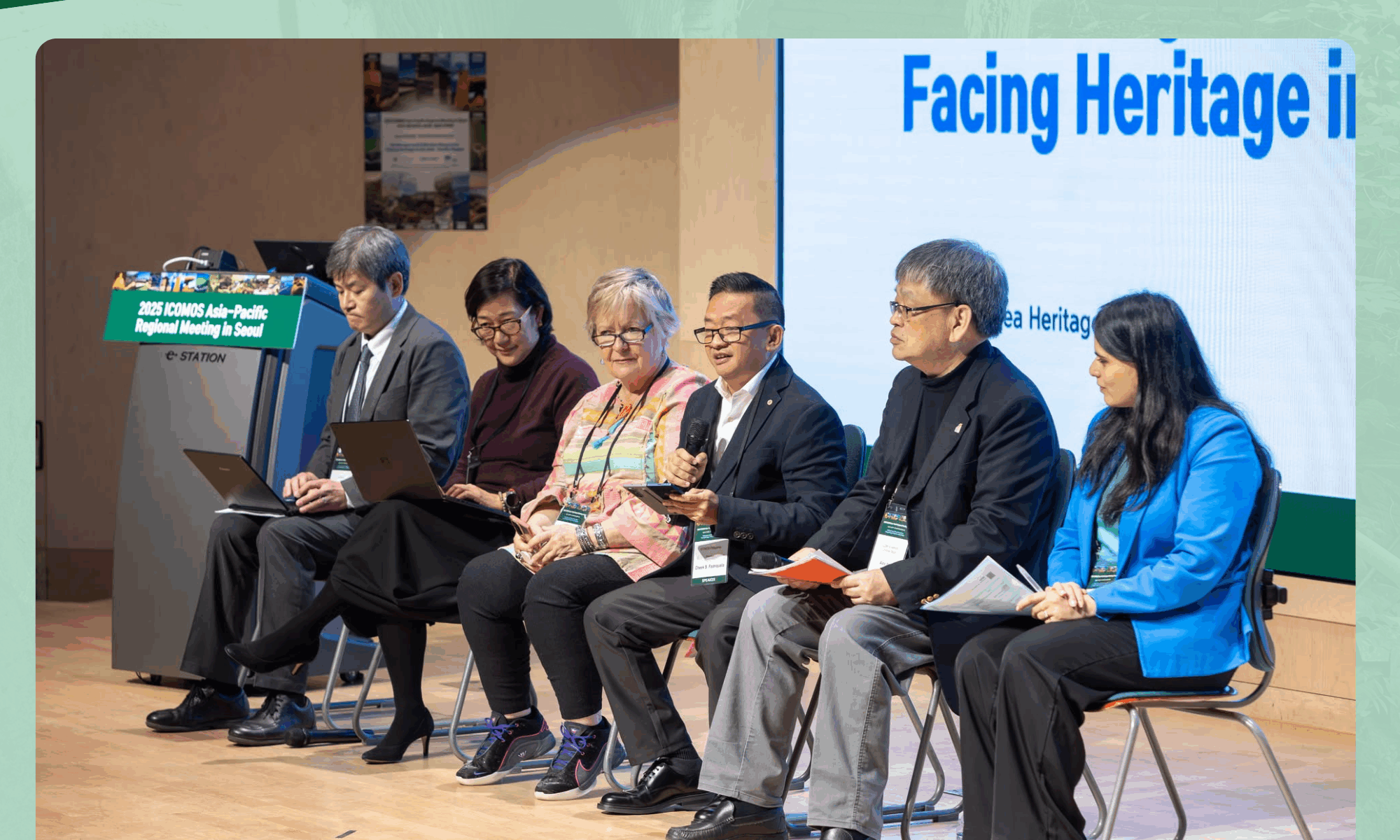
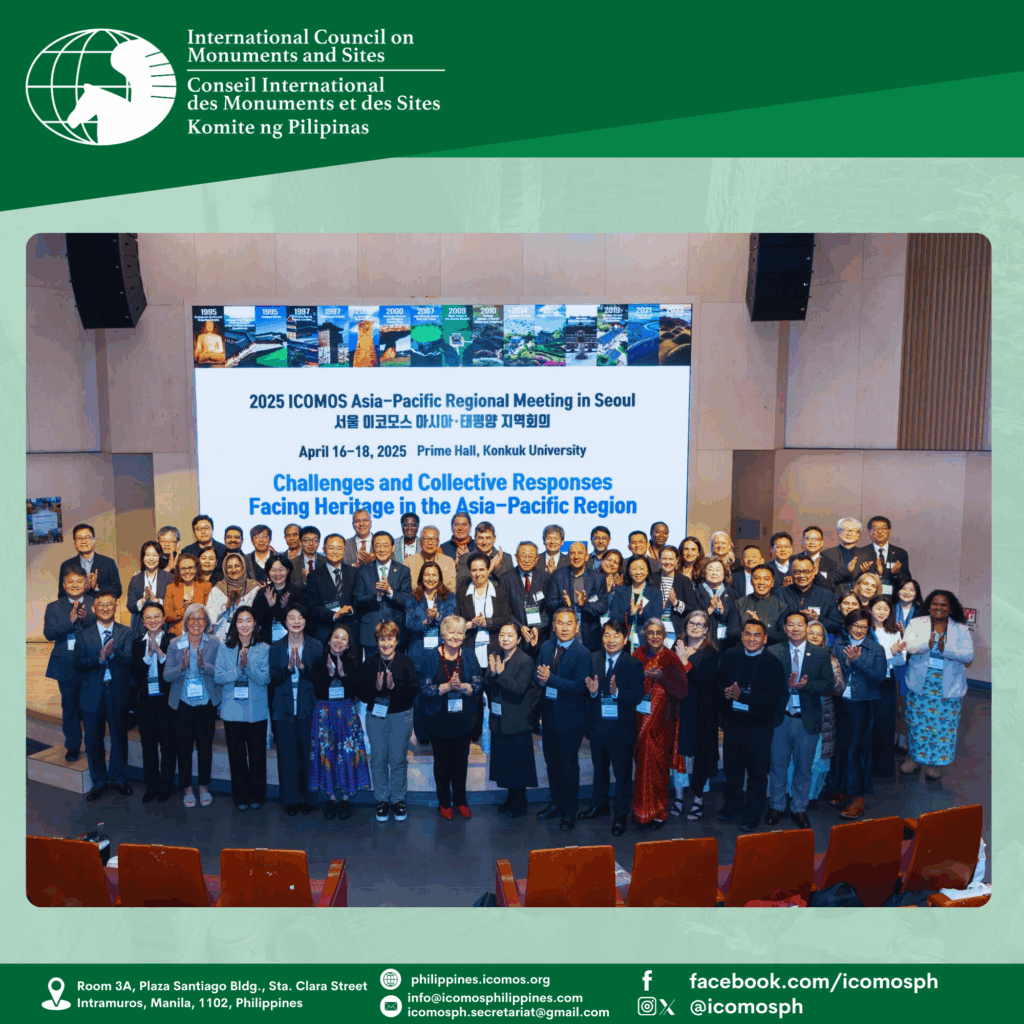
ICOMOS PH Champions Heritage Resilience and Regional Collaboration at the Asia-Pacific Meeting in Seoul

Seoul, Republic of Korea – April 18, 2025 — In a significant gathering of heritage professionals from across the region, the International Council on Monuments and Sites (ICOMOS) held its Asia-Pacific Regional Meeting in Seoul from April 16 to 18, 2025. With the overarching theme, “Challenges and Collaborative Responses for Heritage in the Asia-Pacific Region,” the event served as both a commemoration of the 60th anniversary of ICOMOS and a vital forum to confront the increasingly complex challenges facing cultural heritage in a rapidly changing world.

The meeting brought together delegates from national committees, international organizations, cultural institutions, and academia to engage in knowledge sharing, collaborative planning, and policy dialogue. Against the backdrop of post-pandemic recovery and the intensifying impacts of climate change, the conference emphasized the urgency of creating sustainable, inclusive, and locally rooted approaches to safeguarding heritage across the region.

Representing ICOMOS Philippines were President Dr. Cheek S. Fadriquela, Past President Ms. Tina Paterno, and LAr. Gabriel Caballero. Their presence reinforced the Philippines’ active role in addressing climate-induced risks, promoting community-based heritage management, and advancing transdisciplinary research.

In his panel discussion on “Climate Change + Heritage,” Dr. Fadriquela gave a poignant account of personal and professional encounters with natural disasters in the Philippines. He described a harrowing flight through a super typhoon in Taiwan en route to the ICOMOS Annual General Assembly in Ouru Preto, Brazil, linking his experience to the broader reality of increasingly extreme weather patterns in the Philippines — where six typhoons struck within just two months in 2024, including three categorized as super typhoons. The province of Batanes, renowned for its stone vernacular architecture, was particularly hard-hit. Due to its designation as a protected area, traditional stone-quarrying practices have been banned, forcing communities to build with less resilient materials.

Dr. Fadriquela also outlined ICOMOS Philippines’ growing engagement in Disaster Risk Management (DRM). Following the devastation of Bohol by Typhoon Odette and the earthquake in Vigan in 2022, ICOMOS Philippines mobilized expert teams to assess damages and recommend preservation measures. These actions catalyzed broader institutional developments, including a UNESCO Jakarta grant for post-disaster assessment, participation in DRM training courses at Ritsumeikan University in Japan, and the formal creation of a National Scientific Committee on Risk Preparedness (ICORP) — officially launching on April 30, 2025. During the Seoul meeting, Dr. Zeynep Unal, President of ICORP, Dr.. Teresa Patrício, President of ICOMOS, Dr. Takeyuki Okubo of ICCROM-ITC DMUCH, Dr. Kai Weise, Secretary General of ICORP, and Dr. Alex Yen, Vice President of ICORP extended their congratulatory messages for the said launch 

Ms. Paterno contributed to the session on “Climate Change + Heritage,” where she presented the ongoing “Preserving Legacies” project. This initiative conducts vulnerability assessments on cultural sites affected by climate change, particularly focusing on the Ifugao Rice Terraces. A collaborative effort with local communities, the initiative combines traditional ecological knowledge with scientific methods to develop site-specific adaptation strategies. “By learning from the past and empowering local stewards, we can co-create solutions that are both resilient and respectful of cultural identity,” she noted.

LAr. Gabriel Caballero, ICOMOS Philippines’ Focal Point to the Sustainable Development Goals Working Group, delivered a thought-provoking presentation titled “Developing an Approach for a Collaborative Definition of Outstanding Universal Value (OUV) in the Philippines.” He emphasized the importance of participatory frameworks in determining what is deemed “universal” about heritage, challenging top-down models of inscription and instead advocating for the voices of local and Indigenous communities.

Beyond technical presentations, the meeting served as a platform to strengthen regional collaboration among Asia-Pacific National Committees of ICOMOS. Sessions focused on Heritage Impact Assessment (HIA), Disaster Management, Interpretation, and the development of comprehensive heritage management frameworks that are adaptive to climate, political, and socioeconomic changes. Delegates recognized the importance of transboundary cooperation, cross-disciplinary integration, and the institutionalization of Indigenous and community-based knowledge systems. 

As countries in the Asia-Pacific region continue to grapple with urbanization, environmental degradation, and climate emergencies, ICOMOS Philippines reiterated its call for holistic approaches to heritage conservation — approaches that acknowledge vulnerability while embracing resilience and innovation. Through continued engagement with international networks and on-the-ground community partners, the organization aims to catalyze enduring impact.

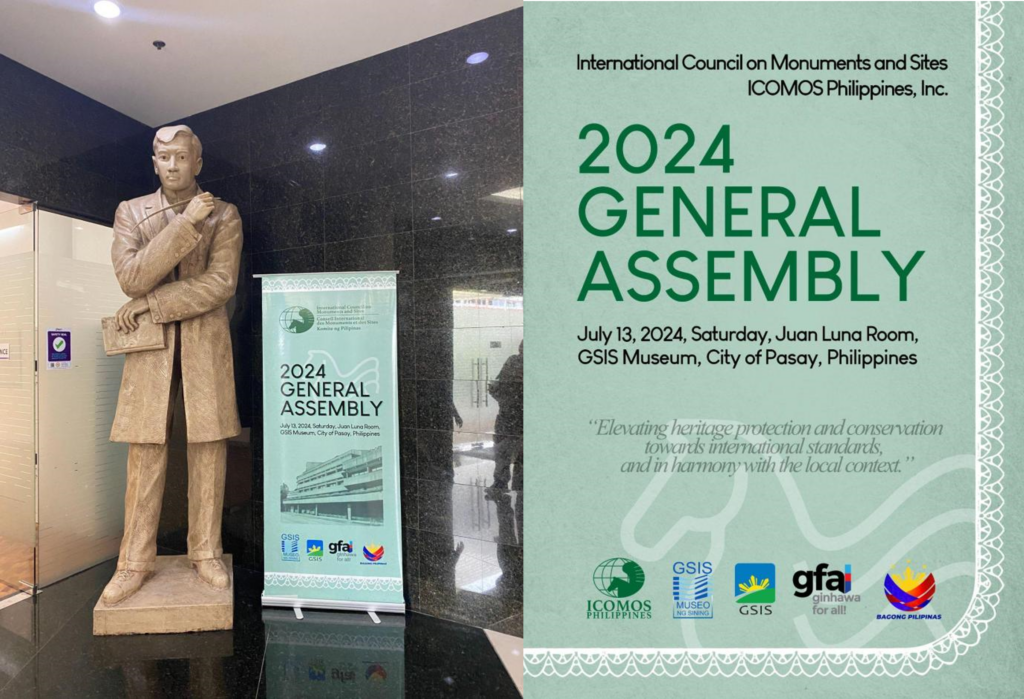
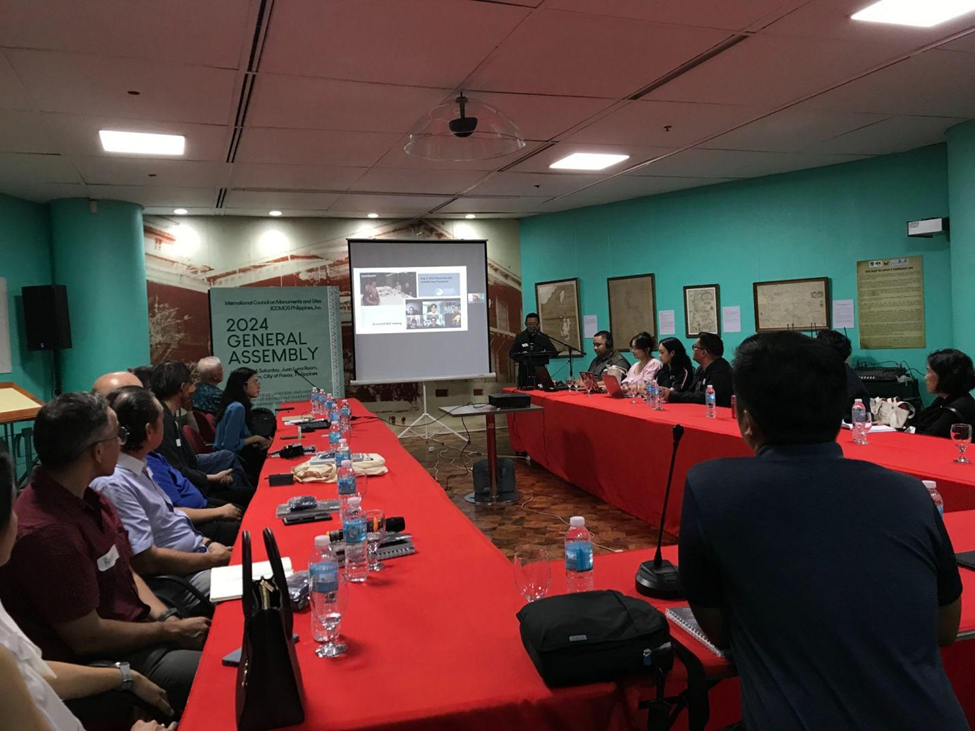
ICOMOS Philippines’ 2024 General Assembly at the GSIS Museum

Pasay, Philippines – ICOMOS Philippines held its annual General Assembly [GA] on 13th July 2024 at the Government Service Insurance System (GSIS) Museo ng Sining. Every year in July, the Executive Officers, Committees and Officers, and ICOMOS Philippines membership gather to review the current and previous year’s activities, understand the organization’s operational, organizational, and financial health, and vote on institutional proposals for the coming year and beyond.

2024 General Assembly ICOMOS Philippines at Government Service Insurance System Museum

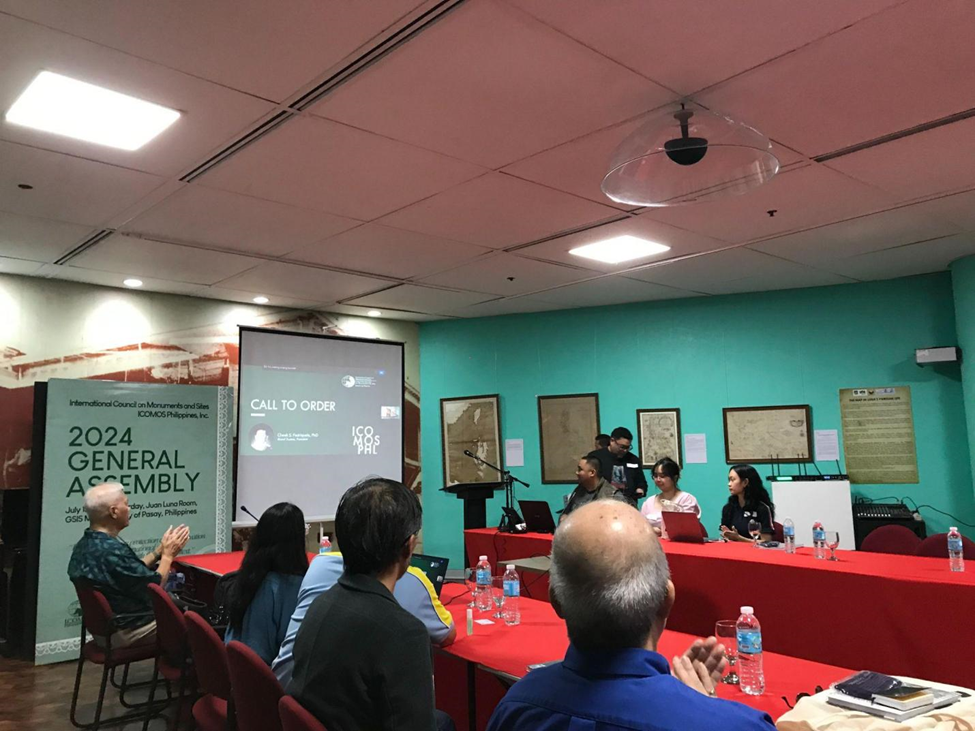
With a quorum of 64, the GA was called to order followed by the President’s Report by Dr. Cheek Fadriquela who spoke about major themes that drove activities throughout the past year. continuity, celebration, commitment, and compliance.  Together, these concepts speak of a thriving organization that continues to grow each year. Some of these activities that engage members are:  voting on issues and electing its Board of Trustee members, pursuing organizational compliance with government agencies, celebrating milestones and achievements, offering its members and the general public a chance to attend webinars, lectures, and capacity building workshops, and, most importantly, engaging its members to participate as volunteers for ICOMOS initiatives. 

President and Chairman Dr. Cheek Fadriquela opens the Meeting with a Call to Order

Vice President Ar. Kenneth Javier Tua, delivered the Vice President’s Report, focusing on operational aspects internally and externally. Major themes from the presentation were the streamlining of decisions and approvals by the Board of Trustees [BOT] due to regularized bi-monthly meetings, membership and stakeholder involvement which reached 63% participation, 15% higher than the previous year, visibility as an organization through medial alliances, social media reach and in print which doubled the frequency of impressions, and development of stronger ties with the national government cultural agencies.

Two major projects were at the center of the reporting. First, the UNESCO Heritage Emergency Fund [HEF] project in the Philippines which was also presented by Ar. Tua. the Country Project Director. The first of its kind in the country to aid in the recovery of a World Heritage Site, the Historic CIty of Vigan. At two selected pilot houses, the scope was to enhance technical standards for the conservation of heritage houses and structures by various technical disciplines who performed investigations, testing, shared observations, and recommended conservation interventions.

Immediate Past President Maria Christina Paterno presented as Project Director the milestones of the second major project of the previous fiscal year, Preserving Legacies Initiative [PLI]. She worked closely with ICOMOS Philippines member and COO of the Save the Ifugao Terraces Movement (SITMo) Marlon Martin who led the onsite focus group discussion. The exercise of assessment through focus discussion groups revealed the negative impacts of climate change on Ifugao livelihoods and traditions.

More reports were shared by the BOT. Treasurer Ar. Harvey Vasquez pointed to the 66% growth of the asset base from 2023-2024 with a reduction of liabilities by 39%. A large part of the revenue was due to donations and grants [HEF], and expenditures were mainly project-related. Corporate Secretary Ms. Liliane “Tats” Rejante Manahan in her report informed the organization’s up-to-date compliance and related to the requirements to file with the SEC every year, to submit quarterly and annual financial reports with the BIR, and maintain Barangay Business Clearance and Mayor’s Permits.

Committee Officers also gave updates to the membership.  Membership Officer Ar. Giuseppe “Gio” Luigi H. Abcede showed membership growth year after a year and shared the impacts of membership calls, the involvement with the International Scientific Committees [ISCs], and the different Working Groups [WG]. John Ray Ramos, the Secretariat and Heritage Affairs Officer [HAO], shared his involvement with the administration of the ICOMOS Philippines office and membership. Communications Officer Joselito “JJ” H. Corpus shared metrics on the organization’s visibility and public outreach on various social media platforms, its growth over the past year, and the impact of contributing articles to national broadsheets.

Works of WG over the past year were presented by HAO Ramos . Ar. Claudia Isabelle V. Montero, EPWG National Representative, showcased her work involving collaboration with emerging professionals, signing MOUs with three Universities (DLSU, ADMU & FEU), and mentoring interns on impact-driven activities and initiatives. Kristine Kate A. Lim, CCHWG National Representative related long-term plans by the CCHWG with culture as the driver in the face of climate change. Ar. Anjelika A. Orui, SDGWG National Representative informed the membership the WG’s consistent involvement with NEDA to implement the Sustainable Development Goals and the addition of four ICOMOS members based in Cebu for an upcoming project.

President Cheek Fadriquela discusses the Major Themes of Last Year’s Activities

Institutional initiatives were presented and voted upon at the last part of the program. The Policy for the Disaster Risk Management of Cultural Heritage (DRMCH) which will form a funded committee on DRMCH that will respond to disruption, hazard, and loss on Philippine’s cultural heritage anchored on the ICOMOS International Scientific Committee on Risk Preparedness [ICORP]  was adapted by the membership. Guidelines for the Institutional Membership did not garner enough votes to be passed and accordingly, it shall then be subject for further review of the membership.

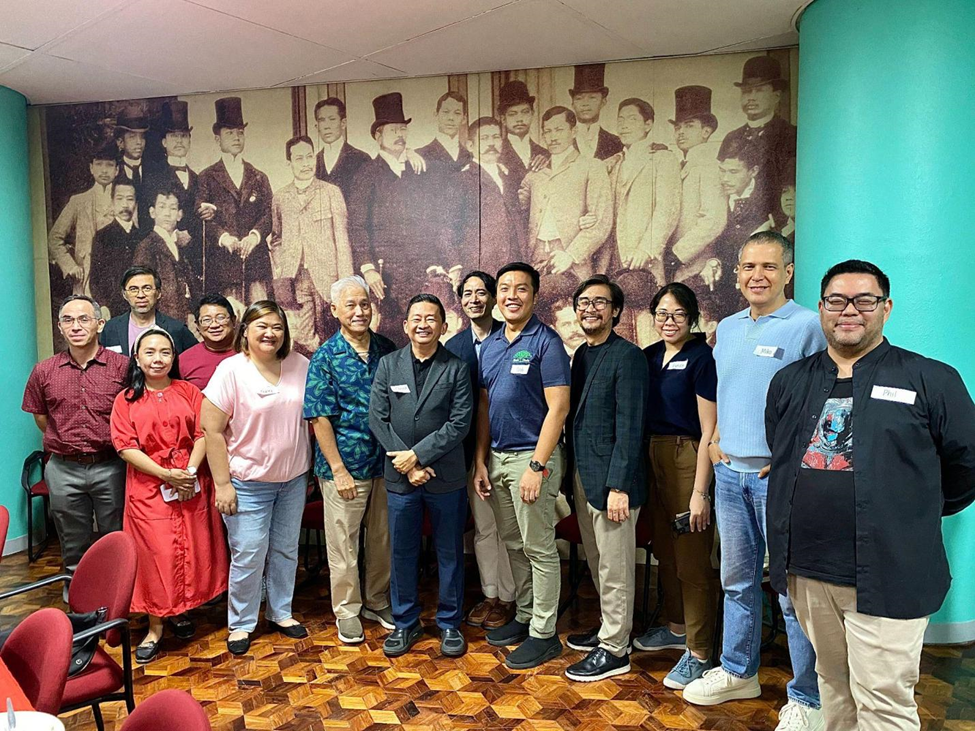
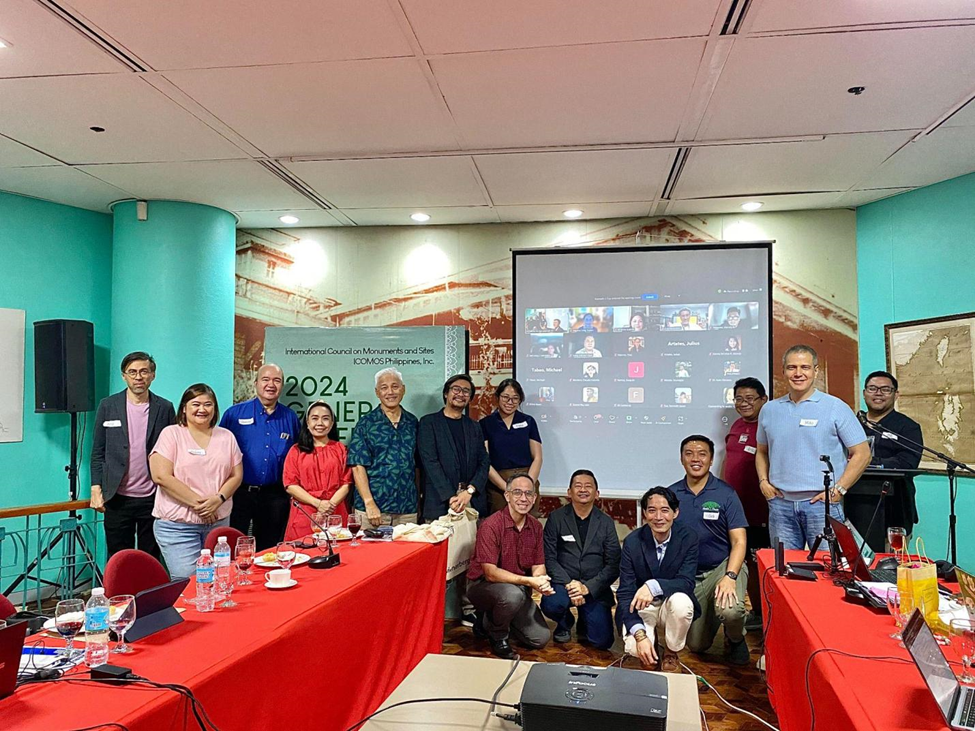
Onsite Attendees of the 2024 ICOMOS Philippines General Assembly
On and off-site members gather for a group photo after the 2024 ICOMOS Philippines General Assembly

The 2024 General Assembly signifies the continued commitment of ICOMOS Philippines to discuss and promote the conservation, protection, use, and enhancement of cultural heritage sites. The assembly serves as a platform for members to exchange knowledge, share best practices, develop and adopt policies, and set the direction for future initiatives in heritage conservation.

(EPWG: Emerging Professionals Working Group, SDGWG: Sustainable Development Goals Working Group, CCHWG: Climate Change and Heritage Working Group. All National Representatives are also Coordinators)

Board of Trustees and the Secretariat

Committee Officers and National Representatives

𝗥𝗲𝗽𝗼𝗿𝘁 𝗟𝗮𝘂𝗻𝗰𝗵 𝗼𝗳 𝘁𝗵𝗲 𝗣𝗿𝗲𝘀𝗲𝗿𝘃𝗶𝗻𝗴 𝗟𝗲𝗴𝗮𝗰𝗶𝗲𝘀: 𝗔 𝗙𝘂𝘁𝘂𝗿𝗲 𝗳𝗼𝗿 𝗼𝘂𝗿 𝗣𝗮𝘀𝘁 𝗽𝗿𝗼𝗷𝗲𝗰𝘁 𝗳𝗼𝗿 𝘁𝗵𝗲 𝗥𝗶𝗰𝗲 𝗧𝗲𝗿𝗿𝗮𝗰𝗲𝘀 𝗼𝗳 𝘁𝗵𝗲 𝗣𝗵𝗶𝗹𝗶𝗽𝗽𝗶𝗻𝗲 𝗖𝗼𝗿𝗱𝗶𝗹𝗹𝗲𝗿𝗮𝘀

Don’t miss the opportunity to participate in our Virtual Live Event for the Climate Change Vulnerability Risk Assessment of the Ifugao Rice Terraces, Philippines.

We are so excited to invite you to the report launch. We’re opening a ten day countdown registration form for our live virtual event, to present findings of the year long study Climate Vulnerability Assessment of the Rice Terraces of the Philippine Cordilleras on June 27, 5:00 PM Philippine time, GMT + 8.

Register today for zoom link here: https://bit.ly/RegisterPLI

How can heritage sites contribute to a sustainable climate future? Join us as we explore Ifugao traditions in the Rice Terraces of the Philippine Cordilleras and uncover their invaluable lessons on adapting to and mitigating climate change. Discover the synergy between indigenous knowledge and climate science and learn how ancient practices can inform modern strategies for resilience and sustainability. Don’t miss this enlightening presentation on climate vulnerability assessment—where the past guides us towards a sustainable future.  This project is a collaboration between National Geographic Society, ICOMOS, and Preserving Legacies.

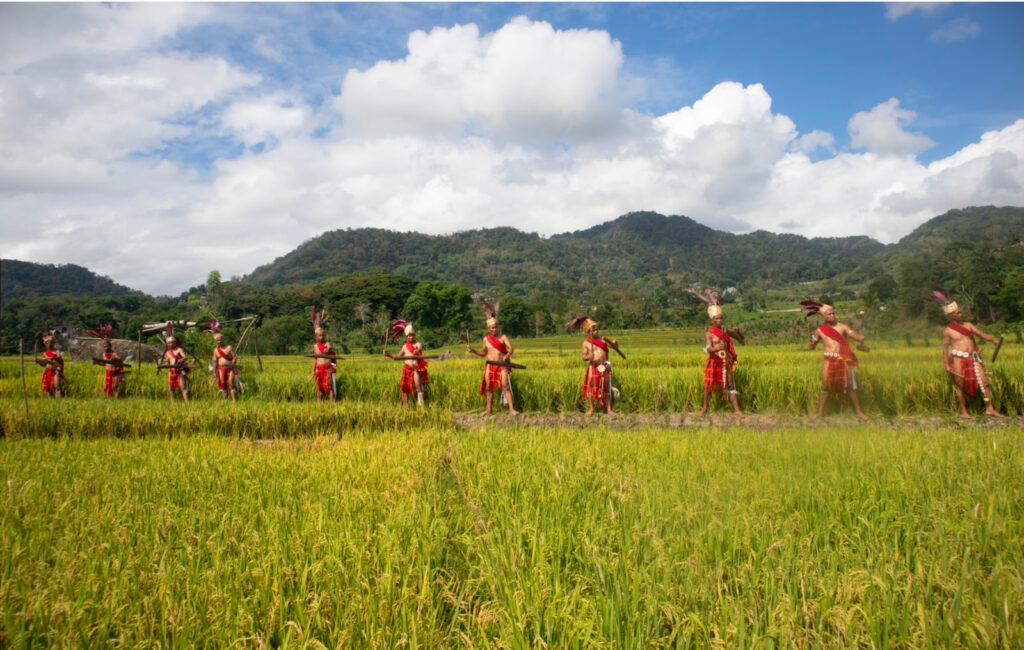
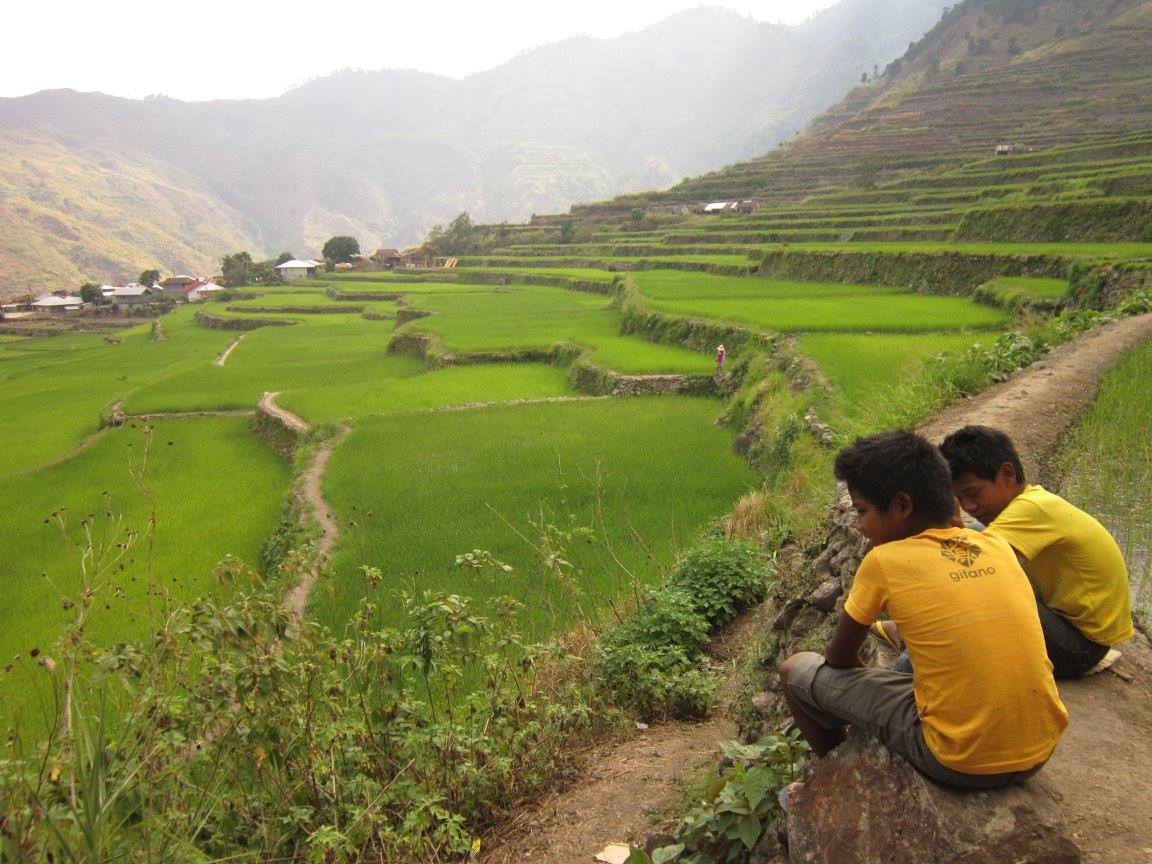
This Ifugao-led study is a climate vulnerability assessment of the rice terraces of the Philippine Cordilleras, a UNESCO World Heritage site. The assessment establishes why local communities value the terraces, and how these values, deeply rooted in indigenous knowledge, are impacted by climate change. The end goal is for communities to strengthen resilience and adaptive capacity as they position to preserve and protect their cultural heritage.

Data was gathered by several focus group discussions among farmers in Nagacadan Hungduan, Mayoyao, Bangaan and Batad. This approach ensures the collection of critical data that truly reflects the lived experiences and needs of the indigenous Ifugao people. The assessment utilizes modern climate science and indigenous knowledge, as both realms of understanding are complementary and necessary to address the climate crisis more effectively.

The Ifugao Rice Terraces confront a web of climate challenges such as intensified typhoons,  erratic precipitation patterns, prolonged droughts and increasing temperatures, which pose imminent risk of soil erosion, reduced crop yield or crop loss, landslides, and structural damage to the terraces. This threatens their ecological integrity, agricultural productivity, amplifies existing vulnerabilities, and can jeopardize the sustainability of this cultural landscape.

Fortunately, their traditional values and indigenous knowledge systems make them moderately resilient. However,  they will need additional support from government to develop infrastructure, and develop technical capacities to  build more robust adaptive strategies and sustainable management practices to preserve ecological resilience and secure the livelihoods of the communities that call the terraces home.

35th Anniversary ICOMOS Philippines Thanksgiving

On Saturday 16 October 2023, ICOMOS Philippines celebrated their annual Thanksgiving get-together to end the year and to celebrate its 35th anniversary.

ICOMOS Philippines Celebrates Its 35th Year Anniversary at ICOMOS Headquarters in Intramuros

One highlight of the celebration was the granting of the Philippine National Committee’s lifetime honorary membership to Regalado “Ricky” Trota José who had started ICOMOS Philippines in the late 1980s. Sir Ricky, as he’s also affectionately known, reminded ICOMOS that rewards or accolades are not what heritage is about; in fact, the practice of heritage is a reward in itself and is a privilege. 

The lifetime honorary membership was given to by virtue of ICOMOS Philippines Board Resolution No. 5 approved on March 31, 2023 wherein the organization recognizes his accomplishments and contributions which included: being the founding president of ICOMOS Philippines; his contributions leading to the inscription of the Baroque Churches of the Philippines on the UNESCO World Heritage List; his works in elevating local church cultural heritage protection and conservation towards international standards in harmony with the local context, and for being an inspiration and mentor among members of the organization.

José recalled the initial membership of ICOMOS Philippines. He said it was a very small number, an amount you could count on one’s fingers. But it was this powerhouse of heritage pioneers who advocated for awareness and sensitivity for our cultural heritage resources. Within the first two decades along with Rachy Cuna, Ramon Faustmann,  Milagros Covarrubias Jamir, and Rene Javellana, S.J., ICOMOS Philippines was pivotal in the inscription of the Baroque Churches of the Philippines, the Ifugao Rice Terraces of the Philippine Cordilleras, and the Historic City of Vigan.

Awarding of Recognition: Former (and Current) Board of Trustees Members

Also a report was presented for the last six months of work at ICOMOS Philippines which included, among others, the funding of Vigan with the Heritage Emergency Fund, the award of Gawad Maestro for being an exemplary NGO as a learning and development institution, the participation with the Creative Industries Group of DTI, a seminar on Built Heritage and FIRE, and reports from the the General Assembly in Sydney this year. 

Cheek Fadriquela, president of ICOMOS graciously stated:  “A million thanks to all who attended our Thanksgiving party last Saturday. It was an event 35 years in the making! Our heartfelt gratitude to former trustees for gracing the occasion with your presence. Special thanks to Lila Shahani and Tracey Santiago for the books they donated to our library. And to our gracious host, Mylene Lising, we are immensely grateful with your kindness and generosity for not only allowing your Consulate to be the venue but also for making your staff assist and stay throughout the event. Kudos to all who made this event a memorable one! May you all have a Merry and Blessed Christmas!”

Invitation and Graphic of Surveying the Ifugao Rice Terraces of the Philippine Cordilleras for Nomination

For more information about ICOMOS Philippines and membership, please contact: info@iicomosphilippines.com

To donate to ICOMOS Philippines so we can continue our advocacy for Philippine heritage, please contact: info@icomosphilippines.com 

UNESCO Heritage Emergency Fund project activities have started in the City of Vigan, Philippines

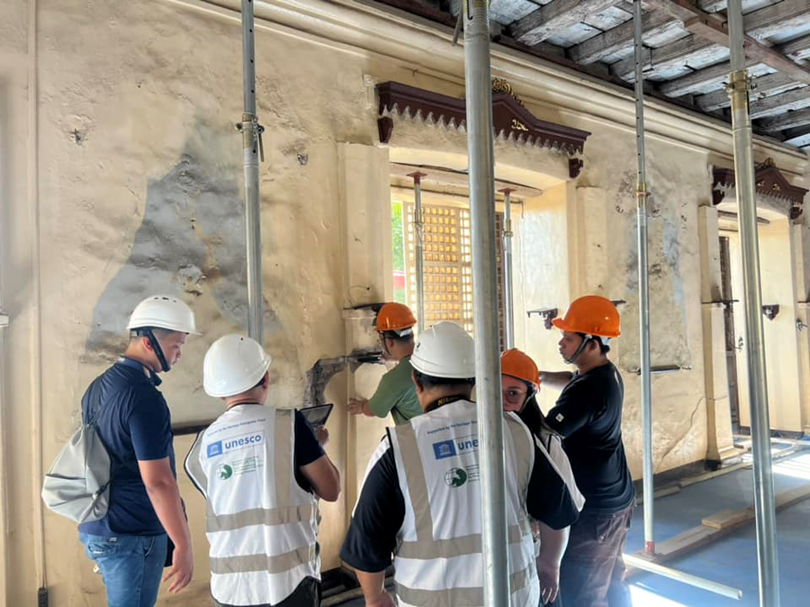
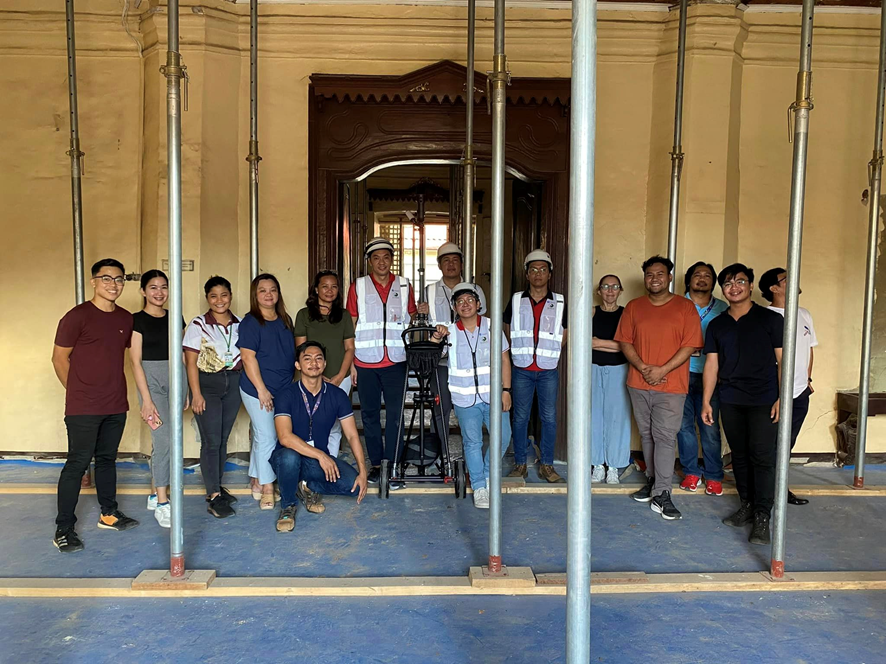
23 – 24 October and 1 – 4 November 2023, City of Vigan, Philippines – Thanks to the UNESCO Heritage Emergency Fund (HEF), the project “Post-Earthquake Damage Assessment of Vernacular Buildings in the World Heritage City of Vigan” was launched by UNESCO Jakarta in partnership with ICOMOS Philippines. Several activities have started in the Historic City of Vigan. The Materials Conservation Team led by Dr. Cheek S. Fadriquela, and the laser scanning documentation team headed by Mr. Conrad Alampay from Digiscript are documented the two ancestral houses, Syquia Mansion and the Cabildo Old House.

The Materials Conservation Expert Team led by ICOMOS Philippines’ President Dr. Cheek Fadriquela collected samples for testing the material composition, and did an onsite XRF test on masonry materials, paint, metals and glass structural materials at Syquia Mansion.

The Material Conservation team members gathered samples and tested the material composition of the original masonry materials; bricks, mortar and plaster in aid of finding compatible materials for restoration and addressing the gap in historic brick masonry materials research in the Philippines.

Mr. Conrad Alampay, President of Digiscript, is leading the training information sessions with some of the local stakeholders of Vigan

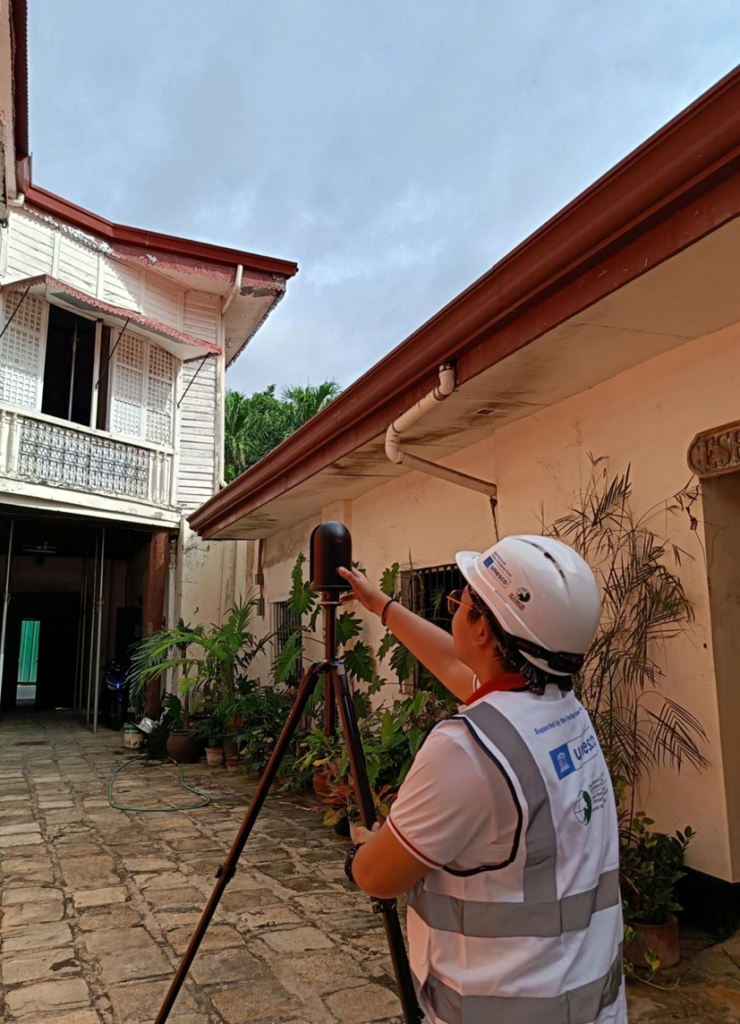
Digiscript, on the other hand, worked on the structures’ digital documentation via 3D laser scanning to generate an accurate set of as-built drawings for analysis. Digiscript also provided training session to 11 local stakeholders from UNP, LGU Vigan and UAP-ICF to maximize the visit and for capacity building. Both are important heritage conservation practices for future building restorations.

A surveyor of Digiscript using LEICA RTC360 scanning for the 3D documentation of the ancestral houses around the pilot site of Syquia Mansion.
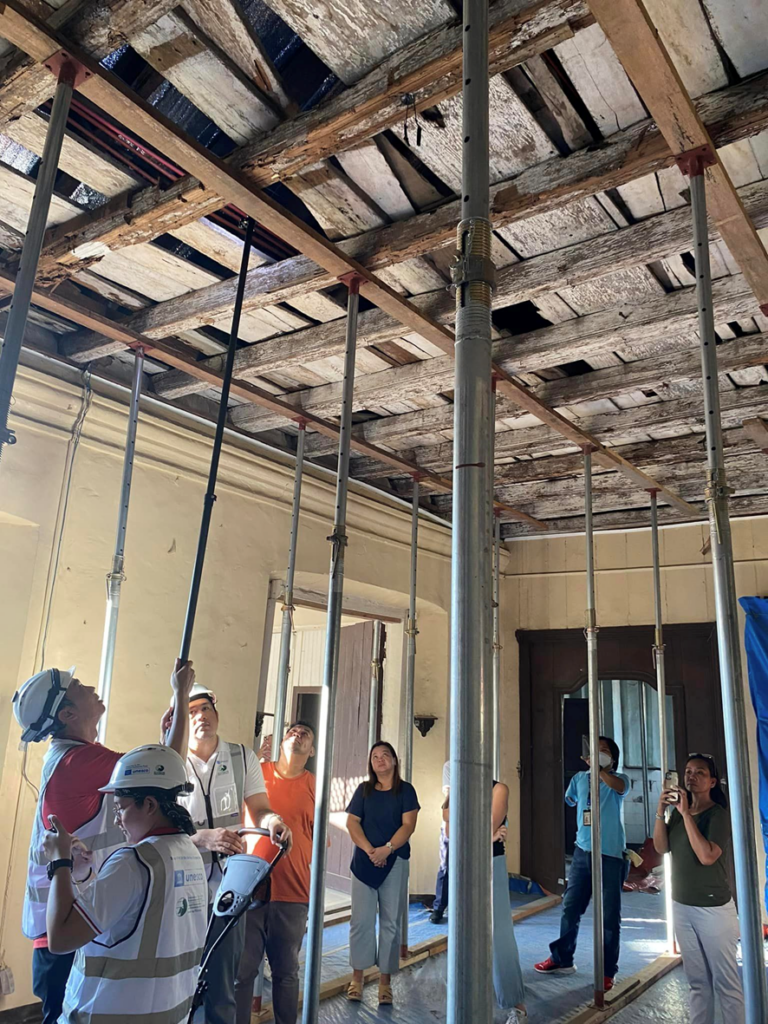
Digiscript team did a laser scanning of the ceiling of Syquia Mansion.
Digiscript snapped a group photo with the successful participants of the laser scanning training information sessions. The following stakeholders are from the Local Government Unit of Vigan City, faculty of the University of Northern Philippines and local architects from United Architects of the Philippines – Ilocos Ciudad Fernandina (ICD) chapter.

This activity is supported by the UNESCO Heritage Emergency Fund. We wish to thank its donors: the Qatar Fund for Development, the Government of Canada, the Kingdom of Norway, the French Republic, the Principality of Monaco, the Republic of Estonia, ANA Holdings INC, the Kingdom of the Netherlands, the Slovak Republic, the Grand Duchy of Luxembourg, the Principality of Andorra, the Republic of Serbia.

Concerned stakeholders who are interested in providing in-kind contribution, you may contact Ar. Kenneth Javier Tua, Country project Director, through kenneth.javier.tua@icomosphilippines.com and cc.: info@icomosphilippines.com. Let’s protect and promote our diverse cultural heritage together.

For more information on ICOMOS Philippines ➡️ https://philippines.icomos.org/

Photo Credits: Ms. Jennie Villanueva Amian of Syquia Mansion, and Mr. Conrad Alampay of Digiscript

#UNESCO #unescoJAKARTA #ICOMOS #icomosPHILIPPINES #HeritageEmergencyFund #firstHEF #WorldHeritageSite #HistoricCityofVigan #PhilippineHeritage #SustainableHeritageManagement, #ProtectHeritage