Biodivercities & The Sustainability of Urban Historic Plazas

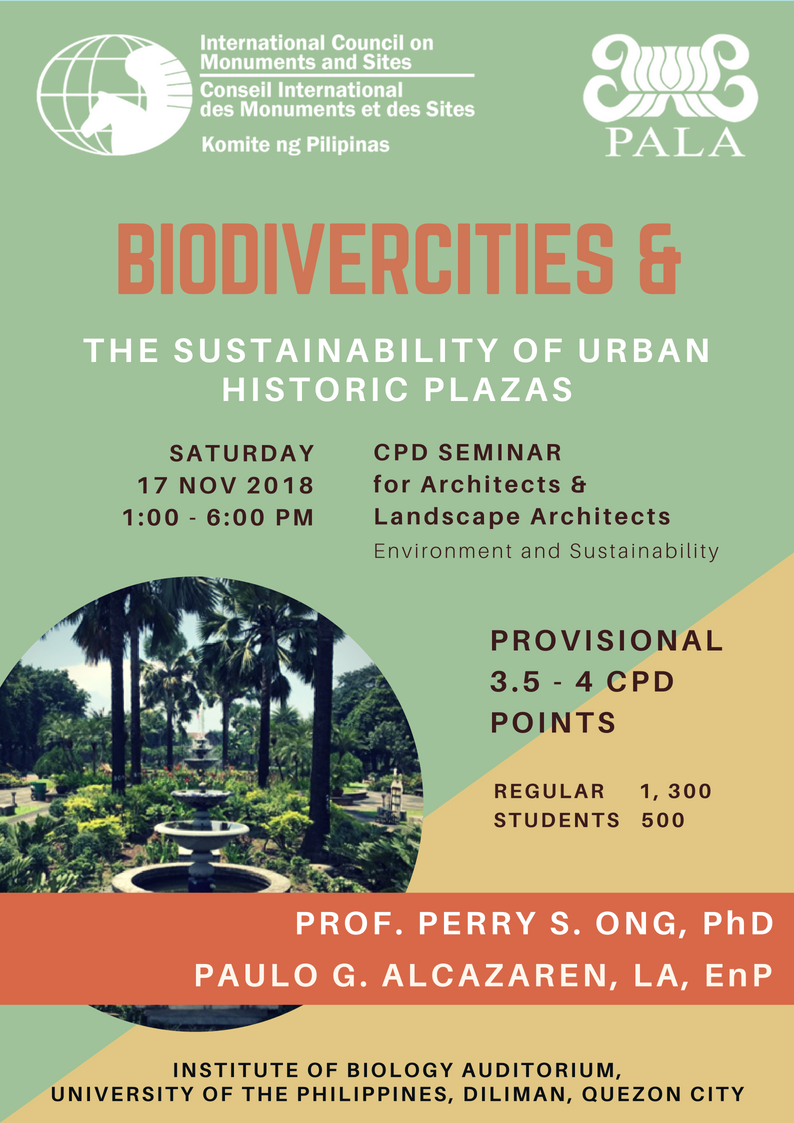
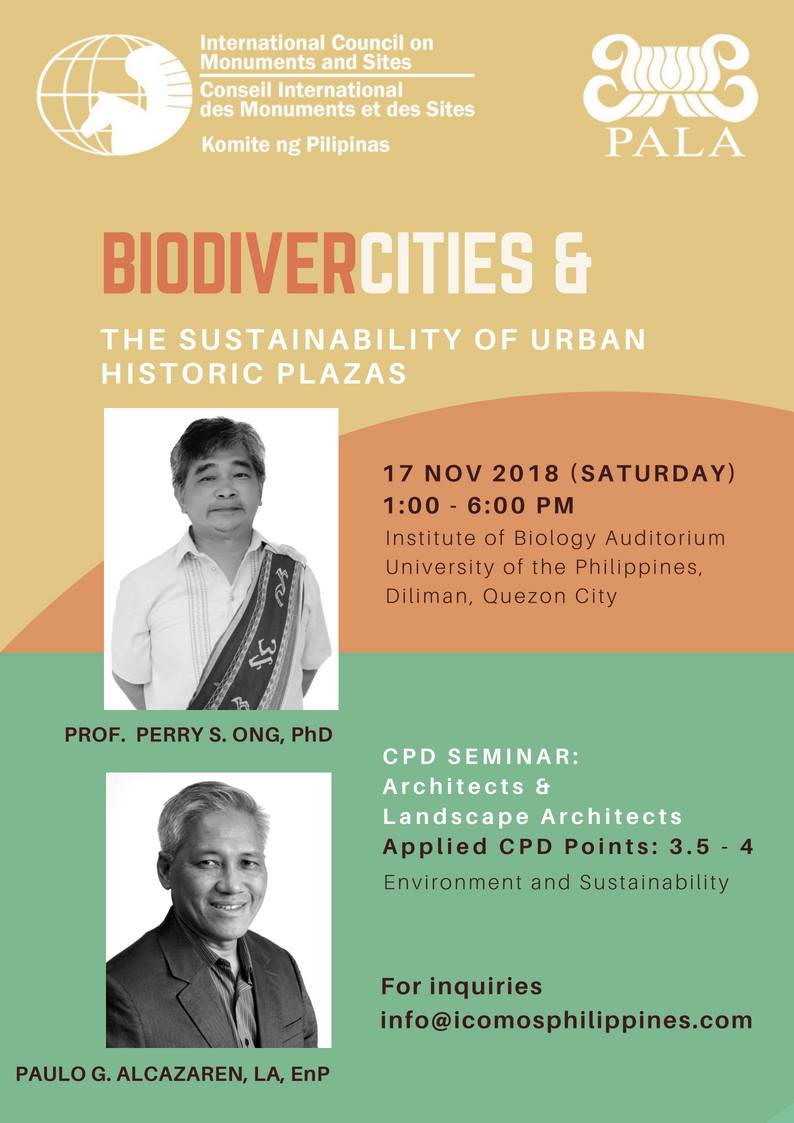
The second joint partnership of ICOMOS Philippines and Philippine Association of Landscape Architects (PALA) brings together two stellar speakers, Prof. Perry S. Ong and Mr. Paulo G. Alcazaren for the CPD Seminar “BiodiverCities and the Sustainability of Urban Historic Plazas” on Nov 17 (Saturday) 1:00 – 6:00 pm at the Institute of Biology Auditorium, UP Diliman.

With rapid urban development of centers, how do we work towards having well-planned, sustainable, and resilient cities and communities?

This program is an accredited CPD Seminar for Architects and Landscape Architects (Applied Points: 3.5 – 4), but is open to other professions, LGUs, scholars, and advocates of sustainability, design, urban planning, biodiversity and natural and cultural heritage.

Registration fee is at Php 1,300 for regular entrants and discounted rates of Php 1,040 for Senior Citizens and Php 500 for students.

To register, kindly follow the instructions on this link: https://goo.gl/forms/WxRdeQT6uEBAcWUt2. For inquiries and other concerns, email info@icomosphilippines.com or visit our facebook page https://www.facebook.com/icomosph/ for more details.

Pre-Disaster Recovery Planning Workshop for Intramuros

Pre-Disaster Recovery Planning Workshop: Intramuros
23 November 2018 (Friday) | 9AM-5PM (Manila City, Philippines)

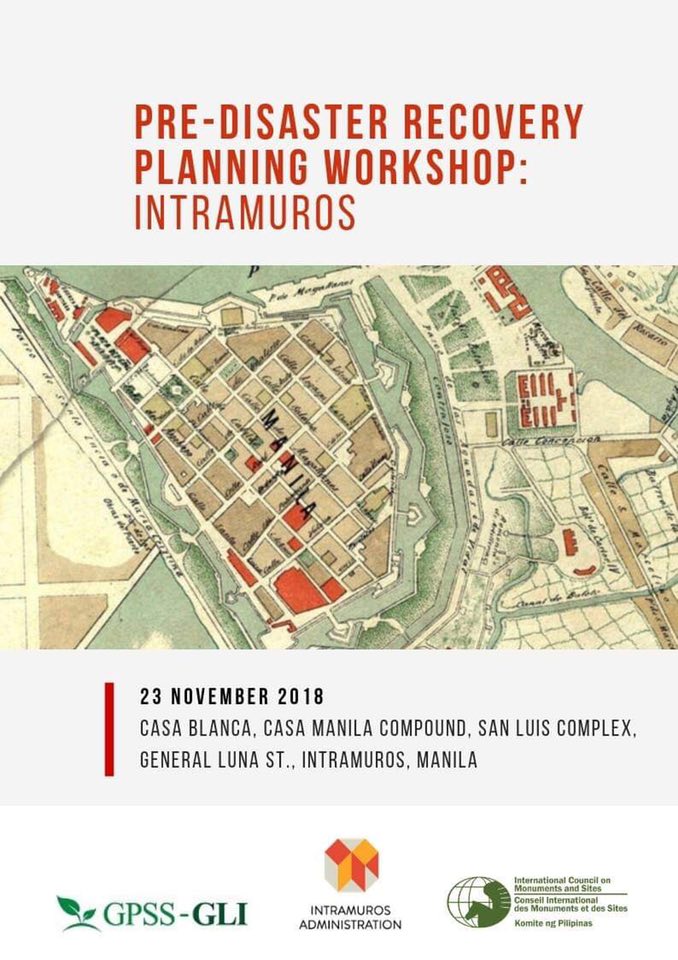
ICOMOS Philippines and the University of Tokyo Graduate Program in Sustainability Science, in collaboration with the Intramuros Administration, will be holding a Pre-Disaster Recovery Planning Workshop for Intramuros on November 23 (Friday), from 9AM-5PM, at the Casa Blanca in Casa Manila Compound, San Luis Complex, Gen. Luna St., Intramuros, Manila City.

The workshop will be based on a slight amendment from the Ritsumeikan Model, which is currently taught in workshops and is considered to be the best practice of disaster workshops for heritage. Already in Phase 2, this workshop will involve the disaster imagination game for contextualizing the disaster; collaborative focus group discussion with stakeholders; and drafting the policy brief.

The Intramuros would be the second historic district in the Philippines, after Vigan, to have such a plan.

For those interested to join us, kindly send us a message at info@icomosphilippines.com for us to save you a seat.

ICOMOS Philippines: New Members 2018

ICOMOS Philippines is very pleased to welcome its new members for the year 2018! Get to know them as we share with you a brief of their profile and expertise.


Vicente L. Rafael

Dr. Vicente L. Rafael is the Giovanni and Anne Costigan Professor of History and Southeast Asian Studies at the University of Washington in Seattle. He obtained his BA from the Ateneo de Manila University and his MA and PhD at Cornell University. He is the author of several books and articles on the history and cultural politics of the Philippines, including “Contracting Colonialism: Translation and Christian Conversion in Tagalog Society Under Early Spanish Rule,” “White Love and Other Events in Filipino Histories,” “The Promise of the Foreign: Nationalism and the Technics of Translation in the Spanish Philippines,” and “Motherless Tongues: The Insurgency of Language Amid Wars of Translation,” all published by Duke University and co-published in the Philippines by Ateneo University Press.

He’s also edited “Discrepant Histories” and “Figures of Criminality in Indonesia, the Philippines and Colonial Vietnam”. Rafael also wrote the Introduction to a collection of Nick Joaquin’s stories, “The Woman Who Had Two Navels and Tales of the Tropical Gothic” recently published by Penguin Classics. 

He has published numerous essays and articles in journals such as the Journal of Asian Studies, Positions: Asian Cultural Critique, Public Culture, Social Text, American Historical Review, Philippines Studies, Cultural Anthropology, American Literature and many others. He is a regular contributor to various newspapers and journals, including Rappler, The Philippine Daily Inquirer, Dissent, and Social Text and Public Culture, Comparative Studies in Society and History, Journal of Asian Studies, American Historical Review and many others.

Throughout the years, he has received several awards, most notably The John Simon Guggenheim Fellowship, Post-doctoral fellowships at Stanford, the Humanities Institute at the University of California at Irvine, Princeton University, East-West Center, University of Hawai’I, Social Science Research Council, the American Council of Learned Societies, among others. He was also the recipient of two National Book Awards from the Manila Critics’ Circle for “Contracting Colonialism” and “White Love.”


Andrea Jalandoni

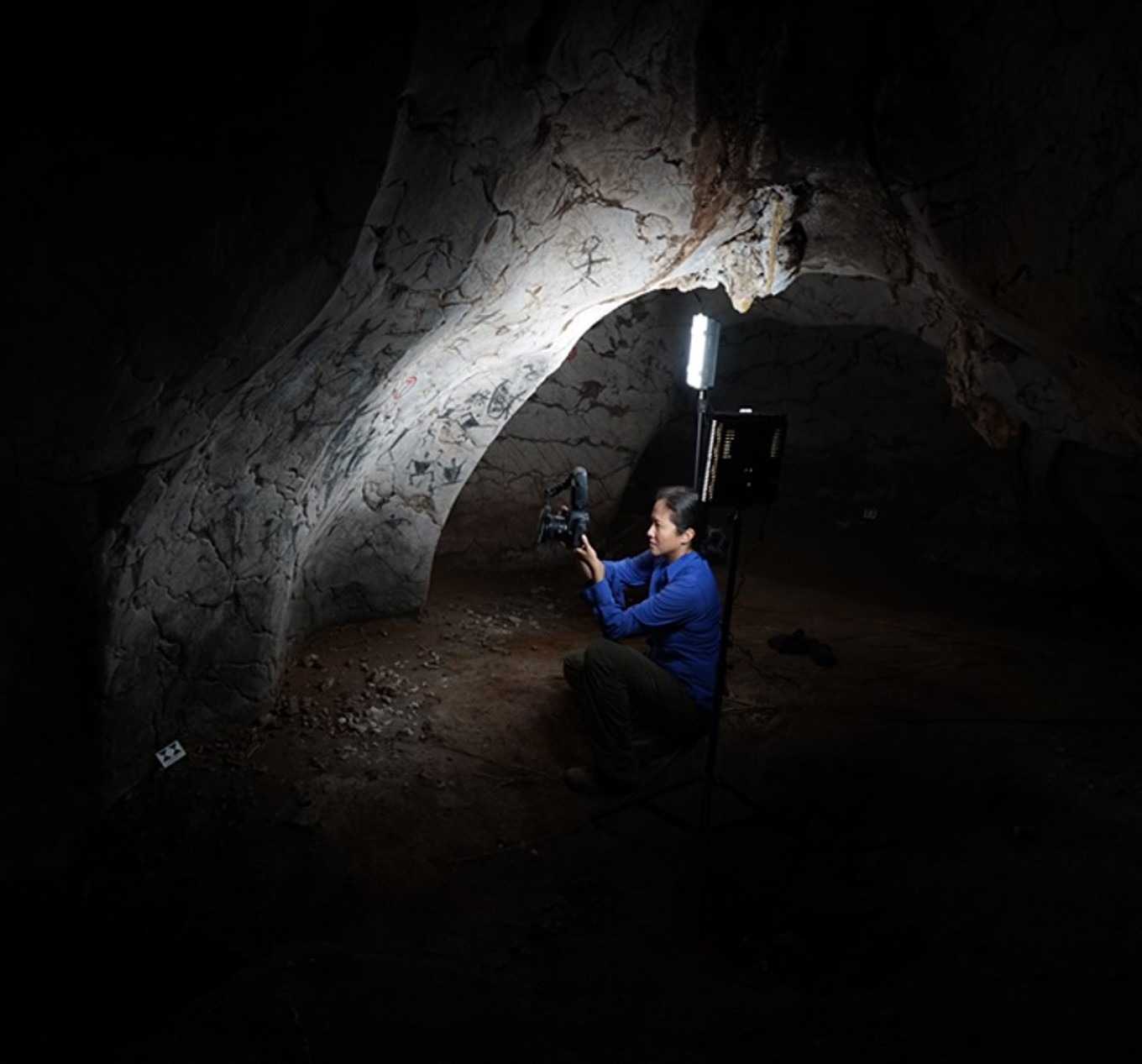
Dr. Andrea Jalandoni is a Digital Archaeologist specializing in rock art recording and enhancement using photogrammetry and other remote sensing techniques including laser scanning and unmanned aerial systems. She obtained her BA at Ateneo de Manila University, MA at the University of the Philippines – Diliman and her PhD at the Griffith University, Gold Coast, Australia where she is Research Fellow on an Australian Research Council Laureate Fellowship project ‘Australian rock art: history, conservation and Indigenous well-being.’

She received grants for the following projects: “Digital Archaeology and Dating: Innovative recoding methods and the first dated rock art in the Philippines” for 2019 – 2020 and currently working at present on “Guam Rock Art Study” under the Guam Preservation Trust. She has certifications on Remote Pilot at the Federal Aviation Administration, United States, and Advance Nitrox at the Technical Diving International.

She has projects in Australia, Southeast Asia, and Micronesia. Among her recent and notable projects are “How 3D models (photogrammetry) of rock art can improve recording veracity: a case study from Kakadu National Park, Australia”, “Inundation Exposure Assessment for Majuro Atoll, Republic of the Marshall Islands Using A High-Accuracy Digital Elevation Model”, “New Insights into the Rock Art of Anbangbang Gallery, Kakadu National Park”, “An Overview of Remote Sensing Deliverables for Rock Art Research”, “Optimizing the Potential of Research Data through an Integrated Data Management Approach: Considering Research Method, Data Life Cycle, Big Data and Linked Data in an Eresearch Example In Australian Rock Art”, and “A Systematic Quantitative Literature Review of Southeast Asian and Micronesian Rock Art”.

Andrea is also interested in Austronesian migration from Southeast Asia to Micronesia and archaeological sites of cultural identity.

Internship Opportunity for Cultural Heritage Research, in partnership with Fundacion Santiago

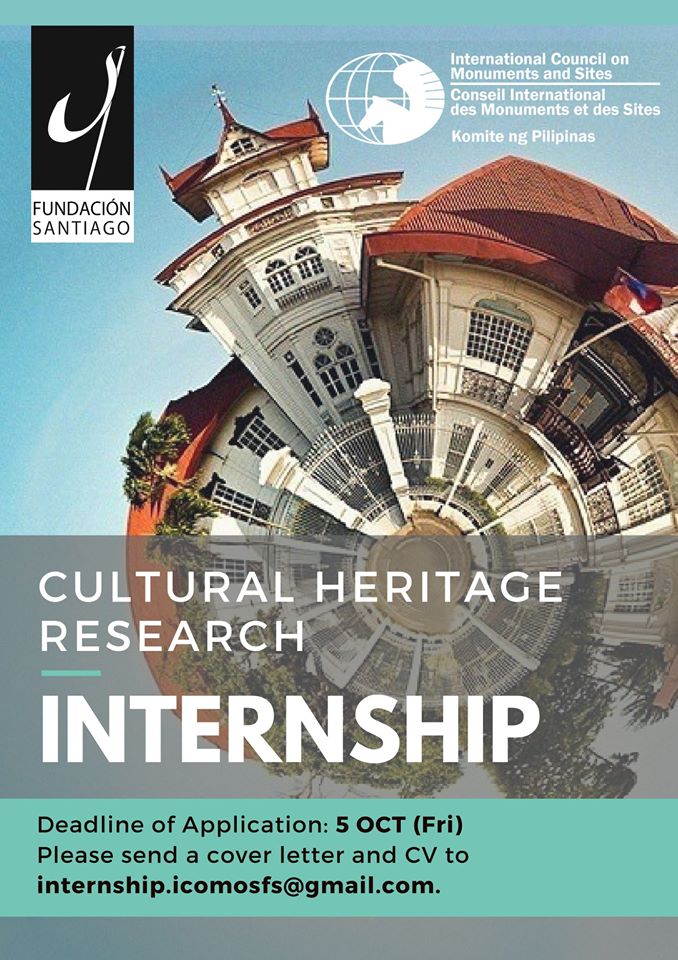
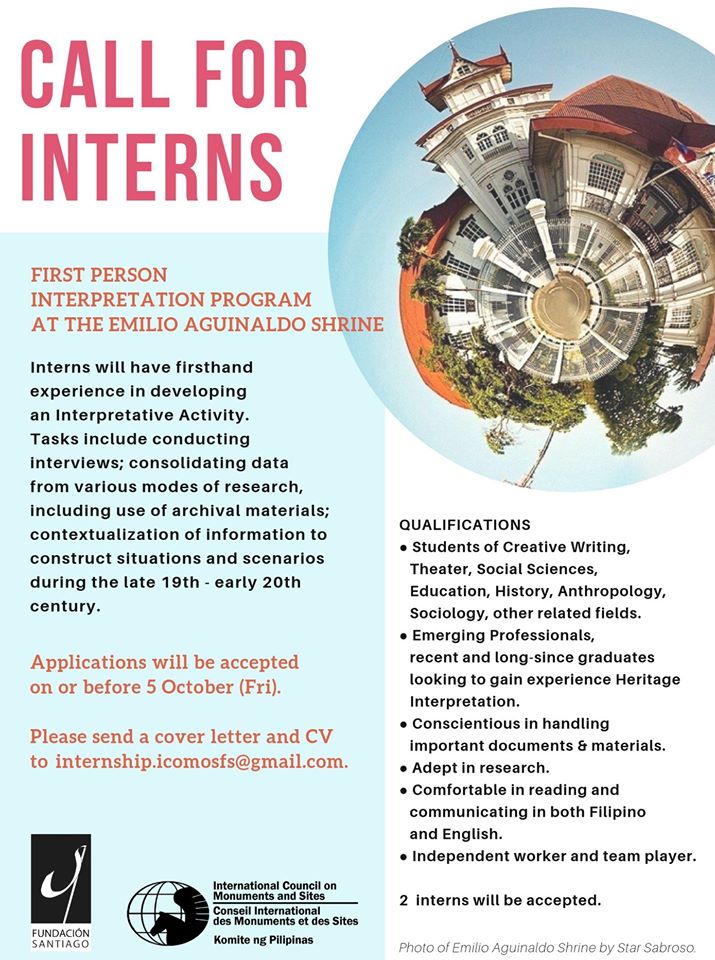
Fundacion Santiago and ICOMOS Philippines are looking for 2 research interns to develop first person stories for the Emilio Aguinaldo Shrine.

Interns will receive close mentorship in research and interpretation of historic data by a leading heritage expert as they conduct interviews, consolidate data from varying modes of research, and contextualize these into scenarios typical of the late 19th and early 20th centuries, and told in first person by those near and dear to Emilio Aguinaldo.

Qualifications. Creative Writing, Theater, Social Sciences, Education, History, Anthropology, Sociology students; or emerging professionals, and graduates looking to gain experience in Heritage Interpretation, who are conscientious in handling important documents and materials; adept in research; comfortable in reading and communicating in Filipino & English; independent worker and team player.

For those interested, kindly send your cover letter and CV to internship.icomosfs@gmail.com on or before October 5, 2018.

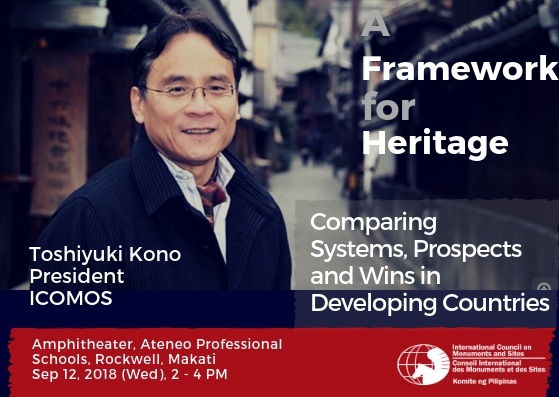
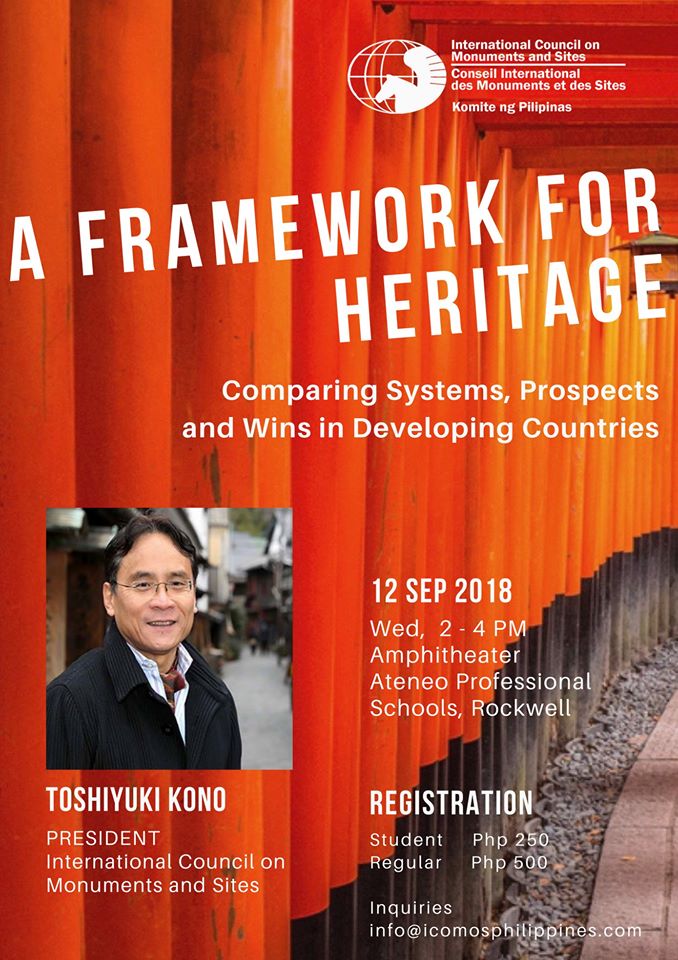
A Framework for Heritage: Comparing Systems, Prospects, and Wins in Developing Countries – A Talk by ICOMOS President Toshiyuki Kono

“A Framework for Heritage: Comparing Systems, Prospects, and Wins in Developing Countries” by Toshiyuki Kono
12 September 2018 (Wednesday) | 2-4PM (Makati City, Philippines)

ICOMOS Philippines invites you to a talk by ICOMOS President Toshiyuki Kono, a Distinguished Professor at Kyushu University in Fukuoka, Japan, entitled “A Framework for Heritage: Comparing Systems, Prospects, and Wins in Developing Countries” on September 12 (Wednesday), 2-4PM, at the Ateneo Professional Schools Ampitheater, Rockwell Center, Makati City.

As many UNESCO World Heritage sites are in developing countries, where the legal infrastructure and management systems for conservation and protection are still evolving. What are the parameters considered for setting up inventories, incentives, and management systems?

In view of this current terrain, President Toshiyuki Kono will discuss prospects and emerging trends in heritage systems for developing countries, along with sustainable heritage wins and best practices.

We would like to acknowledge the Ateneo de Manila University School of Law for co-presenting this talk with us.

For those who are interested to attend, kindly send us an email at info@icomosphilippines.

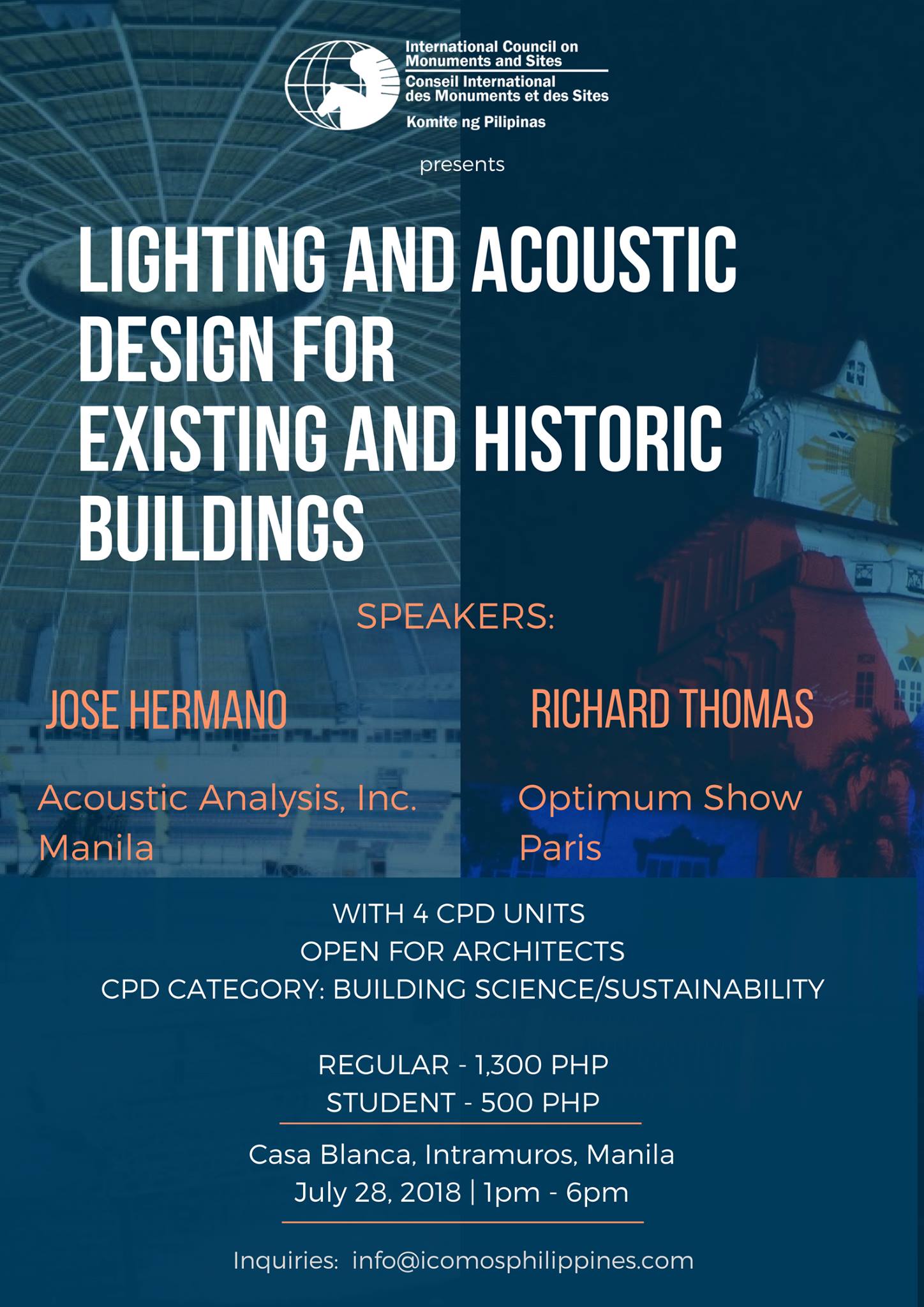
Lighting and Acoustic Design for Existing and Historic Buildings

This CPD Program offered by ICOMOS Philippines will help professionals understand and learn basic principles for lighting and acoustic design for existing and heritage structures. In these talks, the basic theory of each discipline’s approach, and how to get the job done on low, medium, and high-end budgets will be discussed.

Lecturers Mr. Richard Thomas (Optimum Show, Paris, whose projects include: the Louvre, Paris, Petronas Towers, Kuala Lumpur, and the Parthenon, Athens) and Mr. Jose Hermano (Acoustic Analysis Inc., whose projects include Araneta Coloseum, PETA Theater, La Salle Greenhills St. Benilde Gymnasium) will discuss past projects that illustrate and support these principles, and how they might have embellished or reduced the output depending on cost.

This seminar was held on July 28, 2018 (Saturday), 1pm-6pm at Casa Blanca, Intramuros, Manila.

ICOMOS Philippines: New Members 2018

ICOMOS Philippines is very pleased to welcome its new members for the year 2018! Get to know them as we share with you a brief of their profile and expertise.


Lila Ramos Shahani

Lila Ramos Shahani is the former Secretary-General of the Philippine National Commission to UNESCO. Under her leadership (and with the help of other government agencies), her team succeeded in obtaining four UNESCO designations for the country: in Intangible Cultural Heritage, Memory of the World and Creative Cities.

She has taught at the Asian Institute of Management, the Ateneo School of Government and the University of the Philippines. She has published widely, not only academically but as a former columnist for the Philippine Star. In addition, she has published with the Philippine Daily Inquirer, ABS-CBN, GMA News, Rappler, Business World and the Philippine Graphic.

She also spent many years in New York, where she did editorial work for Oxford University Press, writing and research for the United Nations Children’s Fund, and policy and communications work for the United Nations Development Programme.

She received her B.A. in Comparative Literature from Brown University, her M.A. in International Relations from the Fletcher School of Law and Diplomacy at Tufts University, and remains a doctoral candidate in Literature at Oxford University.


John Peterson

Dr. Peterson is an anthropological archaeologist with field research experience in the Philippines, US Southwest and Texas, Northern Mexico, Ecuador, Brazzaville-Congo, and the Daiyuan Valley of Jiangxi Province China. He specializes in historical ecology and archaeological heritage management. He took his BA from Antioch College in Environmental Studies, MA and PhD from University of Texas at Austin, USA and has had academic affiliations with various universities – University of Texas at El Paso, University of Hawaii, University of Guam, and University of San Carlos in Cebu, and has had academic honors including two Fulbright awards, an NEH fellowship, is a National Geographic Explorer, and managed large grant programs for NSF, NASA, NIH, and other US funding agencies.

Aside from this academic engagement, Dr. Peterson operated a mixed grain and livestock farm in Ohio, USA and managed a living historical farm where horses, mules, and steam engines were used to recreate mid-19th century farming in the American Midwest.

John Peterson has been involved with ICAHM, the International Scientific Committee on Archaeological Heritage Management  of ICOMOS since 2008 as a vice president and most recently as president, and has consulted on and contributed to nomination reviews of several world heritage properties.


Stephen Acabado

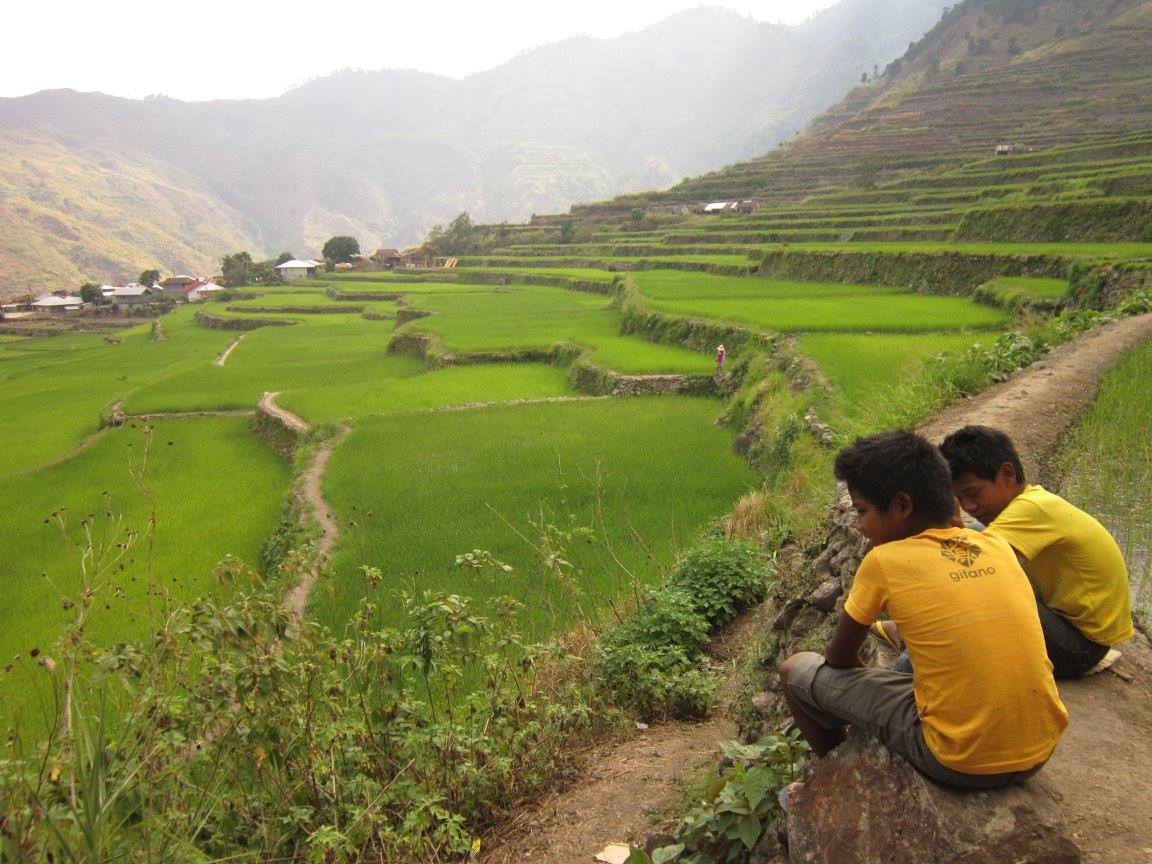
Dr. Stephen Acabado is an associate professor of anthropology and a core faculty at the Cotsent Institute of Archaeology at the University of California, Los Angeles. His archaeological investigations in Ifugao, northern Philippines, have established the recent origins of the Cordillera Rice Terraces, which were once known to be at least 2,000 years old. Dr. Acabado also directs the Bicol and Ifugao Archaeological Projects and co-directs the Taiwan Indigenous Landscape and History Project.

He is a strong advocate of an engaged archaeology where descendant communities are involved in the research process. He is a member of the Engaged Research Grant Advisory Committee of the Wenner-Gren Foundation for Anthropological Research.

IN MEMORIAM: Augusto Villalon

In Memoriam

Augusto F. Villalon

May 31, 1945 – May 5, 2018

Through his tireless advocacy, Arch. Augusto Villalon, former President of ICOMOS Philippines, inspired innumerable heritage conservation practitioners and ordinary citizens alike to protect the national patrimony. Although he was practically a lone voice when he helped introduce heritage conservation to the country some 40 years ago, Arch. Villalon zealously promoted heritage awareness through his writing, speaking, organizing, and campaigning. Publications and countless newspaper articles which he wrote helped mold the national consciousness. Organizations which he helped found, such as the Heritage Conservation Society, generated momentum, as did his years of involvement with both the National Commission for Culture and the Arts and UNESCO’s National Commission of the Philippines. By 2009, the groundswell that he helped create finally led to Republic Act 10066, better known as the Philippines’ Heritage Law.

Arch. Villalon was the bridge between the Philippines and the international heritage conservation community, primarily through his work with ICOMOS. He was President of ICOMOS Philippines for 25 years, was called upon to undertake numerous international missions, and was the moving force behind the inscription of the Philippines’ first five UNESCO World Heritage sites. He was Vice President of the International Committee on Cultural Tourism as well as the International Committee on Vernacular Architecture. He was a founding member of the International Committee on 20th Century Heritage, and he also served in both the Executive and Advisory Committees of the organization. He was so revered worldwide as an elder statesman of the conservation profession that ICOMOS awarded him with an Honorary Membership in 2014, just one of his many prestigious international and local distinctions.

Toti, as he is fondly called by family and friends, effected social change beyond the field of heritage conservation as well. As President of the Gota de Leche Foundation, he helped provide milk and nutrition support to indigent children in Manila—an endeavor to which he passionately dedicated himself.

A devoted husband, father, and grandfather, Arch. Augusto Villalon leaves behind a loving family, respectful friends and colleagues around the world, countless grateful mentees, and the well-deserved legacy of being the father of heritage conservation in the Philippines.