
Speakers for “Color Matters”, an event for National Heritage Month

In celebration of National Heritage Month,  ICOMOS Philippines explores the theme of color. Color is a large contributing factor to its aesthetic value, and to a site’s authenticity- often evidenced by popular  uproar when a historic site is restored with a different color.

ICOMOS Philippines examines color within the broader context of preserving authenticity in heritage. The materiality, symbology, and historic significance of color, from the global to local contexts will be discussed, including practical applications of restoration of colored renders and paint finishes. 

Late May; Date & Time TBD

Leandro Poco gives a historic introduction of the historic significance of color in urban planning and architecture (e.g., use of color in Antiquity such as Greek and Roman statuary and temples, color schemes in Cycladic Islands, colors of Spanish-era colonial settlements such as Vigan, theory of Brutalist finishes, corporate identity color schemes, etc.).

This talk introduces the color and materiality of human settlements and cities using the lenses of history, contextual geography, and socio-economic conditions. It expounds on how color and materiality are not just forms of artistic expression, but, when combined with an understanding of underlying factors, have a deep cultural and contextual meaning that add depth to our understanding of the built environment. One can trace the thread of color and materiality as it starts out as a consequence of geographical context, achieving the height of craftsmanship and expression within local communities. This then moves into the commodification and homogenization of materials into the industrial age of international modernity, wherein increasing production, global trade, and post-ww2 ideologies bring about changes to production and the adoption of a more global (less local) identity. Leading into how the current age of mass market capitalism and branding, suburbanization and corporate enclavization of cities has led to the increased need for mass-customization of materiality and colors to stand out in a public sphere where brands and identity dominate for eyeballs and influence. The aim is to enlighten while presenting, enlightening, and poking fun  at our pre-held conceptions on color in the urban sphere, and make us aware of the subtext of color and materials in our built environment.

Christian Aguilar gives an overview of the use of colors in history from Antiquity via the Middle Ages and the Renaissance and Baroque to the Present. He will then discuss materials (pigments, binders, and admixtures); application (surface treatments, layers, technique); and details (protection, maintenance). Aguilar  discuss the use of colors in restoration projects (case studies of Sta. Ana Church, Pasig Church and San Agustin Churches; the Intramuros walls) and the challenges faced in the Philippines in implementing proper restoration practices. The talk will conclude with a brief overview of contemporary applications of colors in the Philippines discussing challenges and commonly made mistakes. 

Erik Akpedonu will discuss the symbolism of colors in various cultures (e.g., mourning colors in East Asia, Europe, and West Africa) and their application in the built environments of, for example, in Europe and China (Feng Shui). He will discuss the psychology of color in Architecture and in Interior Design in particular, as well as the ecological aspect of proper color choice for ecologically-appropriate color schemes.

Color is a fundamental aspect of how we perceive our environment and has a profound impact on our psychological well-being. Given their powerful effects, colors the world over have been employed to symbolize specific concepts, ideas, and feelings, such as joy and mourning, power and purity, good and evil, aggression and peace, and many more. How colors are used in architecture varies from culture to culture, be it the manifold symbolic meanings of color in Chinese traditional architecture based on geomancy (Feng Shui); the vibrant colors of Bolivia translated into contemporary buildings, or the geometric patterns of sub-Saharan Africa. Perceptions of color are likewise influenced over time by notions of ideology, power, and manipulation, ranging from the colorful emotional extravaganza of the Baroque via the monochromatic rationality of Neoclassicism and the controversial color debates surrounding Classic Modernism up to the present free-for-all of Post-Modernism. Finally, our natural environment influences our choice of colors, be it the blue-and-white schemes of traditional Greek houses, the colorful dwellings of Scandinavia, or the earth tones of traditional clay architecture. Given its strong psychological and symbolic impact, colors also play a vital role in interior design, where they are used in a wide range of combinations to visually reduce or enlarge space, add or remove light, and create the desired ambience depending on the target audience. Finally, color`s physical aspects can be put to good use at a time when Global Warming increasingly calls for designs that use color to aid in passively cooling or heating buildings, creating a sustainable architecture for the 21st century.
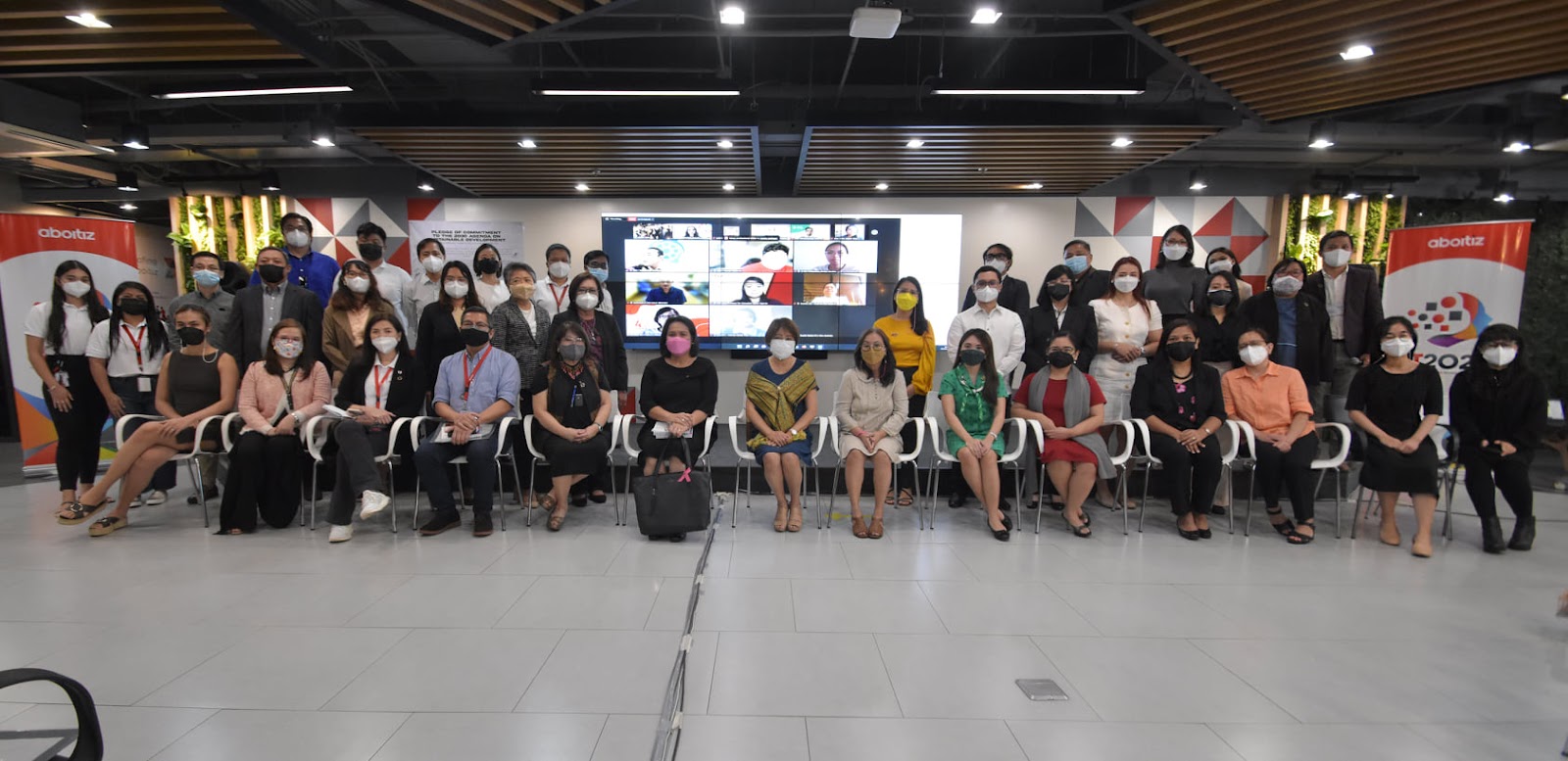
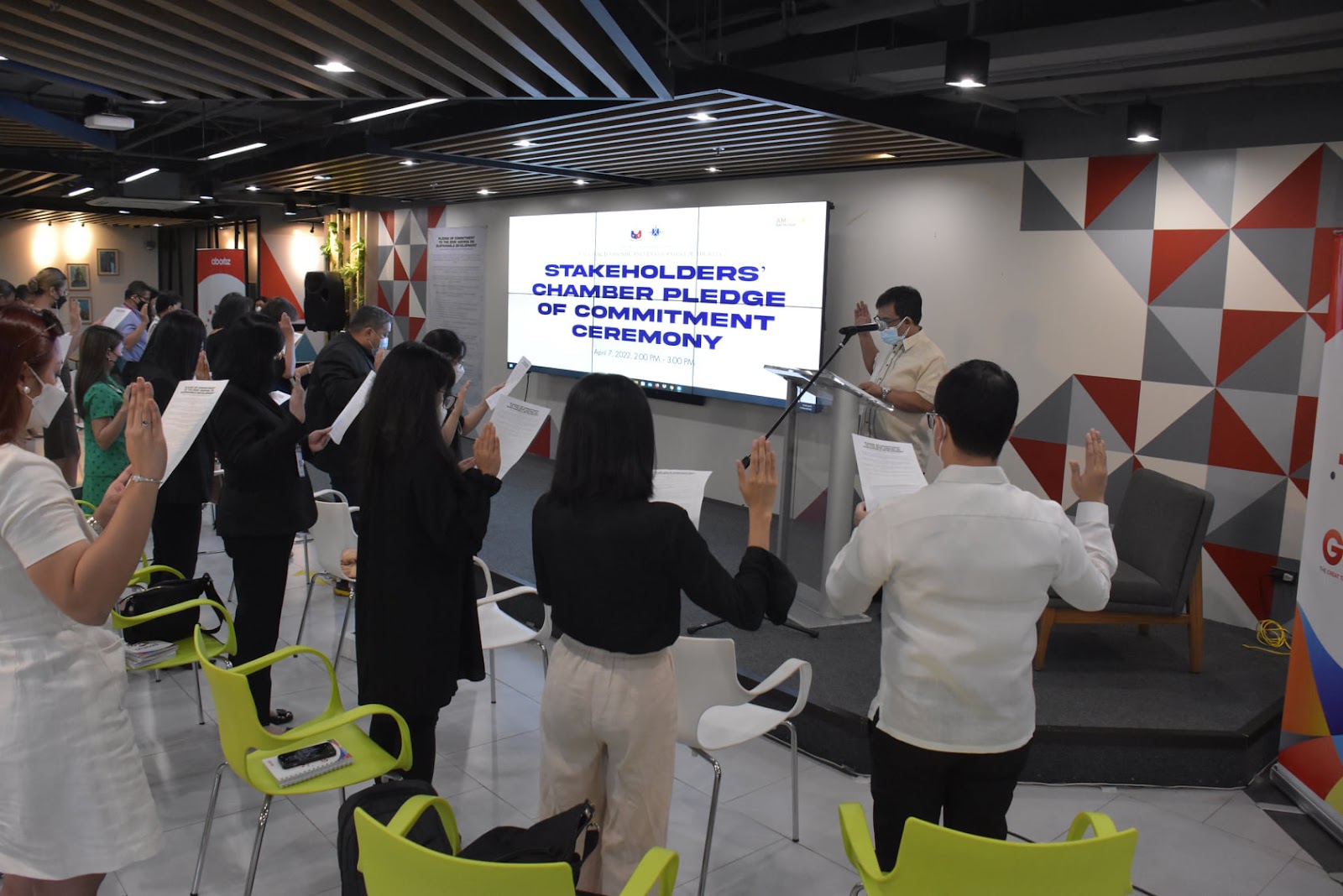
Press Release: ICOMOS Philippines official membership to the Stakeholders’ Chamber on the Sustainable Development Goals (SDGs)

Photo from National Economic and Development Authority (NEDA)

Photo from National Economic and Development Authority (NEDA)

The International Council on Monuments and Sites (ICOMOS) Philippines has officially become a member of the National Economic and Development Authority (NEDA) Stakeholders’ Chamber on the Sustainable Development Goals (SDGs). 

The NEDA Subcommittee on Sustainable Development Goals inaugurated forty-two (42) member organizations from various sectors dedicated to upholding the SDGs in the Philippines.

The Stakeholders Chamber is a platform for the Government to engage Non-Government partners to improve coordination, alignment and understanding, resource management, ownership and facilitate the emergence of well-aligned partnerships for the achievement of the SDGs. The Chamber is the avenue for policy dialogue, stakeholder mapping, increasing awareness and support for the SDGs. The Philippine National Committee of ICOMOS is the sole member of the Chamber whose global expertise works for the conservation and protection of cultural and natural heritage worldwide. ICOMOS is an advisory group of the United Nations Educational, Scientific and Cultural Organization (UNESCO) and ICOMOS Philippines also holds a seat on the National Committee on Monuments and Sites, of the National Commission of Culture and Arts (NCCA).

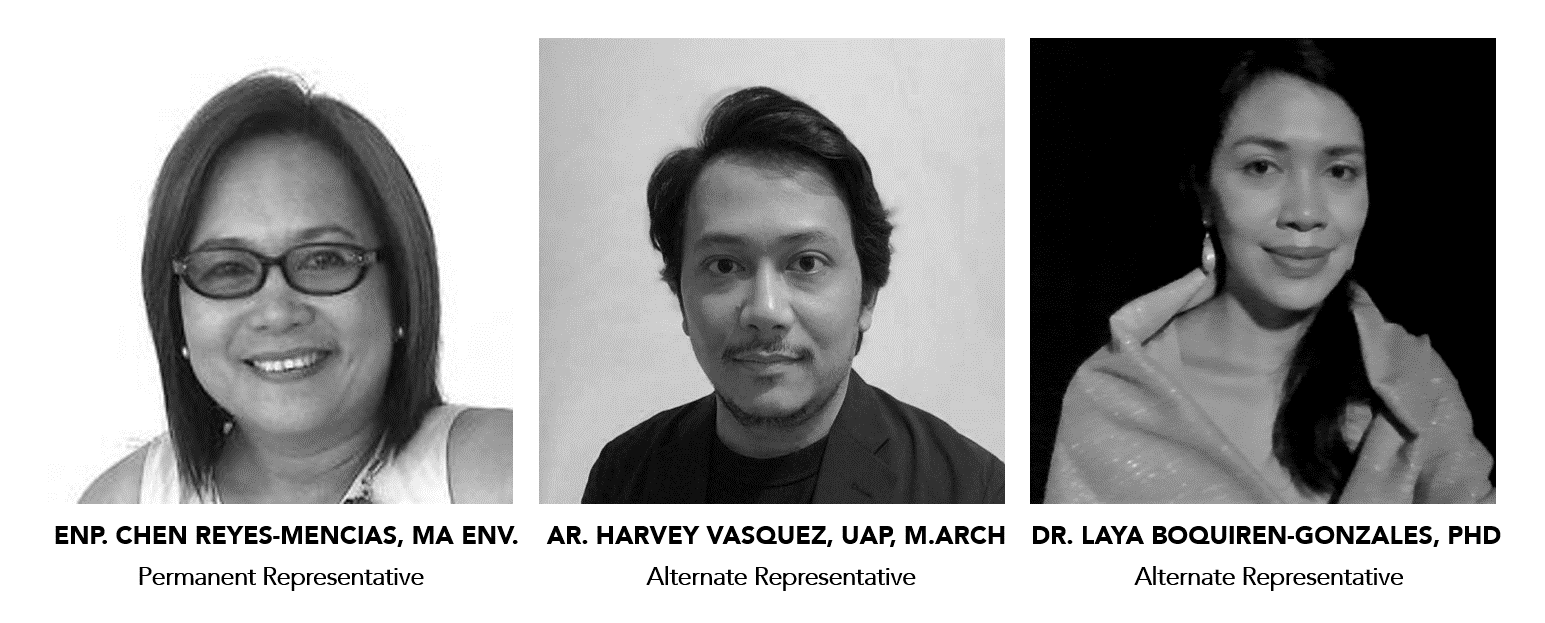
The membership will be effective  for the Fiscal Year 2022, and subject to renewal. The Board of Trustees appointed Sustainable Development Goals Working Group (SDGWG)’s EnP. Marybeth “Chen” R. Mencias as its Permanent Representative. Ar. Harvey Vasquez and Dr. Laya Boquiren-Gonzales as the Alternate Representatives of ICOMOS Philippines.

Photo prepared by ICOMOS Philippines

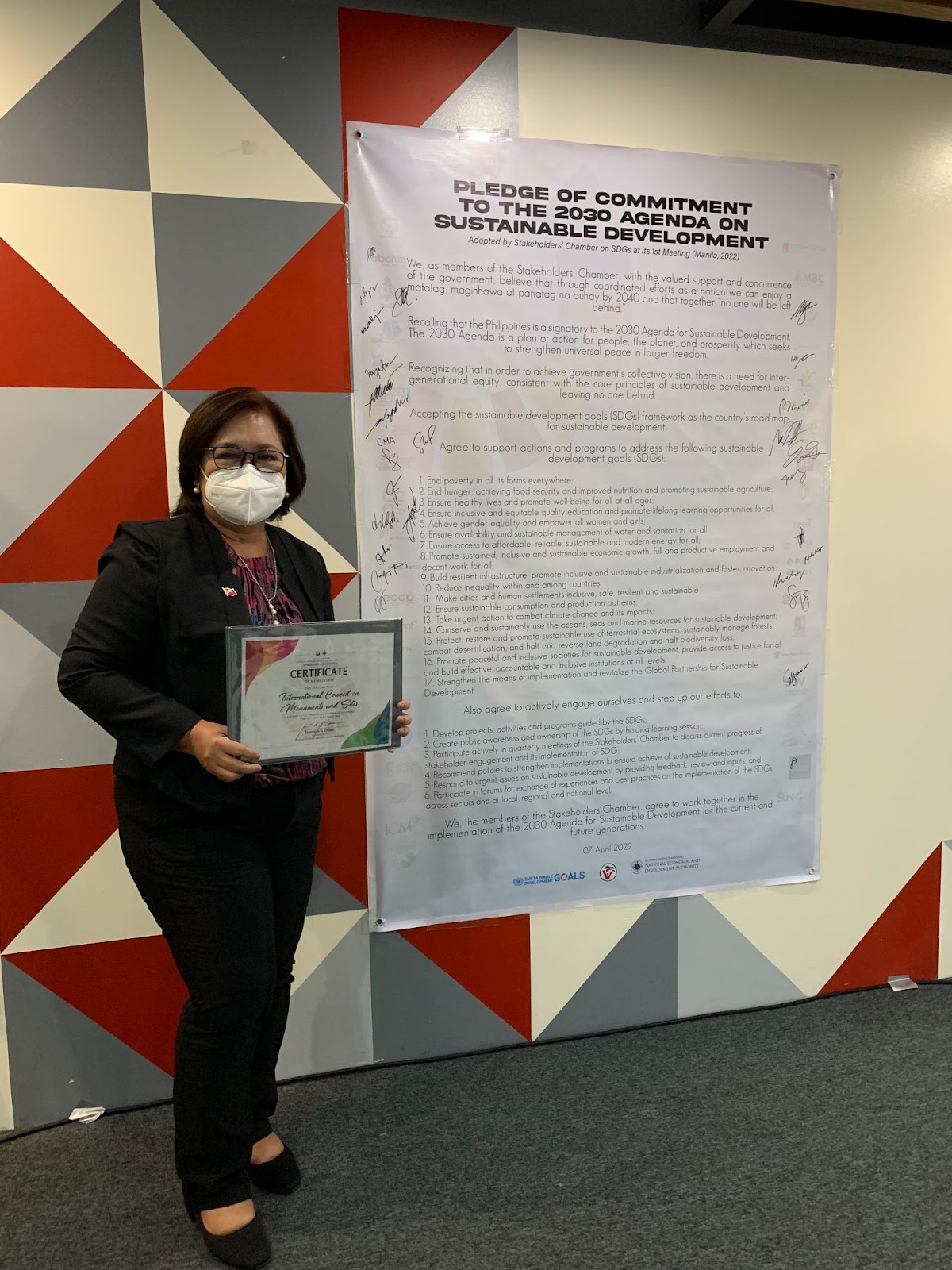
EnP. Mencias represented ICOMOS Philippines during the Pledging Ceremony last April 7, 2022, Thursday, at Aboitiz Equity Ventures Head Office, NAC Tower, Bonifacio Global City, Taguig.

Photo from EnP. Marybeth “Chen” R. Mencias

Due to COVID-19 restrictions, fellow representatives Ar. Harvey Vasquez and Dr. Laya Boquiren-Gonzales attended the Pledging Ceremony remotely.

To know more about NEDA’s initiative, kindly visit this link.

Click this link for more information on ICOMOS Philippines and SDGWG

#ICOMOS #ICOMOSPH #SDGWG #SustainableDevelopmentGoals #LikasKayangPagUnlad #PhilippineHeritage #PAMANA2030 #PartnershipForTheGoals #2030Agenda #StakeholdersChamberForSDGs #SustainableDevelopment #AmBisyonNatin2040

ICOMOS Philippines established the National Sustainable Development Goals Working Group (SDGWG)

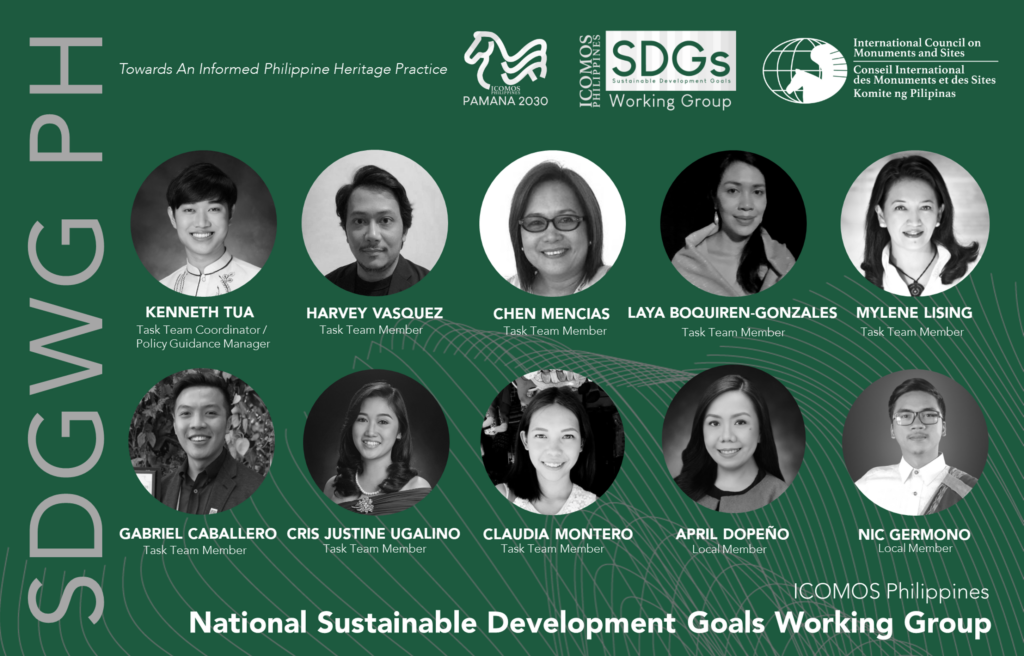
In January 2021, ICOMOS Philippines appointed National Representatives to ICOMOS International SDGWG eventually establishing the National Sustainable Development Goals Working Group (SDGWG PH). At present, it is now composed of ten (10) ICOMOS members. 

The Sustainable Development Goals Working Group of ICOMOS Philippines (SDGWG PH) coordinates ICOMOS response to the 2030 Agenda, through advocacy, policy, and localizing of the SDGs. SDGWG PH looks into the important role of culture and heritage as a driver and enabler of the implementation of the United Nations 2030 Agenda. It believes that Culture and Heritage supports the achievement of all the 17 SDGs. The linkages of Culture and Heritage starts at Target 11.4 to “strengthen efforts to protect and safeguard the world’s cultural and natural heritage to make our cities inclusive, safe, resilient and sustainable”, but it also enables the achievement of various SDG targets. This belief is anchored from the ICOMOS International Policy Guidance for the Sustainable Development Goals

SDGWG PH through the PAMANA 2030 (Heritage 2030) Campaign aims to develop a policy guidance document to localize the “ICOMOS International Policy Guidance document for Heritage and Sustainable Development Goals” from 2021 to 2023. 

TEAM, 2021-23: 

Ar. Kenneth Tua  is the Policy Guidance Manager / Task Team Coordinator. With him as Task Team members are LAr. Gabriel Caballero, EnP. Chen Reyes-Mencias, Dr. Laya Boquiren-Gonzales, IDr. Mylene Lising, Ar. Harvey Vasquez, Ar. Claudia Isabelle Montero, and LAr. Cris Justine Ugalino, and as local members are: Ms. April Dopeño and Mr. Nicanor Germono.

Know more about the people behind the ICOMOS Philippines SDGWG:

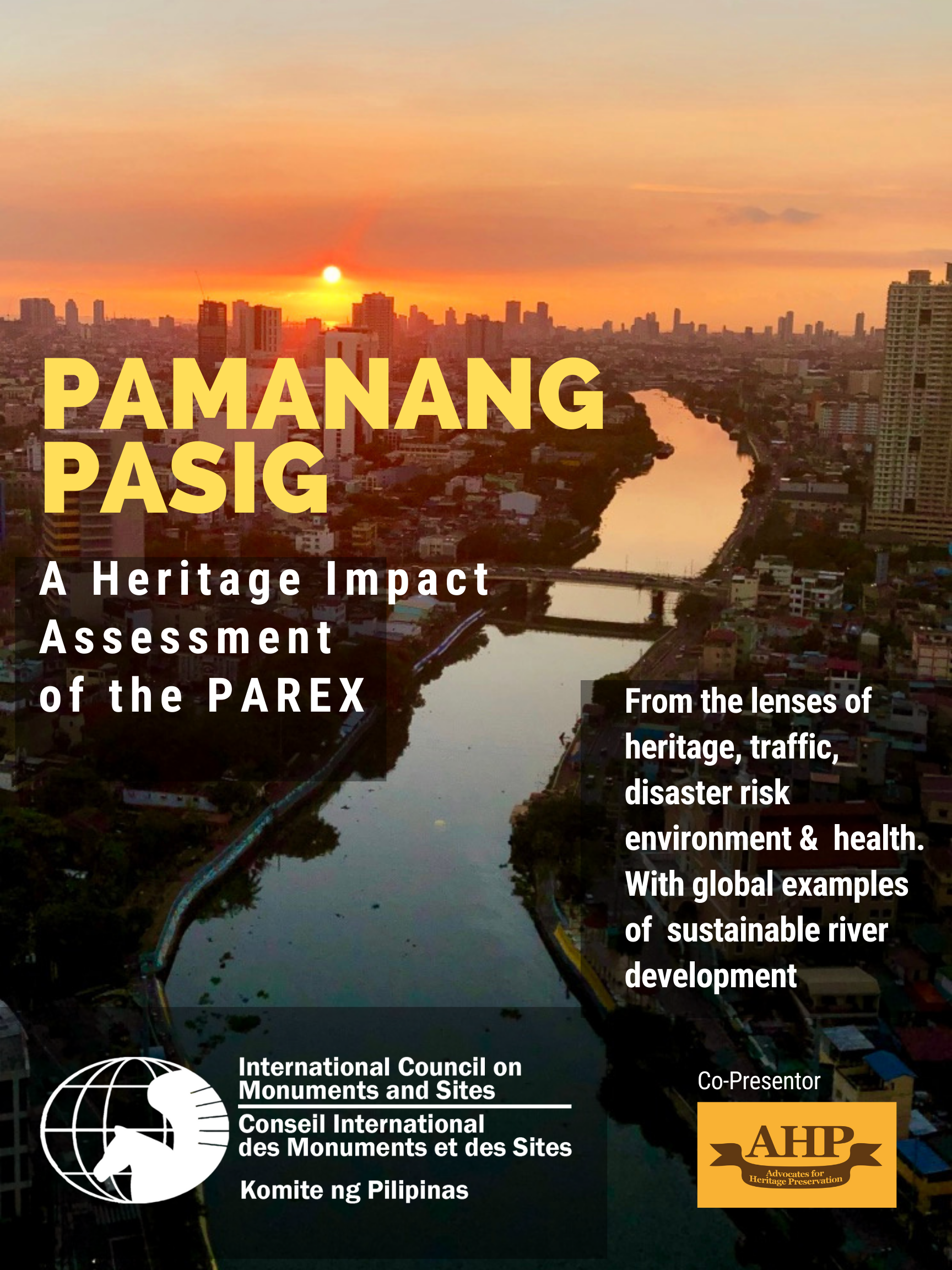
PAMANANG PASIG: A Heritage Impact Assessment of the PAREX

In September 2021, the Toll Regulatory Board (TRB) and San Miguel Corporation (SMC) signed the Supplemental Toll Operations Agreement (STOA) for the Pasig River Expressway (PAREX), a 19.37-kilometer six-lane, all elevated expressway over the Pasig River as a solution to Manila’s traffic problems.

The Pasig river, and the many  historic buildings along its banks are our heritage. The PAREX sacrifices our river heritage for benefits that are still unproven, and with impacts that are still unsubstantiated.

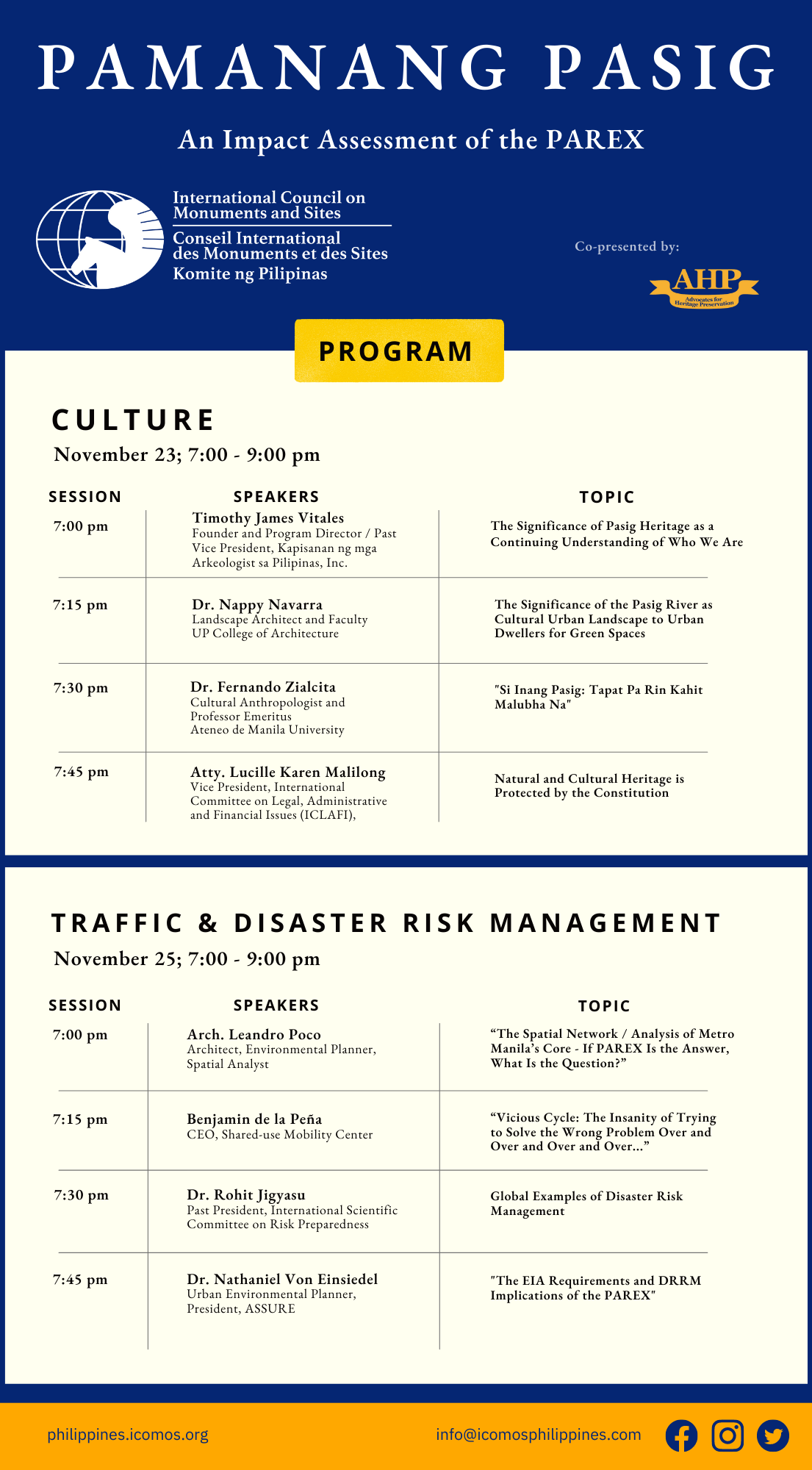
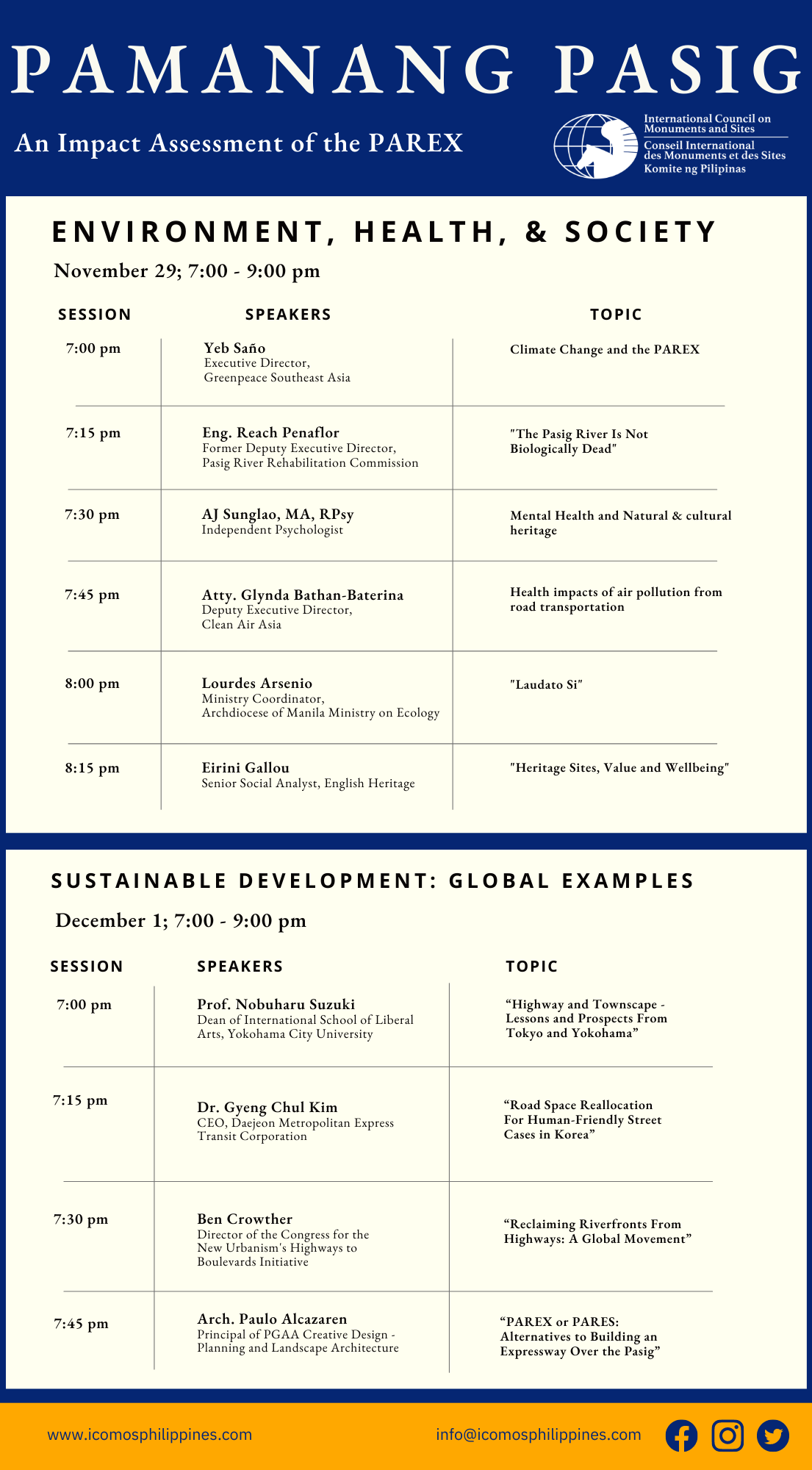
Pamanang Pasig  is a heritage impact assessment forum on the Pasig River and heritage buildings along its banks.   Experts  discuss the historical, aesthetic and social significance of the river  and the impact the Pasig River Expressway (PAREX) will have on these values. Experts will also discuss the Impact on traffic,  disaster risk management,  health, ecology, and society.  Global examples of freeways constructed over or along riverbanks,  now being torn down for more sustainable and people-centered alternatives, will be presented.  

The goal of this forum series is to enable a broader perspective on the PAREX. By  providing multidisciplinary and data-driven discussions by experts, we hope to invite more conversations and provide more facts for people to decide if this benefits our city.

Here is a statement that ICOMOS Philippines co-authored:

Register at: https://tinyurl.com/fb8zf4ym

Hosted by: ICOMOS Philippines

Facebook Page: https://www.facebook.com/icomosph

ICOMOS Philippines’ PAMANA 2030 – Press Release

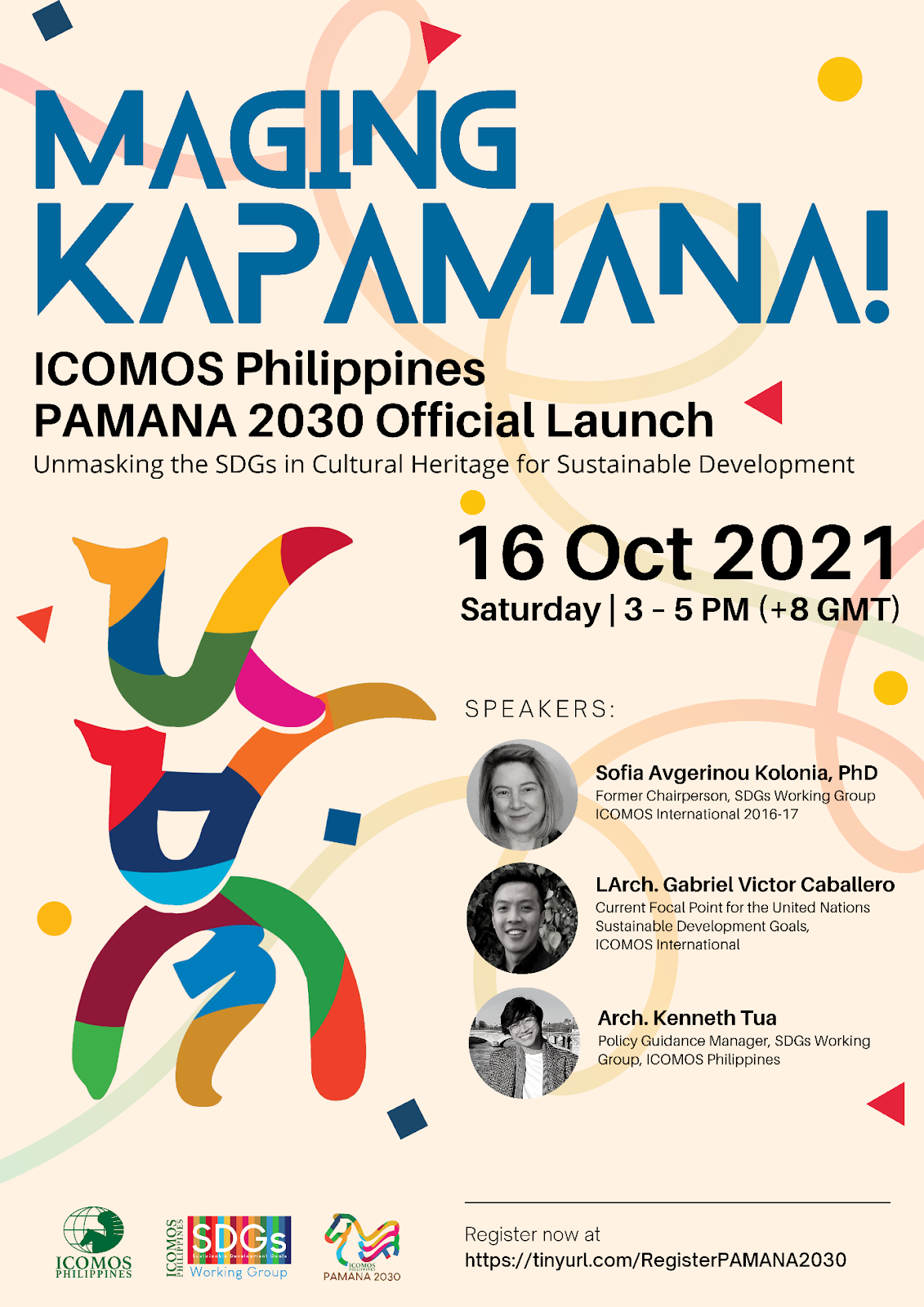
ICOMOS is participating at the ICOMOS Philippines – Sustainable Development Goals Working Group’s Campaign Launch for the Philippine Heritage and the 17 SDGs, “𝗣𝗔𝗠𝗔𝗡𝗔 𝟮𝟬𝟯𝟬: 𝗨𝗻𝗺𝗮𝘀𝗸𝗶𝗻𝗴 𝘁𝗵𝗲 𝗦𝗗𝗚𝘀 𝗶𝗻 𝗖𝘂𝗹𝘁𝘂𝗿𝗮𝗹 𝗛𝗲𝗿𝗶𝘁𝗮𝗴𝗲 𝗳𝗼𝗿 𝗦𝘂𝘀𝘁𝗮𝗶𝗻𝗮𝗯𝗹𝗲 𝗗𝗲𝘃𝗲𝗹𝗼𝗽𝗺𝗲𝗻𝘁”, with expert contributions as speakers to the online webinar. 

SDGsWG Philippines established the PAMANA 2030 together with ICOMOS Philippines as part of localizing the ICOMOS International Policy Guidance document for the SDGs to provide baseline information of the context of Philippine Heritage to support Local Government Units (LGUs) and to show that heritage can be a driver and enabler of inclusive, equitable, Sustainable Development.

𝗖𝗮𝗺𝗽𝗮𝗶𝗴𝗻 𝗹𝗮𝘂𝗻𝗰𝗵 𝗽𝗿𝗼𝗴𝗿𝗮𝗺𝗺𝗲

For the first time, ICOMOS Philippines will be localizing the United Nations’ 17 Sustainable Development Goals (SDGs) for the Philippine Heritage! Join Philippine Heritage practitioners & advocates, government officials / public servants, Local Government Units (LGUs), academicians, students, and other stakeholders across the Philippines for five presentations and speeches on 𝗢𝗰𝘁𝗼𝗯𝗲𝗿 𝟭𝟲, 𝟮𝟬𝟮𝟭, 𝗦𝗮𝘁𝘂𝗿𝗱𝗮𝘆, 𝟯 – 𝟱 𝗣𝗠 (+𝟴 𝗚𝗠𝗧) 𝗣𝗵𝗶𝗹𝗶𝗽𝗽𝗶𝗻𝗲 𝗧𝗶𝗺𝗲.

The presentations include the potentialities of the SDGs for Heritage, its inclusion in the United Nations Agenda 2030 and mobilization for the Decade of Action, and ICOMOS Philippines’ efforts in localizing the 17 SDGs for the Philippine Heritage.

The following ICOMOS members will present: Ms. Maria Cristina Paterno, MS, President and Board of Trustee of ICOMOS Philippines; Emeritus Prof. Arch. Sofia Avgerinou Kolonia, PhD, Former Chairperson of the Sustainable Development Goals Working Group (SDGWG) International 2016 – 2017; LArch’t. Gabriel Victor Caballero, MA WHS, Current Focal Point for the United Nations Sustainable Development Goals of ICOMOS International; and Arch’t. Kenneth J. Tua, UAP, MSc – MA DYCLAM+, MA CDIR, Task Team Coordinator, SDGWG Philippines. To be moderated by Dr. Laya Boquiren – Gonzales, PhD, Policy Guidance Task Team Member, SDGsWG Philippines.

With a keynote speech from Her Excellency Atty. Maria Leonor “Leni” Gerona Robredo, 14th and incumbent Vice President of the Philippines, Office of the Vice President of the Republic of the Philippines.

The campaign launch webinar is being held by ICOMOS Philippines and SDGWG Philippines. For more information, please like and follow the official campaign Facebook page and to register for the webinar, visit the link here: PAMANA 2030 Registration Form

Again, join us! Watch as the following advocates and experts invite you in the Campaign Launch: Ms. Maria Cristina PaternoArch’t. Dominic GaliciaArch’t. Gerard Lico, PhDDr. Boy AbundaMrs. Sarah Tua Geronimo – Guidicelli, Mr. Matteo Guidicelli and many more! Please ‘Like & Follow’ the PAMANA 2030 Facebook page!

New Intern: Rhizza Mae B. Comandante (September 2021)

Rhizza Mae B. Comandante is an undergraduate student from the Polytechnic University of the Philippines taking a Bachelor of Arts in History. She is a student and research assistant at the PUP Center of Human Rights and Studies. She is an active member of the PUP-Samahan ng mga Mag-aaral ng Kasaysayan, and an active deputy of the Kabataan Partylist, a youth partylist group in the Philippine congress.  Despite her numerous responsibilities outside the university, she is a consistent President’s and Dean’s Lister and a scholar of the Taguig City Government.

Her research interests focus primarily on (1) Local History; for the aspiration to give limelight to the collective struggles and experiences of the grass-root masses and Indigenous people, (2) Cultural Heritage; as she believes that the long-standing history of the people is reflected on their Cultural Heritage, and (3) Asian Studies; because she wanted to acquire an interdisciplinary understanding in studying the diverse culture and profound history of the Asian countries.

She joined the ICOMOS Philippines Internship Program because of the belief that this institution will help her achieve her utmost goal: to serve the Filipino people. As a scholar, she would like to amplify the voice of the Filipino masses and Indigenous communities by studying their remarkable history and culture, by contributing to the conservation of their Cultural Heritage and traditions, and lastly, by advocating that history must be accessible to the general public. Under the program, she hopes to create a significant contribution to the organization with the guidance of the ICOMOS Philippines mentors.

New Intern: Jake Advincula (August – October 2021)

Jake is a graduate student currently taking up MA Philippine Studies at the University of the Philippines Asian Center. Having graduated BS Communications Technology Management from the Ateneo de Manila University, he is passionate about how marketing, design, and heritage all intersect and inform the Philippine cultural identity. 

With ICOMOS, he hopes that his internship will deepen his understanding of heritage work in the country, as well as provide him an opportunity to contribute. He believes that heritage is an important part of realizing and appreciating who we are as Filipinos.

New Intern: Novo Mickey M. Mitra (September 2021)

C:\Users\PC4\Desktop\242502457_191758816316232_7883639439883519345_n.png

Novo Mickey M. Mitra is an undergraduate student from the Polytechnic University of the Philippines-Manila studying Bachelor of Arts in History. She is an active officer of the student organization of the Department of History PUP ‘Samahan ng mga Mag-aaral ng Kasaysayan’ as a year-level representative. Aside from school, she is an active officer and a member of a community organization ‘Rotaract Club of Culiat’ as Professional Service Director. She’s a consistent President’s Lister and a scholar. 

She joined a month Internship with ICOMOS Philippines because of her interest in studying culture in Traditions of the Philippines as well as Military History and the ruins that wars left in the soil of the Philippines. She believes that there is a world beyond books that she wants to discover in order to understand the diversified communities, their stories and their significance to each other. Like her program History, Heritage studies become closer to her heart as she met and read about the Indigenous People and their struggles about keeping their culture and Heritage in modern days and ICOMOS Philippines is one of the most powerful places to empower such ambition. She hopes to learn new things and knowledge outside her current program and contribute to the ICOMOS.