
๐—จ๐—ก๐—˜๐—ฆ๐—–๐—ขโ€™๐˜€ ๐—™๐—ถ๐—ฟ๐˜€๐˜ ๐—›๐—ฒ๐—ฟ๐—ถ๐˜๐—ฎ๐—ด๐—ฒ ๐—˜๐—บ๐—ฒ๐—ฟ๐—ด๐—ฒ๐—ป๐—ฐ๐˜† ๐—™๐˜‚๐—ป๐—ฑ (๐—›๐—˜๐—™) ๐—ฃ๐—ฟ๐—ผ๐—ท๐—ฒ๐—ฐ๐˜ ๐—ถ๐—ป ๐˜๐—ต๐—ฒ ๐—ฃ๐—ต๐—ถ๐—น๐—ถ๐—ฝ๐—ฝ๐—ถ๐—ป๐—ฒ๐˜€: ๐—ข๐—ณ๐—ณ๐—ถ๐—ฐ๐—ถ๐—ฎ๐—น ๐—ฃ๐˜‚๐—ฏ๐—น๐—ถ๐—ฐ๐—ฎ๐˜๐—ถ๐—ผ๐—ป

MANILA, Philippines — After the initial report on the damage assessment of the World Heritage Site of the Historic City of Vigan [Post-Earthquake Damage Assessment of Vernacular Building in the World Heritage City of Vigan [PEDAVBV],โ€ UNESCO granted a Heritage Emergency Fund (HEF) for the Post-Earthquake Technical Enhancement of Standards for the Conservation and Protection of Ancestral Vernacular Houses of Vigan that was officially launched on September 14, 2023.

EXECUTIVE SUMMARY (11.3 MB)

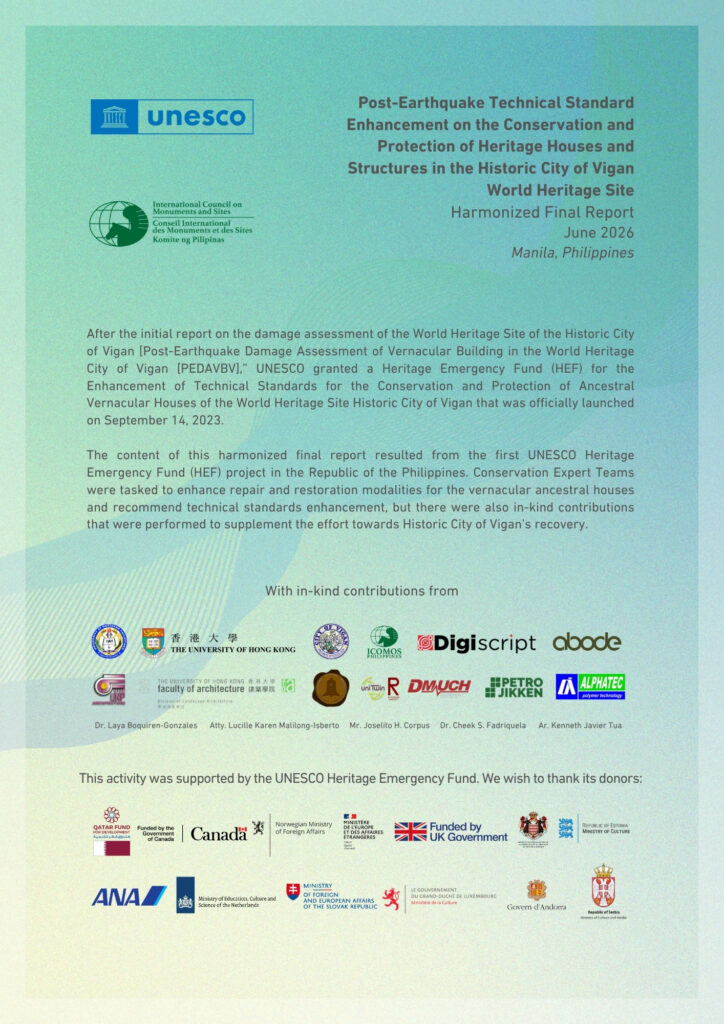
The content of this report resulted from the first Heritage Emergency Fund project in the Philippines. Conservation Expert Teams were tasked to enhance repair and restoration modalities for the vernacular ancestral houses and recommend technical standards enhancement, and there were also in-kind contributions that were performed to supplement the effort towards Viganโ€™s recovery.

DOWNLOAD THE FULL REPORT HERE. (981.7 MB)

To access the chapter report please download each file below.

Chapter 1 of the report is called โ€œFirst UNESCO Heritage Emergency Fund (HEF) Project in the Philippines.โ€ This section explains the objectives of the report, presenting the general introduction of the assignment as well as scope and project delimitations. It contains the strategic project framework on awareness raising, knowledge sharing, and collective application.

It also presents the stakeholders involved – the project management teams and expert teamsโ€™ delegation, organizational chart, calendar, and a chronological timeline of activities and milestones achieved.

DOWNLOAD CHAPTER 1 HERE. (8.3 MB)

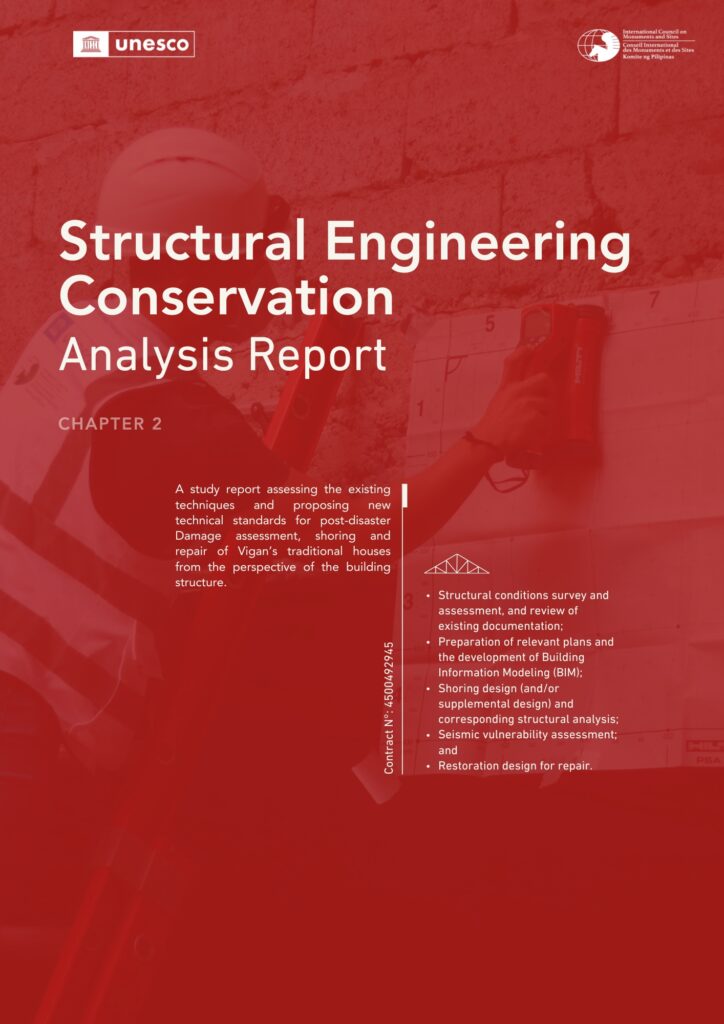
Chapter 2 is the analytical report of the Structural engineering Conservation. This assessment included performing a comprehensive structural investigation, including material testing and characterization, evaluating the structure, and proposing a restoration design based on the evaluation results and conservation principles. Using the results of the assessment, strengthening measures and repair are proposed.

Moreover, the assessment addresses structural safety concerns for damaged areas by providing a shoring design.

DOWNLOAD CHAPTER 2 HERE. (43.6 MB)

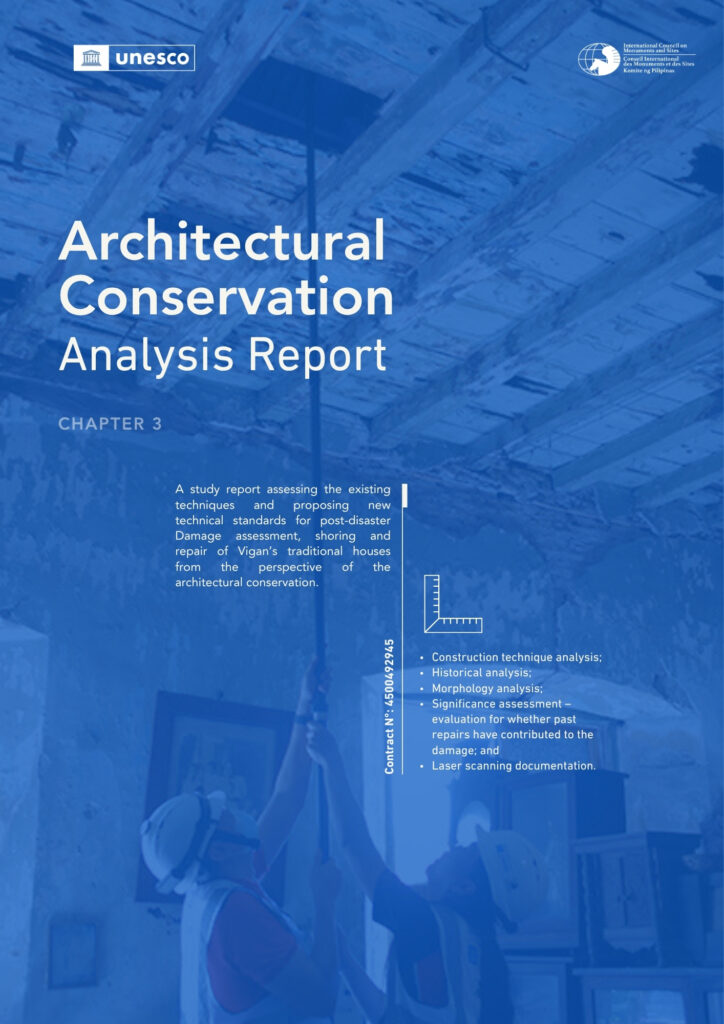
Chapter 3 of this report documents the Architectural Conservation Analytical Report. Highlights of this section of the report are the morphological analysis of the two pilot sites. Utilizing remnant design features, and architectural and structural components, the Architectural Conservation Team was able to forensically reconstruct the evolution of the two houses: its materials, design, and construction techniques.

Comparatively, this analysis considers the typologies of Filipino houses termed Bahay na Bato to the versions found in Vigan. This study also aims to analyze the kinship networks and ownership of these houses and how that affected their massing, form, function, and use.

DOWNLOAD CHAPTER 3 HERE. (165 MB)

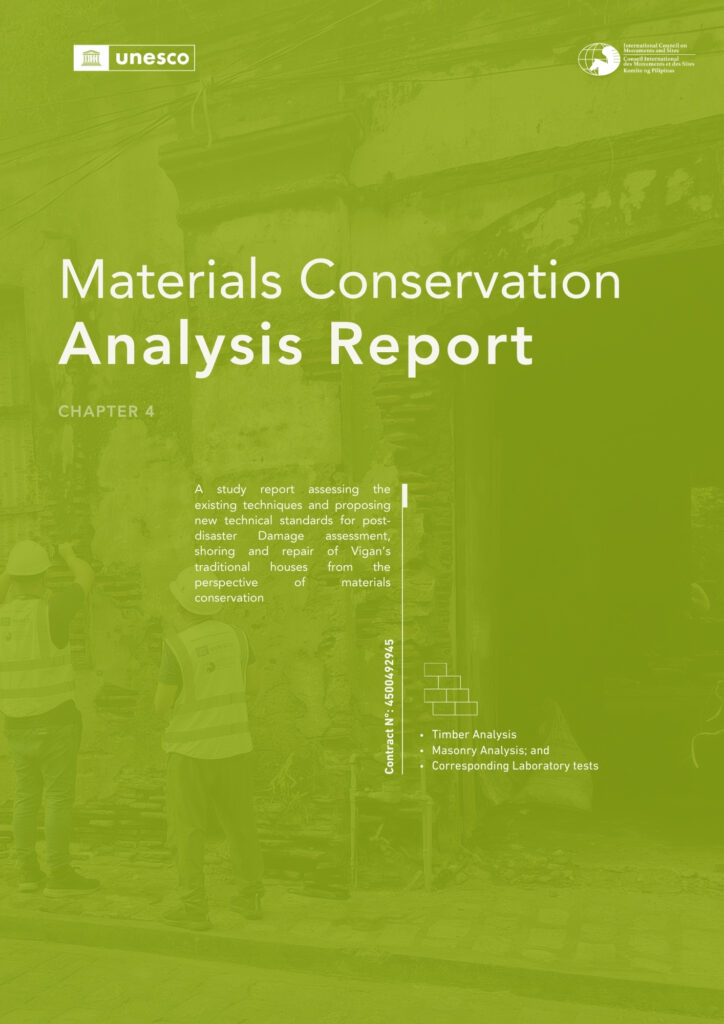
Chapter 4 details the analytical report on the Materials Conservation investigation of two ancestral houses, emphasizing the importance of studying construction materials for effective restoration. This ensures compatibility, minimal intervention, and reversibility while respecting original materials and ensuring security, protection, and disaster risk management.

Understanding materials helps conservators find suitable replacements. Specialists in timber and masonry conservation, along with a forester, a materials scientist, and a chemist, began their studies in October 2023, and this report presents the results from their onsite visits and lab tests.

DOWNLOAD CHAPTER 4 HERE. (213.6 MB)

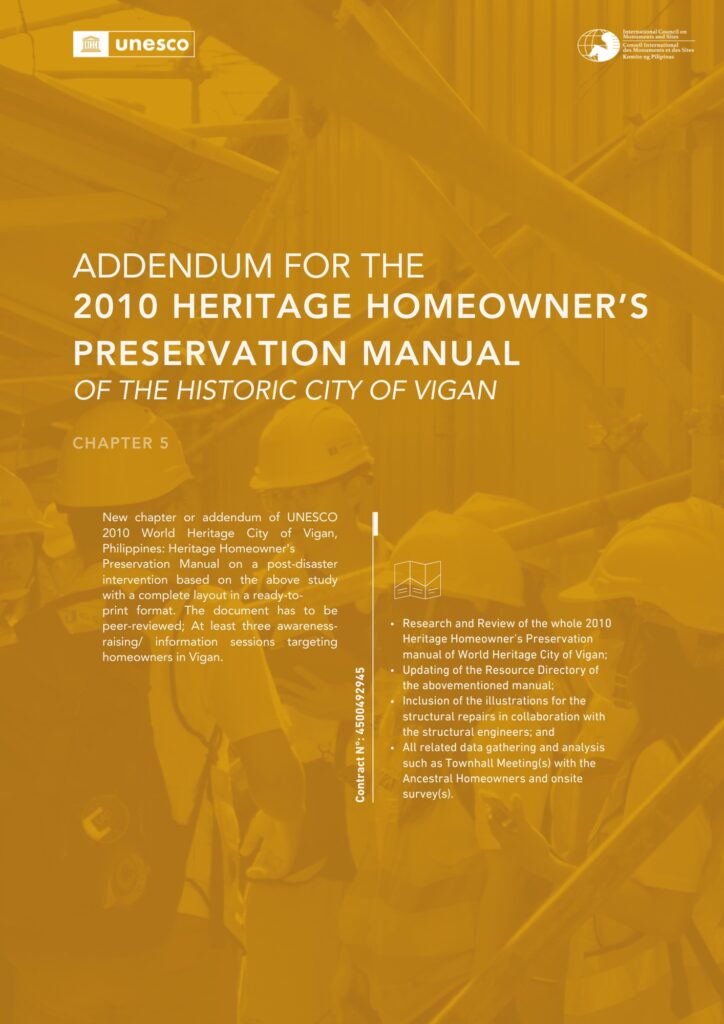
Chapter 5 outlines the addendum for the Heritage Homeownerโ€™s Manual of the Historic City of Vigan. This update incorporates suggested technical standards, assessment findings, and the assigned teamโ€™s research methodologies. To gather more data for the manual, team leader Dr. Fatima Nicetas Alonzo co-led a project with Dr. Linda Shetabi and Ms Michelle Chelsea Ho from The University of Hong Kong (HKU),

where local team members and 21 faculty facilitators from the University of Northern Philippines (UNP) guided 104 students grouped in 15 teams in documenting 15 heritage structures damaged in the July 27, 2022 earthquake.

DOWNLOAD CHAPTER 5 HERE. (42.5 MB)

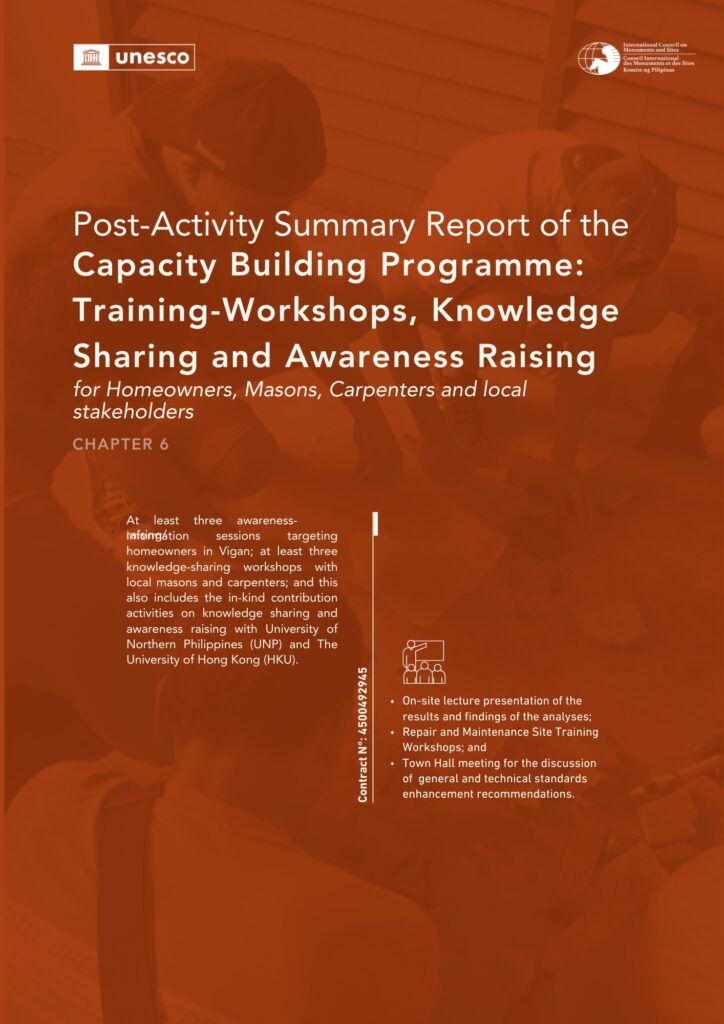
Chapter 6 details the Capacity Building Program and Awareness Raising activities that took place on March 11 – 13, 2024 in Vigan, organized by the Pontifical and Royal University of Santo Tomas Graduate School – Center for Conservation of Cultural Property and Environment in the Tropics (USTGS-CCCPET), the Training-Workshop Team of the project. As part of this report is a letter to UNESCO Jakarta that details activities until May 2024;

this is a summary of all the lectures, workshops, programs, and discussions which includes outputs, insights, and recommendations.  This section has the following content: project title, technical details, description of activities, highlights, issues and recommendations/ideas, program brochures, and master list of participants with gender disaggregation and affiliation. As part of the project programming, the Local Manual Review (HCLMRE) Team organized a Town Hall Meeting with local stakeholders and homeowners at Tadena Hall, UNP. Furthermore, the USTGS-CCCPET held a series of lectures and training workshops on Vigan as a World Heritage Site which covered Vigan’s history, design, building materials, hazard vulnerabilities, and conservation strategies. Workshops by Master Mason Shiela Soliveres and Master Carpenter Elvin Alexon Ferrer at the Vigan Conservation Complex, provided by the local government, taught local participants like homeowners, contractors, and craftsmen how to handle traditional materials used in Vigan. These activities helped participants understand the conservation process and gain practical skills for conserving the heritage site.

DOWNLOAD CHAPTER 6 HERE. (20.8 MB)

Chapter 7 is a Disaster Risk Management Plan for Culture Heritage (HDRM) for Vigan. A disaster risk management plan for Vigan focuses on protecting and preserving the site against natural and human-made hazards. This plan includes assessing vulnerabilities, implementing early warning systems, and developing emergency response protocols to ensure rapid and effective action during disasters.

It also involves training local communities and stakeholders in disaster preparedness, conducting regular drills, and integrating traditional knowledge with modern techniques for site conservation. Additionally, the plan emphasizes the importance of collaboration with government agencies, non-governmental organizations, and international bodies to secure resources and support for ongoing risk reduction and recovery efforts.

DOWNLOAD CHAPTER 7 HERE. (45.2 MB)

Chapter 8 is a summation of the major project documentation and visibility outputs. Major project documentation and visibility outputs include detailed reports, visual records, and public presentations showcasing the project’s progress and results. These outputs ensure transparency and accountability, featuring comprehensive assessments, photographs, and videos of key activities.

Public exhibitions such as those tied with the closing ceremonies, press releases, and social media updates helped increase awareness and engagement among stakeholders and the wider community.

DOWNLOAD CHAPTER 8 HERE. (27.3 MB)

Chapter 9 reports donations or in-kind contributions for the HEF VIgan Project. In-kind contributions provided valuable resources and services without monetary exchange, significantly aiding projects and initiatives. For the UNESCO Emergency Fund, in-kind contributions from individuals, organizations, and partners were crucial in the recovery of Vigan after the earthquake.

These contributions varied and included investigation, expertise, lectures, and workshops, among others, which were essential towards the restoration and preservation efforts in Vigan. By supplying professional services, and volunteer work, these in-kind contributions augmented the projectโ€™s outputs, paving the way towards a more efficient recovery process. Their importance cannot be overstated, as they not only filled funding gaps but also fostered community involvement and ownership, ensuring that the conservation efforts were both comprehensive and sustainable.

DOWNLOAD CHAPTER 9 HERE. (7.5 MB)

Chapter 10: Closing Ceremony Summary Report. This portion of the report includes the summary of  the closing ceremony activities that took place at Tadena Hall at the University of Northern Philippines at the World Heritage Site of the Historic City of Vigan on August 12, 2024. This momentous event provided the opportunity for all stakeholders, participants, and in-kind contributors to the HEF Vigan Project to celebrate its milestones and accomplishments in person and online in a hybrid session.

Eighty persons composed of homeowners, masons, carpenters, local and national government, in-kind contributors, partners, the academe, and the HEF team attended the ceremony. Individuals or representatives of organizations were asked to give a few words about the projectโ€™s impact and significance. The conclusion of the project marks the shared commitment to conserving the cultural heritage of Vigan. However, this event does not conclude the activities for the recovery of Vigan; from the HEF Vigan Project, testing and investigations and recommendations are available for use to rehabilitate damaged buildings still remaining.

DOWNLOAD CHAPTER 10 HERE. (20.2 MB)

Chapter 11 describes the initial project funded by the UNESCO Heritage Emergency Fund in the Philippines that had a clear goal: to enhance the conservation efforts for Vigan’s historic houses following an earthquake. With UNESCO Jakarta and ICOMOS Philippines at the helm, the project aimed to support Vigan’s recovery journey.

Experts from ICOMOS Philippines used a comprehensive set of principles and developed recommendations to improve technical standards and bolster the country’s preparedness for future disasters. These guidelines are designed to be flexible, catering to the specific needs of each heritage site. The overarching aim is to elevate conservation practices nationwide, ensuring a sustainable approach to preserving our cultural treasures for generations to come.
DOWNLOAD CHAPTER 11 HERE. (13.8 MB)

The last chapter of the report, Chapter 12, shares the Key Achievements and Milestones of the First UNESCO Heritage Emergency Fund Project in the Philippines. This chapter brings all of the activities together describing in detail the impact that the project had on the recovery of Vigan. Topics include mobilization of diverse, gender-sensitive, and intergenerational Expert Teams,

Technical Assessment and Conservation Standards Enhancement, enabling stakeholders through Capacity Building and Knowledge Sharing, Knowledge Sharing: Awareness-Raising towards Coalition Building and Collective Application, and centering Heritage as a Public Good to raise In-kind Contributions. A discussion of challenges and prospects for future emergency and related projects follows with an analysis of strengths, weaknesses, threats, and opportunities. Lastly in the third section, desirable outcomes and outputs on disaster risk management and post-crisis recovery are presented, reflecting on implementation of the fund – and how to bring continued recovery activities for the future.

DOWNLOAD CHAPTER 12 HERE. (9 MB)

In conclusion, the initiatives undertaken in response to the damage assessment of the Historic City of Vigan, supported by the UNESCO Heritage Emergency Fund, signify a significant step towards preserving and safeguarding cultural heritage in the Philippines. Despite inherent limitations and challenges, including governmental constraints and funding disparities, the project has created a multidisciplinary approach to conservation, encompassing structural, architectural, and materials assessments.

Furthermore, the integration of in-kind contributions and capacity-building lectures and workshops underscores the importance of community engagement and knowledge dissemination in ensuring the sustainability of conservation efforts.

Ultimately, the comprehensive achievements outlined in this report reflect a concerted commitment to enhancing conservation practices, reaffirming the significance of heritage as a collective endeavor for the benefit of future generations.

To read more, click the image to download.

Tabang Cebu:ย 

ICOMOS/ICORPโ€™s Post-Disaster Recovery Steps Towards the Reconstruction of Santa Rosa de Lima Parish, Daanbantayan, Cebu

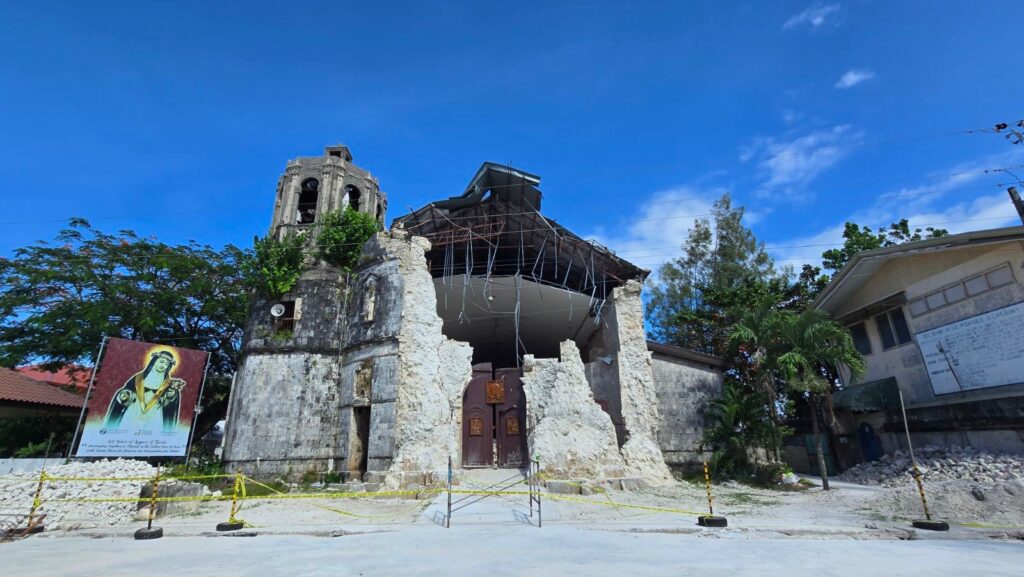
Cleared Facade of Santa Rosa de Lima Parish Church, Daanbantayan, Cebu (Source: Father B. Brigoli, Archdiocese of Cebu)

On 30 September 2025, a new fault line was discovered in the northern reaches of Cebu province.  In recorded history, there had been no earthquakes in this area until the Bogo fault caused a 7.3. mW earthquake. In its wake, heritage churches were toppled, housing damaged  and infrastructure was heavily compromised. This caused the closure of churches, most especially the parish church of Santa Rosa de Lima in Daanbantayan. At this church, the unreinforced masonry structureโ€™s primary facade crumbled with the energy of the quake. Not only did the initial quake cause considerable destruction but subsequent aftershocks loosened the stone cladding on the belfry. 

The initial team to assess the damage at Daanbantayan was from the University of San Carlosโ€™ College of Architecture and College of Engineering immediately after the quake and deployed for October 4th and 5th, 2025. The rapid visual survey was completed at three churches. The result was a characterization of the destruction, overturning of the roof and walls which were qualified and quantified. 

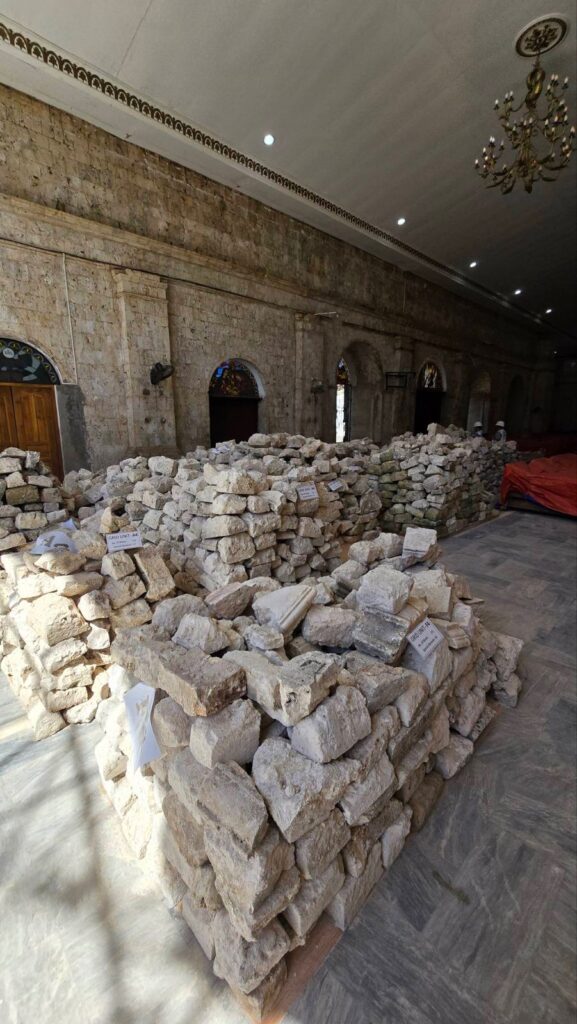
However, the debris at Daanbantayan needed clearance to get an accurate portrait of the complete destruction that may have been hidden. WIth the direction of archaeologist Archie Tiauzon, salvage and debris clearance was accomplished using a grid system to understand where the stones fell in relation to the structure. This act of sorting and segregation will help reconstruct the church with sound materials that survived, and with the recovery, the approximate original placement of masonry stone units.

Segregation and Storage of Fallen Stones from Primary Facade (Source: Father B. Brigoli, Archdiocese of Cebu)

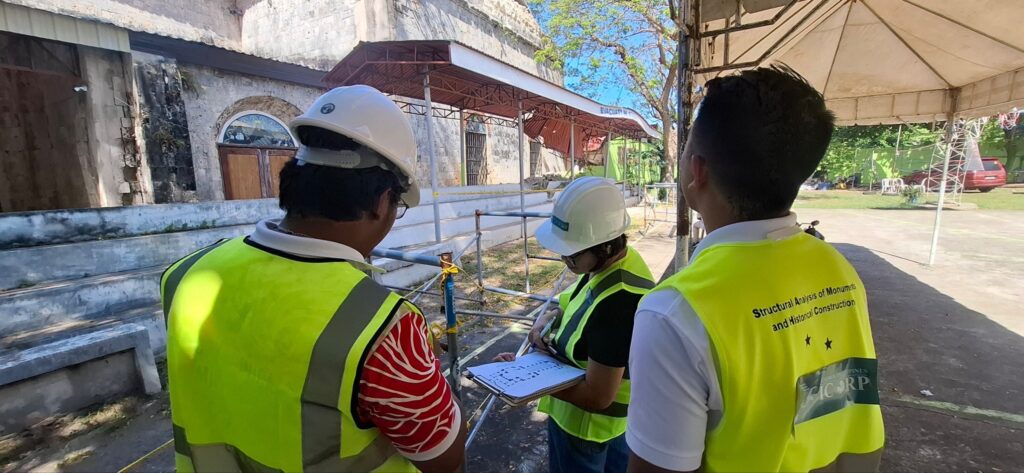
At Daanbantyan, from Sunday March 15ย  to Tuesday March 17, 2026, ICOMOS/ICORP’s head Mr. JH Corpus, upon Board approval, activated members conservation structural Engineers Team Leader Mary Grace Casuncad and Joaquin Ramos and conservation architects Ronald Allan Mabunga, Jr. and Carmencita Solis as well as Ar. Vangie Ulila from University of San Carlos, representing CHERISH joined the effort. All documentation will be processed by conservation architect Timothy Augustus Ong, who is providing support for the effort from Manila.ย 

Conservation Architects Ronald J. Magumba and Architect Carmen Solis are joined by a local architect from Daanbantayan (Source: Tabang Cebu Team)

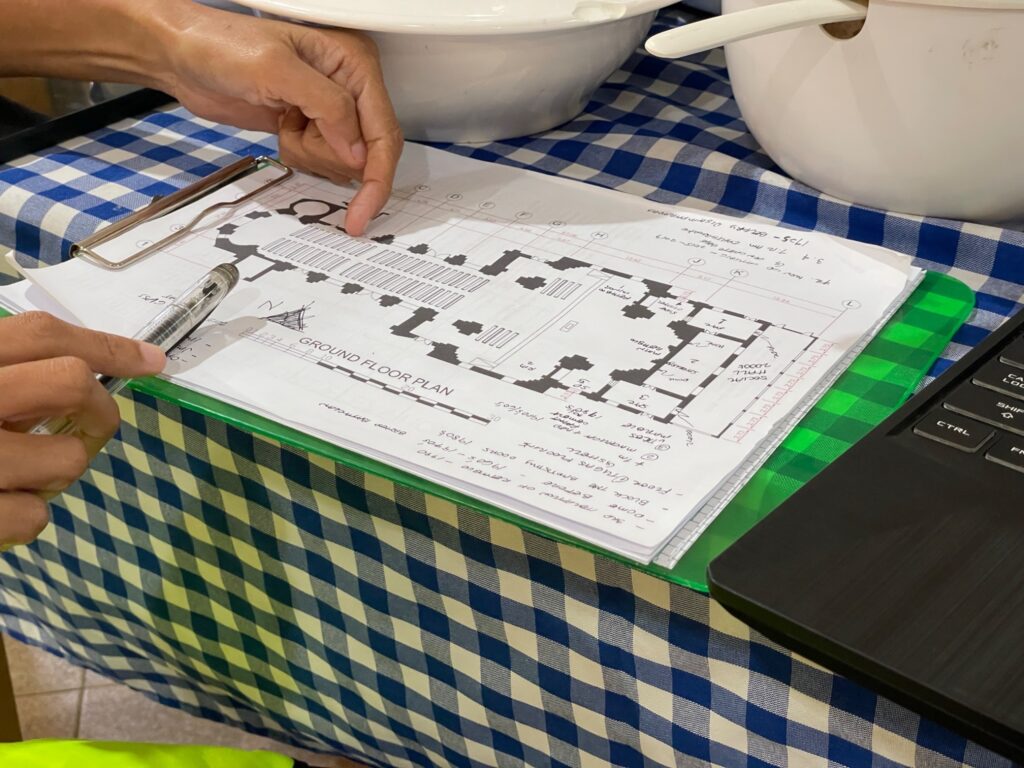
Scaled drawings of Daanbantayan (Source: Tabang Cebu Team)

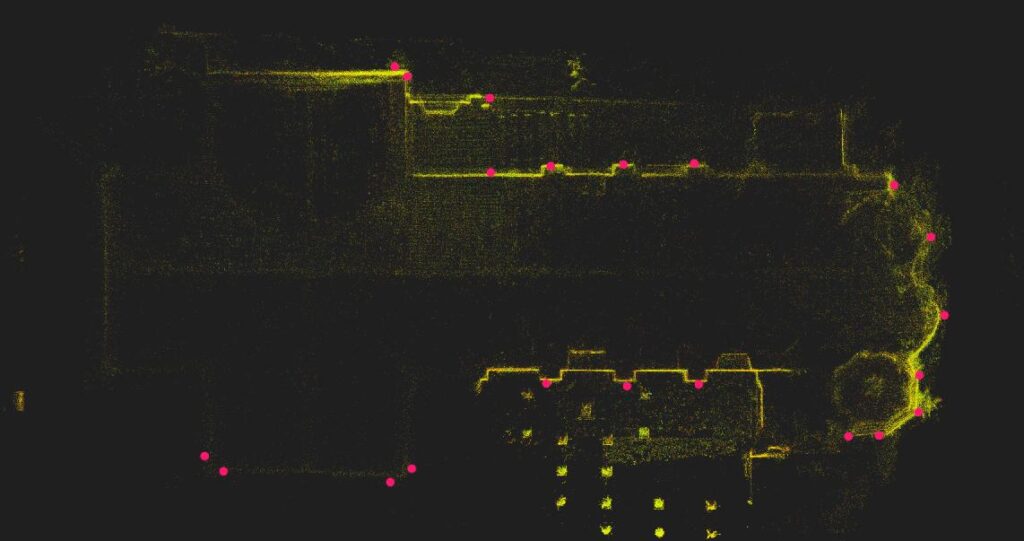
With the instruction of Ar. Timothy Augustus Ong, the team on the ground are employing technologies that provide an accurate depiction of the church; drones are being flown around the church with control points on the surfaces of the walls. Interiors are covered by dSLR cameras which yield high resolution photos and will be stitched together to form a complete picture of the interiors.

Partial Point Cloud of Daanbantayan Church with Ground Control Points Defined

This important phase of documentation will allow both teams to further study the building so that recommendations are based on evidence and will yield an initial cost estimate for the churchโ€™s reconstruction. Also out of this plan will come a timeline for stabilization and eventual reconstruction. 

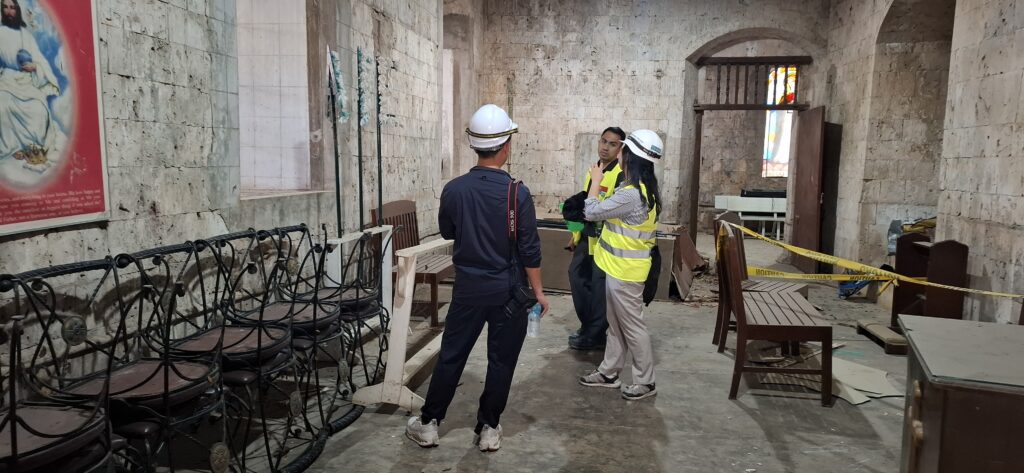
For this step in the restoration of the church, the conservation engineers and architects are documenting with drone footage and by dSLR the current conditions of the church in order to stabilize the structure and shore the damaged structural and architectural elements.

ICORP Philippines Activated (Source: Tabang Cebu Team)

ICOMOS/ICORP extends its sincere gratitude to Reverend Father Brigoli for his trust and confidence in the organization to assist in the recovery of St. Rose of Lima Parish Church, reflecting a shared commitment to safeguarding the cultural and spiritual heritage entrusted to this historic church and its community.

This effort by ICOMOS/ICORP is dedicated to the parishioners of Daanbantayan, whose faith and stewardship continue to sustain the heritage of their community. The mission was made possible through the support of ICOMOS/ICORP, including funds provided by ICORP to assist the team in undertaking the work. It was further made possible through the generosity and cooperation of Reverend Father Brian C. Brigoli, Chairman of the Archdiocesan Commission on Cultural Heritage of the Church of Cebu, who ensured that the team could travel to and remain near the site in order to carry out the work.

ICOMOS Philippines Completes Heritage Project in Vigan

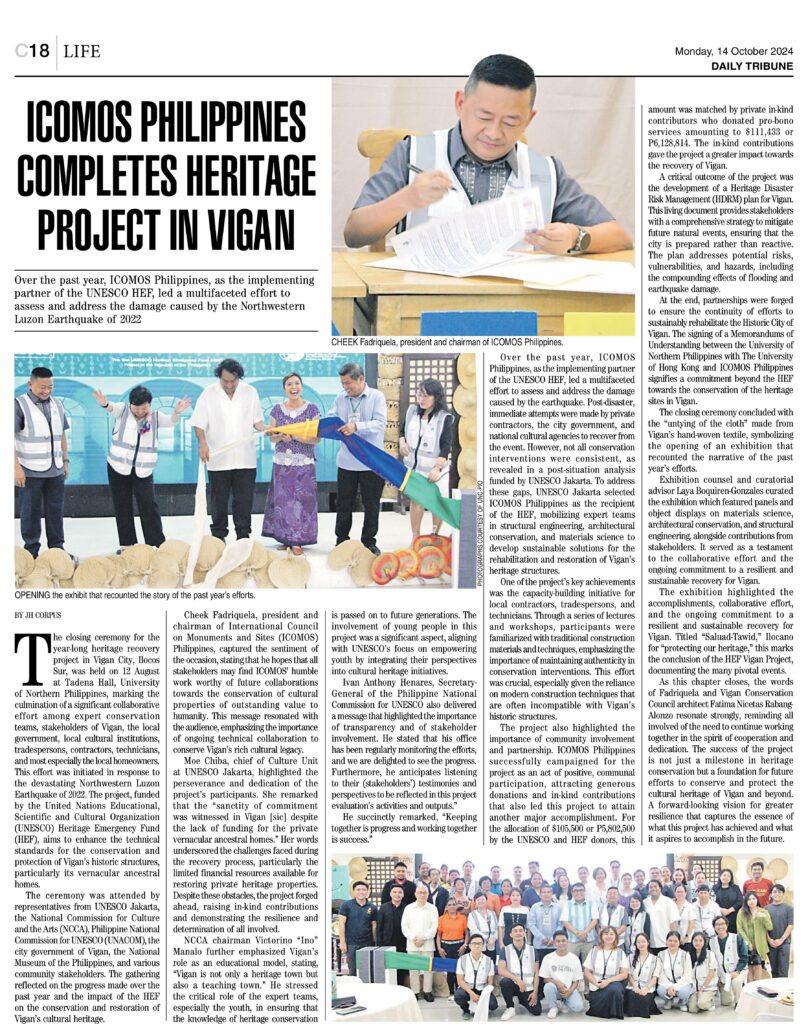
On August 12, 2024, the closing ceremony for the year-long heritage recovery project in Vigan was held at Tadena Hall, University of Northern Philippines. This event marked the culmination of a significant collaborative effort between the expert conservation teams, stakeholders of Vigan, the local government, local cultural institutions, tradespersons, contractors, technicians, and most especially the local homeowners, which was initiated in response to the devastating Northwestern Luzon Earthquake of 2022. The project, funded by the United Nations Educational, Scientific and Cultural Organization (UNESCO) Heritage Emergency Fund (HEF), aimed to enhance the technical standards for the conservation and protection of Viganโ€™s historic structures, particularly its vernacular ancestral homes.

One of the projectโ€™s key achievements was the capacity-building initiative for local contractors, tradespersons, and technicians. Through a series of lectures and workshops, participants were familiarized with traditional construction materials and techniques, emphasizing the importance of maintaining authenticity in conservation interventions. This effort was crucial, especially given the reliance on modern construction techniques that are often incompatible with Viganโ€™s historic structures.

The project also highlighted the importance of community involvement and partnership. ICOMOS Philippines successfully campaigned for the project as an act of positive, communal participation, attracting generous donations and in-kind contributions that also led this project to attain another major accomplishment. For the allocation of $105,500 or โ‚ฑ 5,802,500 by the UNESCO and HEF donors, this amount was matched by private in-kind contributors who donated pro-bono services amounting to $111,433 or โ‚ฑ 6,128,814. The in-kind contributions gave the project a greater impact towards the recovery of Vigan.

The success of the project is not just a milestone in heritage conservation but a foundation for future efforts to conserve and protect the cultural heritage of Vigan and beyond. A forward-looking vision for greater resilience that captures the essence of what this project has achieved and what it aspires to accomplish in the future.

Please see the article in the The Daily Tribune. Read here โžก๏ธ https://bitly.cx/aR60.

This activity was supported by the UNESCO Heritage Emergency Fund. We wish to thank its donors: the Qatar Fund for Development, the Government of Canada, the Kingdom of Norway, the French Republic, the United Kingdom, the Principality of Monaco, the Republic of Estonia, ANA Holdings INC, the Kingdom of the Netherlands, the Slovak Republic, the Grand Duchy of Luxembourg, the Principality of Andorra, the Republic of Serbia.

For more information on ICOMOS Philippines โžก๏ธ https://philippines.icomos.org/

#UNESCO #unescoJAKARTA #ICOMOS #icomosPHILIPPINES #HeritageEmergencyFund #firstHEF #WorldHeritageSite #HistoricCityofVigan #PhilippineHeritage #SustainableHeritageManagement #ProtectHeritage

ICOMOS Philippines Takes Part in the 2024 National Conference on Local History and Heritage

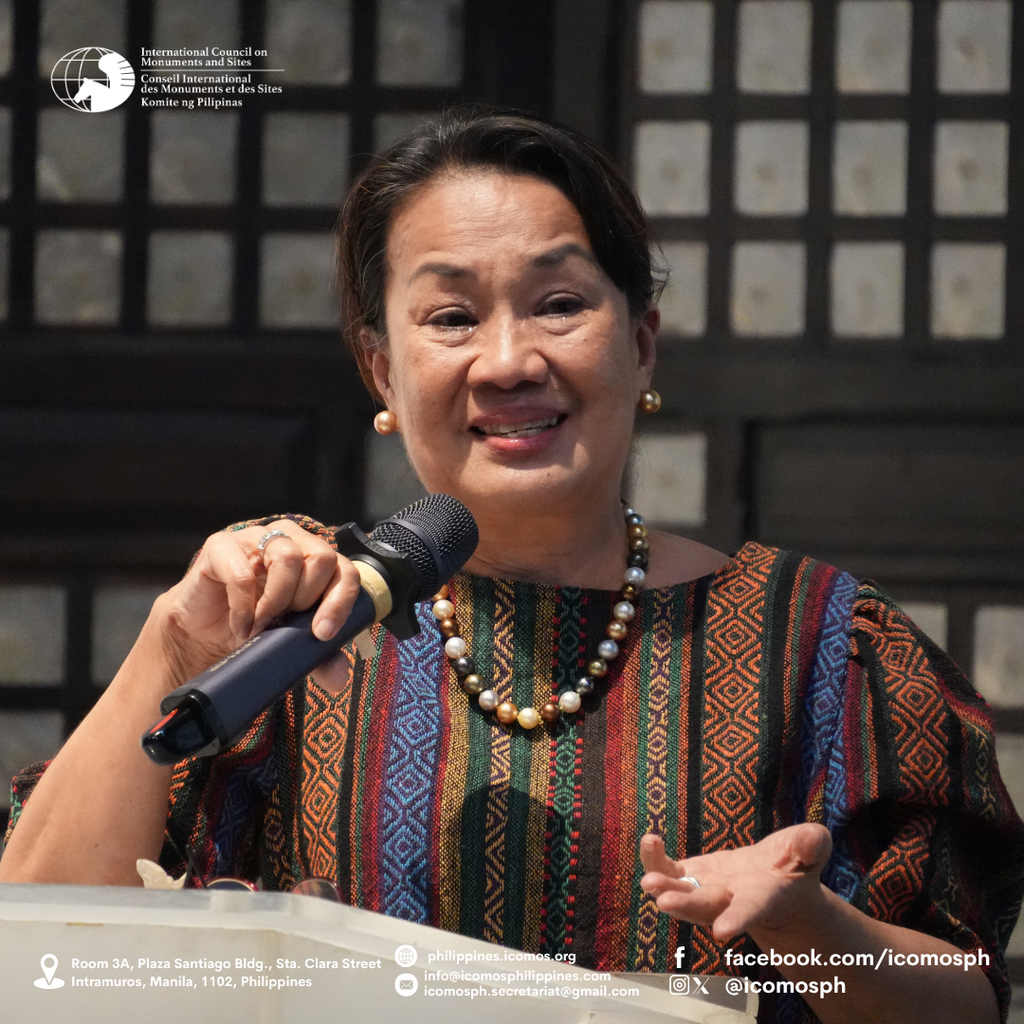
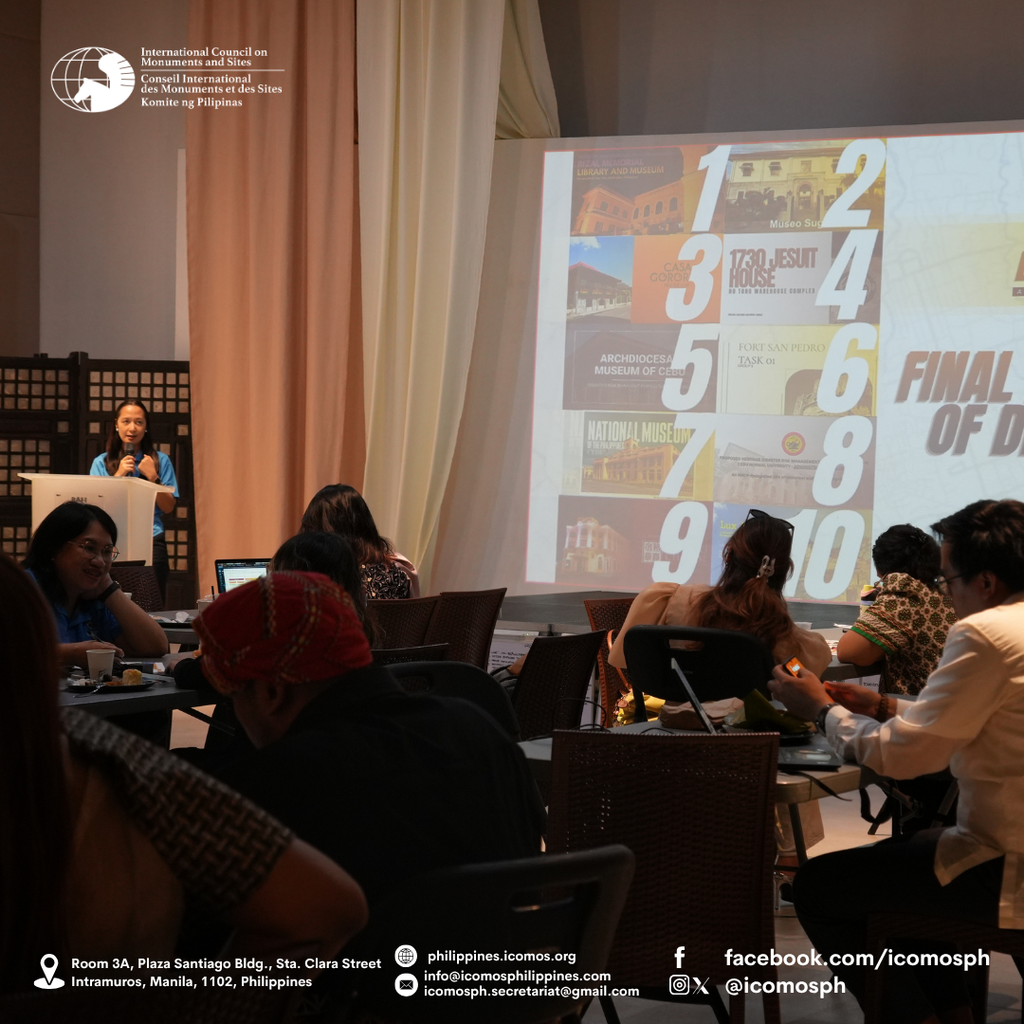
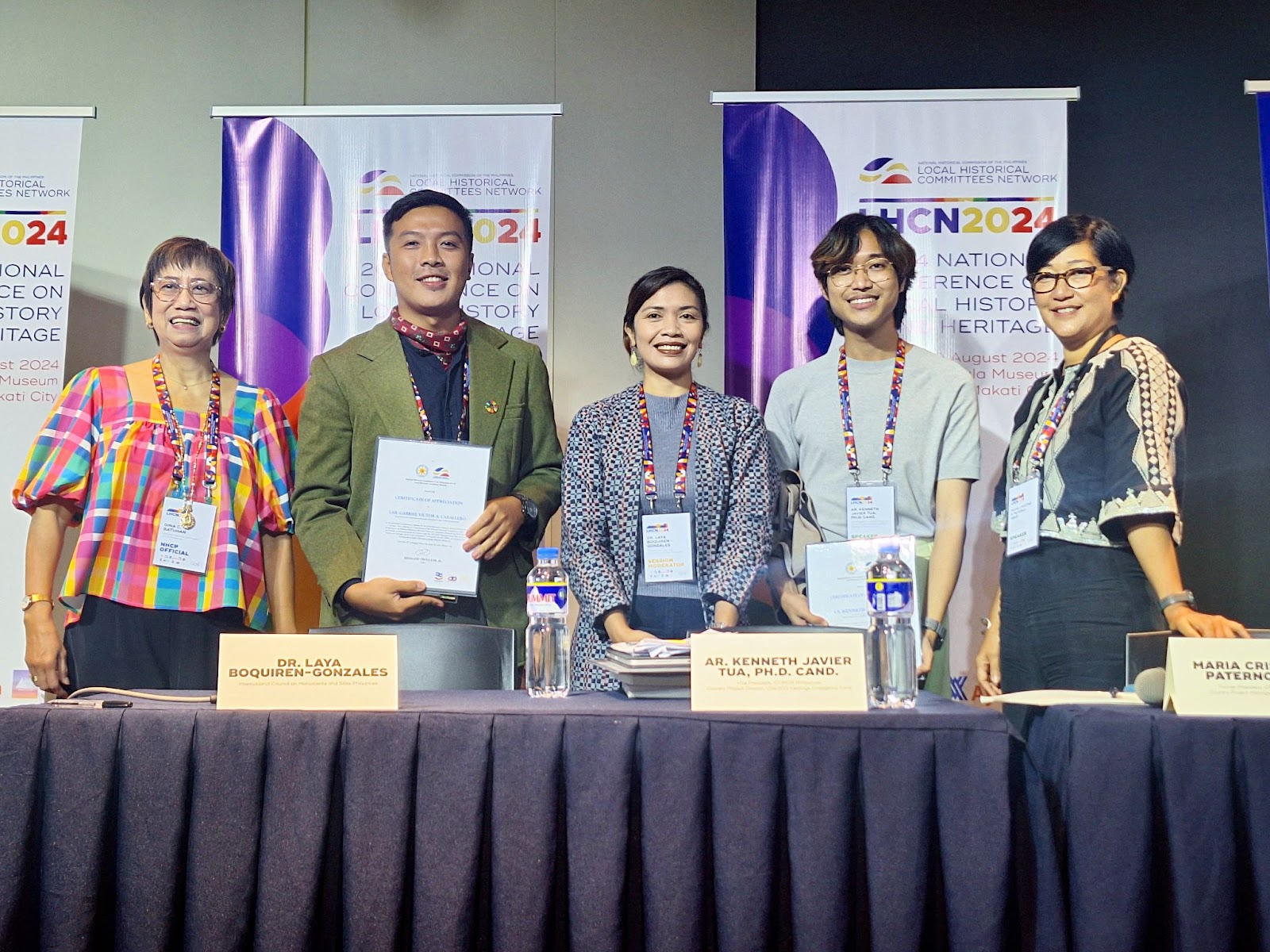
Dr. Laya Boquiren-Gonzales stirred the discussion with onsite participants. She moderated the open forum of the panel taking in questions from the diverse audience composed of other cultural workers and local heritage advocates.

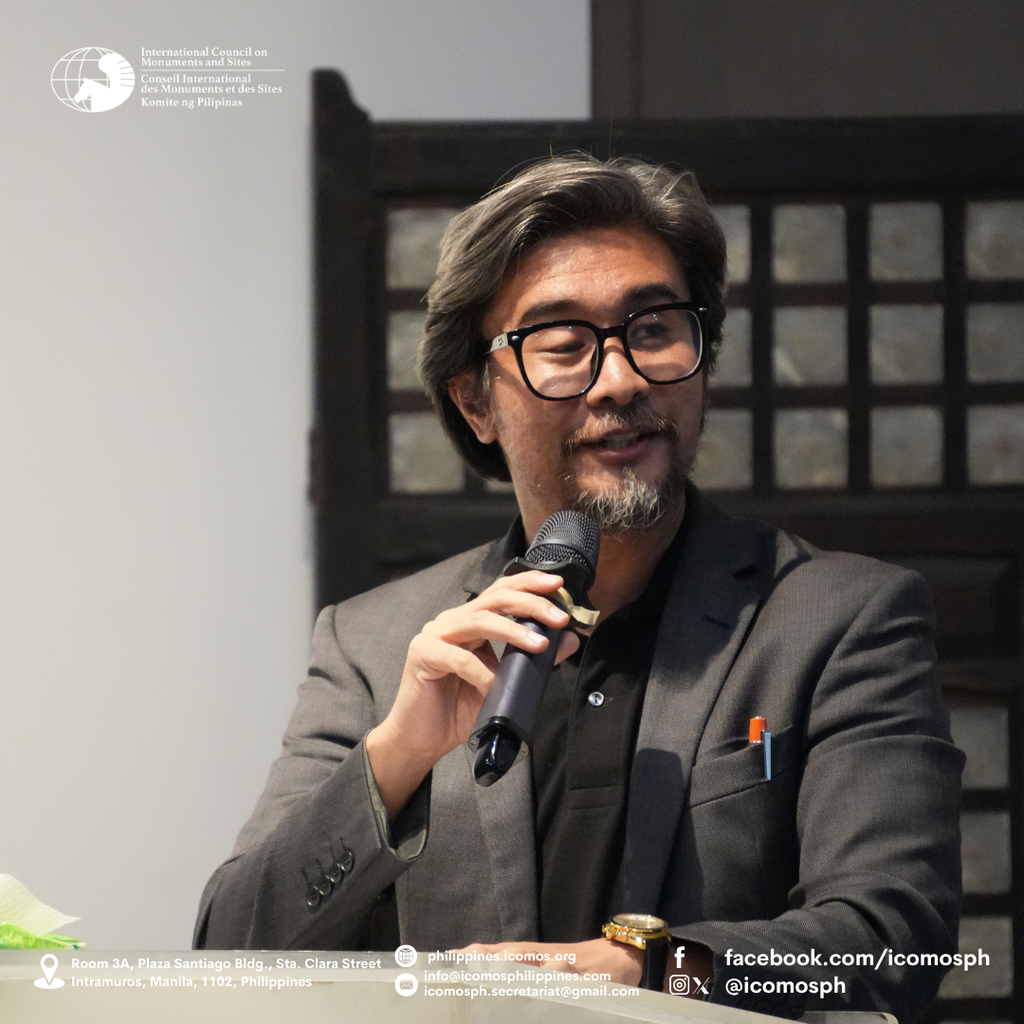
ICOMOS Philippines led a panel discussion at the 2024 National Conference on Local History and Heritage (NCLHH) last August 29, 2024, in the Ayala Museum, Makati City. The panel with the title Heritage Conservation Practices in the Philippines was chaired and moderated by Dr. Laya Boquiren-Gonzales, PhD, and was composed of Ms. Maria Cristina Paterno, Ar. Kenneth Javier Tua, and LAr. Gabriel Caballero.

Ms. Maria Cristina P. Paterno, Immediate Past President of ICOMOS Philippines and Projects Manager of Preserving Legacies presented โ€œClimate Vulnerability Assessment of the Ifugao Rice Terraces: Preserving Legacies, A Future for Our Past.โ€ She shared the findings and experience of the recently published study that looked into the values of the terraces for the local communities and how these values, rooted in Indigenous knowledge, are impacted by climate change, as well as contribute to strengthening resilience and adaptive capacity as they try to preserve and protect their cultural heritage by integrating modern climate science.

Ar. Kenneth Javier Tua, Vice President of ICOMOS Philippines and Country Director of the UNESCO-Heritage Emergency Fund project for the Historic City of Vigan presented โ€œSaluad-Tawid: Conserving and Protecting Heritage Houses and Structures in the Historic City of Vigan After the 2022 Earthquake.โ€ The recently concluded project provided valuable lessons for disaster risk management for cultural heritage and working in a multi-stakeholder environment.

LAr. Gabriel Victor A. Caballero, Focal Point for the United Nationโ€™s Sustainable Development Goals (SDGs) of ICOMOS International presented โ€œPamana 2030: Local Case Profiles on Philippine Heritage and Sustainable Development Goals.โ€ He presented selected efforts by the ICOMOS Sustainable Development Goals Working Group (SDGWG) to document heritage initiatives that intersect with SDGs.

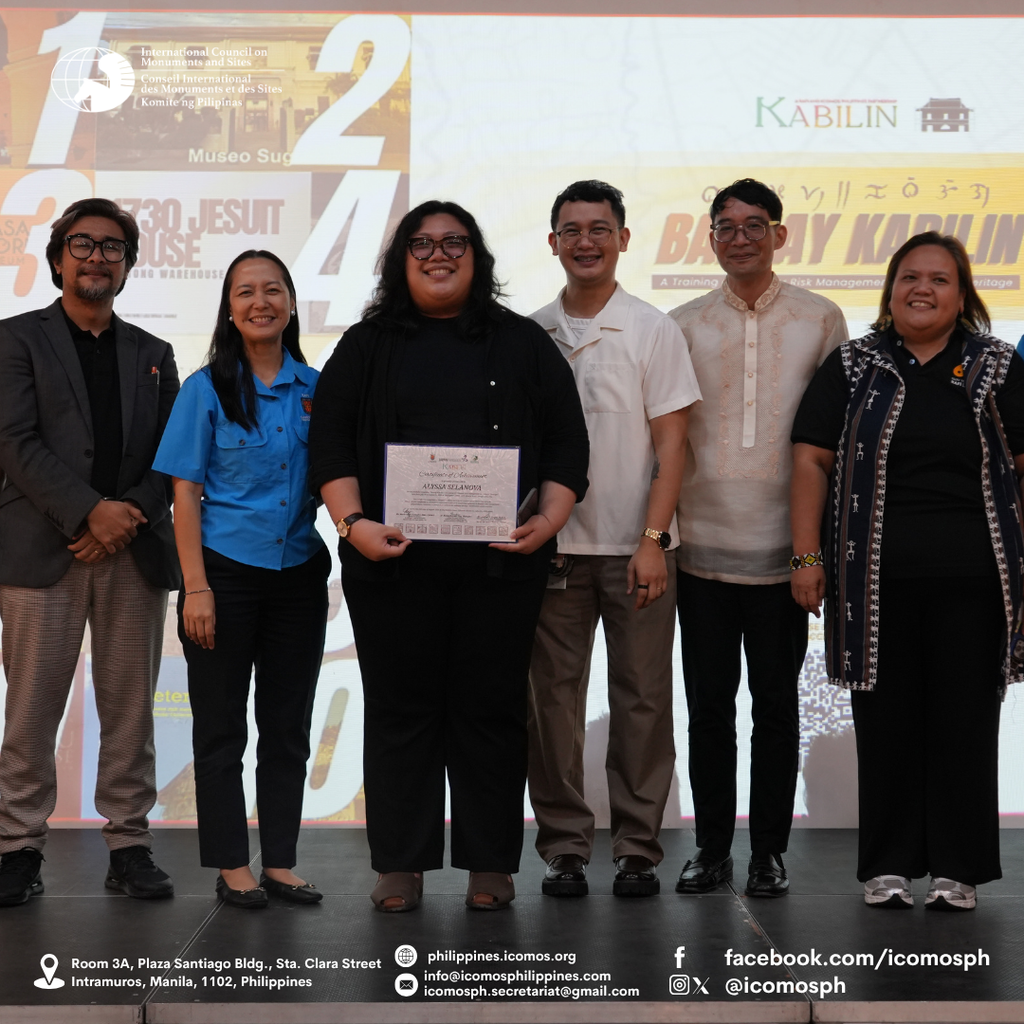
Laya Boquiren-Gonzales, PhD, gave a short presentation about the upcoming initiative to document and safeguard the heritage of the devotion to the Santo Niรฑo de Cebรบ in partnership with Ramon Aboitiz Foundation Inc. (RAFI), one of the three landmark projects under the โ€˜Kabilin Partnershipโ€™ with ICOMOS Philippines.

Dr. Laya Boquiren-Gonzales stirred the discussion with onsite participants. She moderated the open forum of the panel taking in questions from the diverse audience composed of other cultural workers and local heritage advocates.

We in ICOMOS Philippines express our sincere gratitude and congratulations to the National Historical Commission of the Philippines, the organizers of the conference for the opportunity to share our work and on-ground experience towards a respected heritage profession in the country, and Philippine heritage that is conserved to the highest standards. We look forward to taking part again in the next NCLHH Conference.

For more information on ICOMOS Philippines โžก๏ธ https://philippines.icomos.org/

#ICOMOSPH #NHCP #ParaSaPamana #Kabilin #HistoryMonth #PatuloySaPagtuklas #OurHistoryContinues #HeritageConservation #LHCN2024

ICOMOS Philippines Appoints a New Board Member and Legal Counsel

Manila, Philippines โ€“ ICOMOS Philippines Board of Trustees appointed a new Board Member and Legal Counsel last August 1, 2024 on its 11th Board Meeting of the year.

We happily welcome you and look forward to working with you in Philippine heritage that is celebrated and conserved through the highest standards.

Board Trustee Hon. Caroline Marie Q. Lising is a university lecturer, archaeologist, licensed interior designer, visual artist, and entrepreneur. She is also the Honorary Consul of Georgia in Manila and Luzon. As an archaeologist, she specializes in cultural heritage management of materials and sites of deep history. She obtained her PhD in Prehistoric Archaeology (Magna cum laude) from the Goethe University in Frankfurt, Germany. 

She created Crania Heritage Sciences, Inc in 2015 as a venue to deliver programs and events related to collaborative science-based heritage management. Mylene is president of Plaza Management, Inc. which manages Plaza Santiago, a courtyard and buildings across Fort Santiago–the most popular tourist, cultural, historical, and archaeological site within Intramuros, the historical walled city of Manila. 

Legal Counsel Atty. Lucille Karen E. Malilong-Isberto is a lawyer with advocacies in forest and cultural heritage preservation. She holds degrees in law and economics from the University of the Philippines Diliman. 

She headed the Committee on Monuments and Sites at the National Commission for Culture and the Arts (NCCA) from 2014 to 2016. She was Chairperson and later Executive Director of the Nayong Pilipino Foundation (2019-2021), a government owned and controlled corporation mandated to conduct research on humanities and social sciences.  She is currently a Vice President of the ICOMOS International Scientific Committee on Legal, Administrative and Financial Issues.

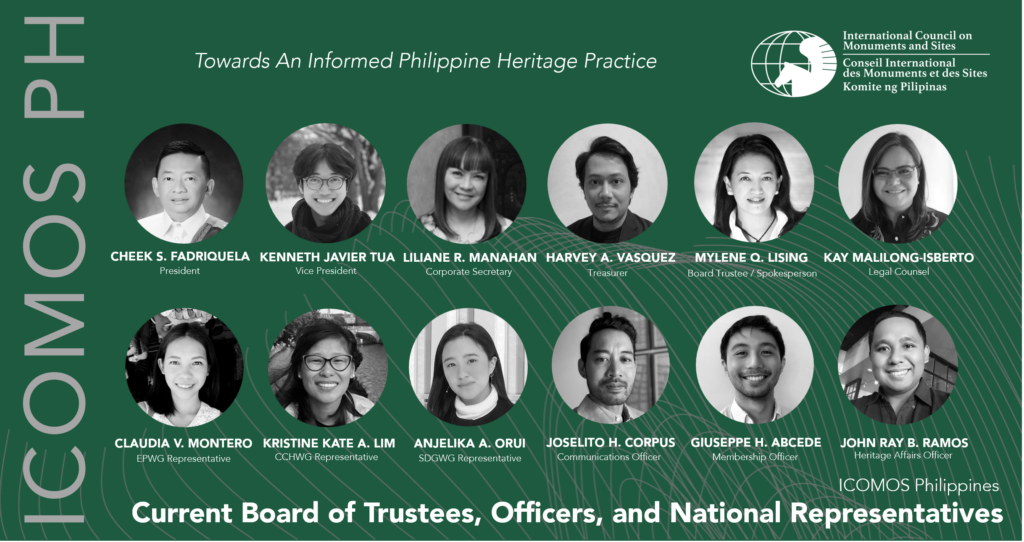
For the remaining term of 2024 โ€“ 2026, the following are the current Board of Trustees (BoT), Executive Officers (EOs) and Officers, Representatives and Coordinators (ORCs) as of August 19, 2024:

Chairman / President: Dr. Cheek S. Fadriquela, PhD

Vice President: Ar. Kenneth Javier Tua

Corporate Secretary: Ms. Lilia Rosa โ€œTatsโ€ Rejante-Manahan

Treasurer: Ar. Harvey A. Vasquez

Board Trustee and Spokesperson: Dr. Caroline โ€œMyleneโ€ Marie Quinto-Lising, PhD

 Legal Counsel: Atty. Lucille โ€œKayโ€ Karen E. Malilong-Isberto

Communications Officer: Mr. JH Corpus

 Membership Officer: Ar. Giuseppe โ€œGioโ€ Luigi Hernandez Abcede

 EPWG National Representative: Ar. Claudia Isabelle V. Montero

SDGWG National Representative: Ar. Anjelika A. Orui

CCHWG National Representative: Ms. Kristine Kate A. Lim

(EPWG: Emerging Professionals Working Group, SDGWG: Sustainable Development Goals Working Group, CCHWG: Climate Change and Heritage Working Group. All National Representatives are also Coordinators)

Current Board of Trustees, Officers and National Representatives

The ICOMOS Philippines Membership is pleased to have them in the National Committee and looks forward to their valuable contribution towards the continuation of an excellent and fruitful three-year term.

Know more about the people behind the International Council on Monuments and Sites Philippines in the links below: 

Board of Trustees and the Secretariat

Committee Officers and National Representatives

Sagada Mission Compound Girls Dormitory Conservation Assessment

Click here to download the Report

Built in 1912, the Girlsโ€™ Dormitory is the first school building of the Mission of St. Mary the Virgin in Sagada. It played an essential role in the education of the children of the Cordilleras as it served as the first school building in the area from 1912 until 1951. An example of American-Philippine Colonial architectural style, the structure is currently unoccupied and under rehabilitation.

A product of collaboration between ICOMOS Philippines and the Episcopal Church in the Philippines, the Conservation Assessment of the Mission Compound Girls Dormitory by ICOMOS Philippines member Ar. Aris Go of Ninety Design Studio is a detailed example of doing proper conservation assessment which analyzes multiple facets of the heritage structure including architectural, material, and structural condition, and provides sound recommendations drawn from data. 

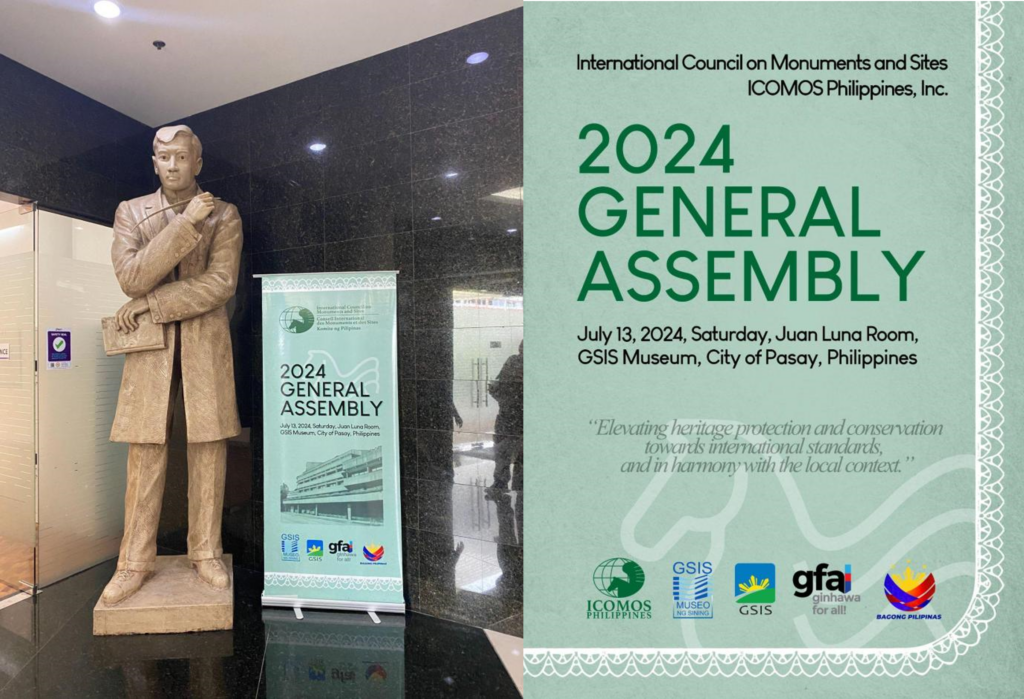
ICOMOS Philippinesโ€™ 2024 General Assembly at the GSIS Museum

Pasay, Philippines โ€“ ICOMOS Philippines held its annual General Assembly [GA] on 13th July 2024 at the Government Service Insurance System (GSIS) Museo ng Sining. Every year in July, the Executive Officers, Committees and Officers, and ICOMOS Philippines membership gather to review the current and previous yearโ€™s activities, understand the organization’s operational, organizational, and financial health, and vote on institutional proposals for the coming year and beyond.

2024 General Assembly ICOMOS Philippines at Government Service Insurance System Museum

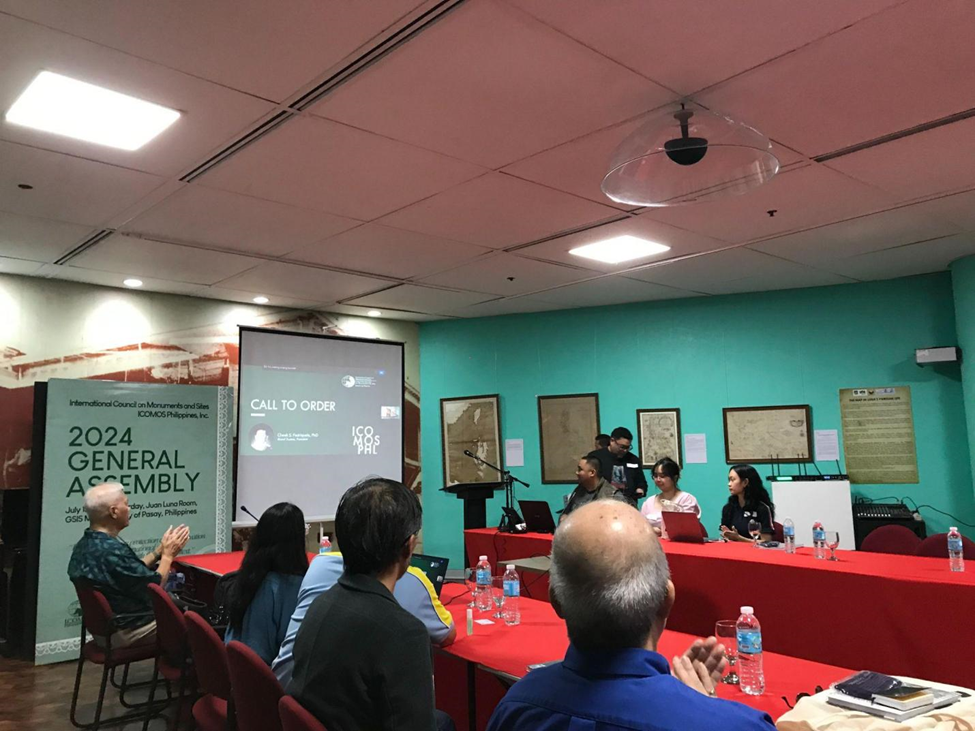
With a quorum of 64, the GA was called to order followed by the Presidentโ€™s Report by Dr. Cheek Fadriquela who spoke about major themes that drove activities throughout the past year. continuity, celebration, commitment, and compliance.  Together, these concepts speak of a thriving organization that continues to grow each year. Some of these activities that engage members are:  voting on issues and electing its Board of Trustee members, pursuing organizational compliance with government agencies, celebrating milestones and achievements, offering its members and the general public a chance to attend webinars, lectures, and capacity building workshops, and, most importantly, engaging its members to participate as volunteers for ICOMOS initiatives. 

President and Chairman Dr. Cheek Fadriquela opens the Meeting with a Call to Order

Vice President Ar. Kenneth Javier Tua, delivered the Vice Presidentโ€™s Report, focusing on operational aspects internally and externally. Major themes from the presentation were the streamlining of decisions and approvals by the Board of Trustees [BOT] due to regularized bi-monthly meetings, membership and stakeholder involvement which reached 63% participation, 15% higher than the previous year, visibility as an organization through medial alliances, social media reach and in print which doubled the frequency of impressions, and development of stronger ties with the national government cultural agencies.

Two major projects were at the center of the reporting. First, the UNESCO Heritage Emergency Fund [HEF] project in the Philippines which was also presented by Ar. Tua. the Country Project Director. The first of its kind in the country to aid in the recovery of a World Heritage Site, the Historic CIty of Vigan. At two selected pilot houses, the scope was to enhance technical standards for the conservation of heritage houses and structures by various technical disciplines who performed investigations, testing, shared observations, and recommended conservation interventions.

Immediate Past President Maria Christina Paterno presented as Project Director the milestones of the second major project of the previous fiscal year, Preserving Legacies Initiative [PLI]. She worked closely with ICOMOS Philippines member and COO of the Save the Ifugao Terraces Movement (SITMo) Marlon Martin who led the onsite focus group discussion. The exercise of assessment through focus discussion groups revealed the negative impacts of climate change on Ifugao livelihoods and traditions.

More reports were shared by the BOT. Treasurer Ar. Harvey Vasquez pointed to the 66% growth of the asset base from 2023-2024 with a reduction of liabilities by 39%. A large part of the revenue was due to donations and grants [HEF], and expenditures were mainly project-related. Corporate Secretary Ms. Liliane โ€œTatsโ€ Rejante Manahan in her report informed the organizationโ€™s up-to-date compliance and related to the requirements to file with the SEC every year, to submit quarterly and annual financial reports with the BIR, and maintain Barangay Business Clearance and Mayorโ€™s Permits.

Committee Officers also gave updates to the membership.ย  Membership Officer Ar. Giuseppe โ€œGioโ€ Luigi H. Abcede showed membership growth year after a year and shared the impacts of membership calls, the involvement with the International Scientific Committees [ISCs], and the different Working Groups [WG]. John Ray Ramos, the Secretariat and Heritage Affairs Officer [HAO], shared his involvement with the administration of the ICOMOS Philippines office and membership. Communications Officer JH. Corpus shared metrics on the organizationโ€™s visibility and public outreach on various social media platforms, its growth over the past year, and the impact of contributing articles to national broadsheets.

Works of WG over the past year were presented by HAO Ramos . Ar. Claudia Isabelle V. Montero, EPWG National Representative, showcased her work involving collaboration with emerging professionals, signing MOUs with three Universities (DLSU, ADMU & FEU), and mentoring interns on impact-driven activities and initiatives. Kristine Kate A. Lim, CCHWG National Representative related long-term plans by the CCHWG with culture as the driver in the face of climate change. Ar. Anjelika A. Orui, SDGWG National Representative informed the membership the WGโ€™s consistent involvement with NEDA to implement the Sustainable Development Goals and the addition of four ICOMOS members based in Cebu for an upcoming project.

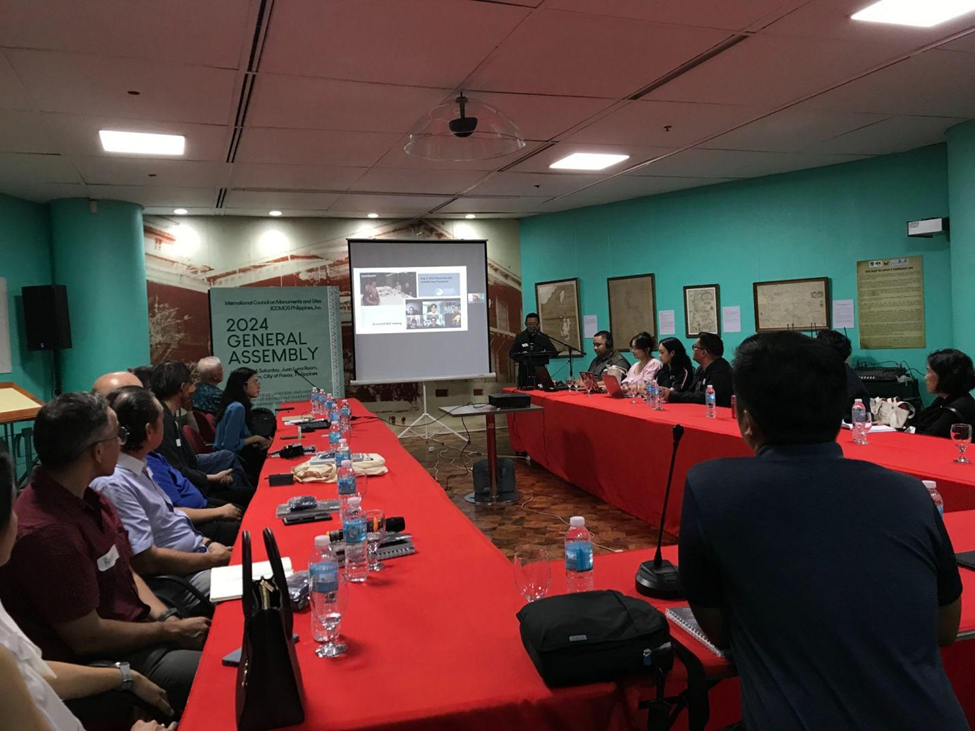
President Cheek Fadriquela discusses the Major Themes of Last Yearโ€™s Activities

Institutional initiatives were presented and voted upon at the last part of the program. The Policy for the Disaster Risk Management of Cultural Heritage (DRMCH) which will form a funded committee on DRMCH that will respond to disruption, hazard, and loss on Philippineโ€™s cultural heritage anchored on the ICOMOS International Scientific Committee on Risk Preparedness [ICORP]  was adapted by the membership. Guidelines for the Institutional Membership did not garner enough votes to be passed and accordingly, it shall then be subject for further review of the membership.

Onsite Attendees of the 2024 ICOMOS Philippines General Assembly
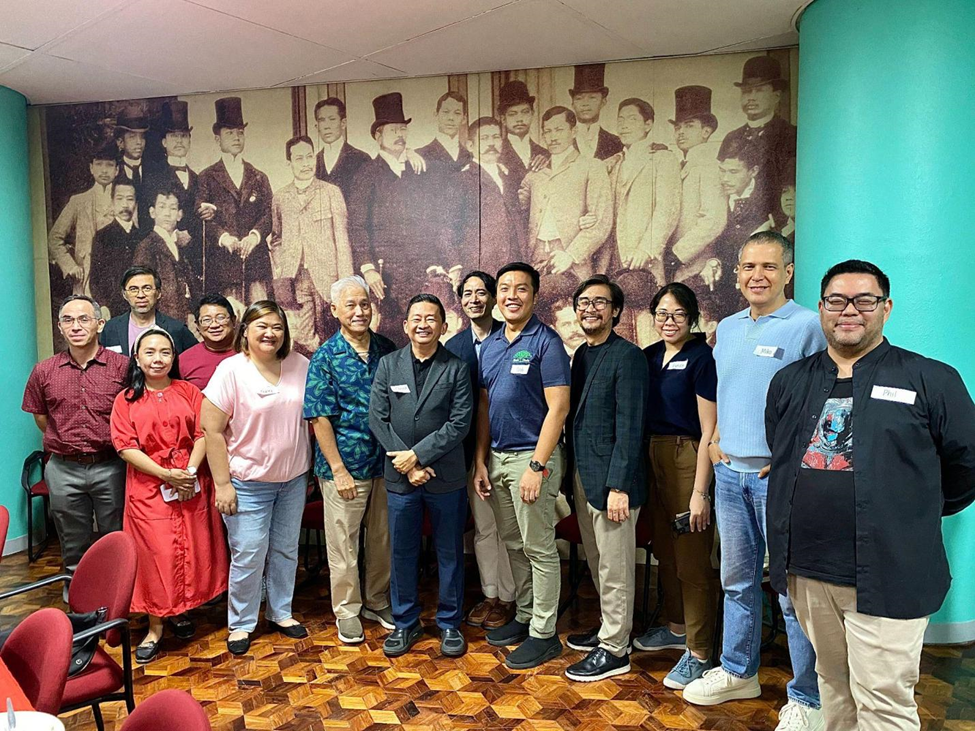
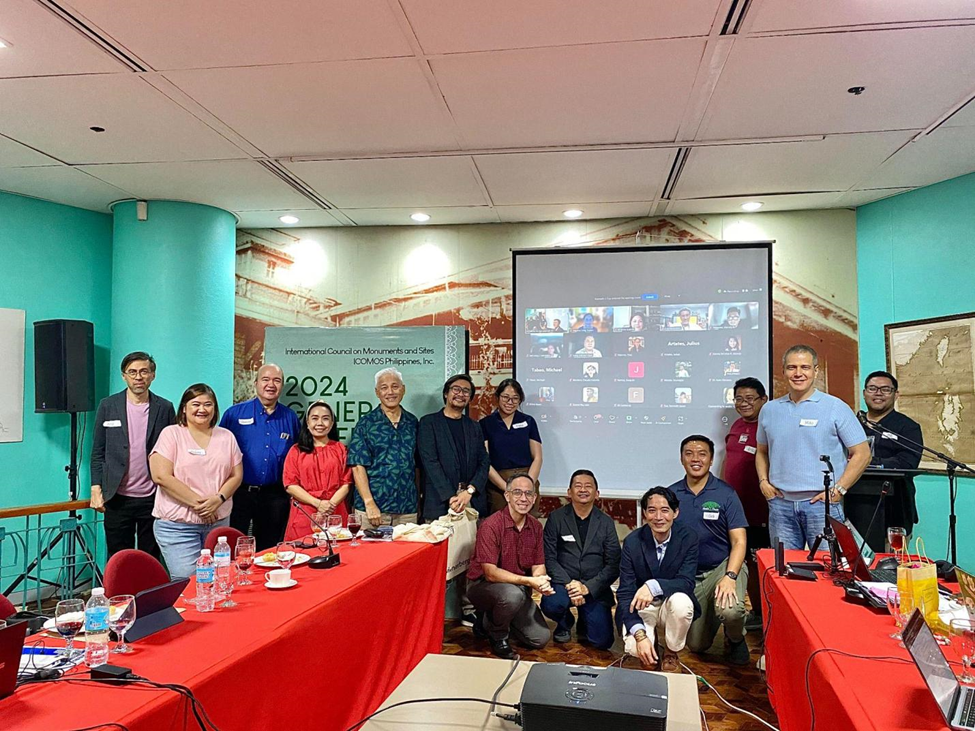
On and off-site members gather for a group photo after the 2024 ICOMOS Philippines General Assembly

The 2024 General Assembly signifies the continued commitment of ICOMOS Philippines to discuss and promote the conservation, protection, use, and enhancement of cultural heritage sites. The assembly serves as a platform for members to exchange knowledge, share best practices, develop and adopt policies, and set the direction for future initiatives in heritage conservation.

(EPWG: Emerging Professionals Working Group, SDGWG: Sustainable Development Goals Working Group, CCHWG: Climate Change and Heritage Working Group. All National Representatives are also Coordinators)

Board of Trustees and the Secretariat

Committee Officers and National Representatives

Project Report on the Climate Vulnerability Assessment of the Rice Terraces of the Philippine Cordilleras

Click here to download the Report

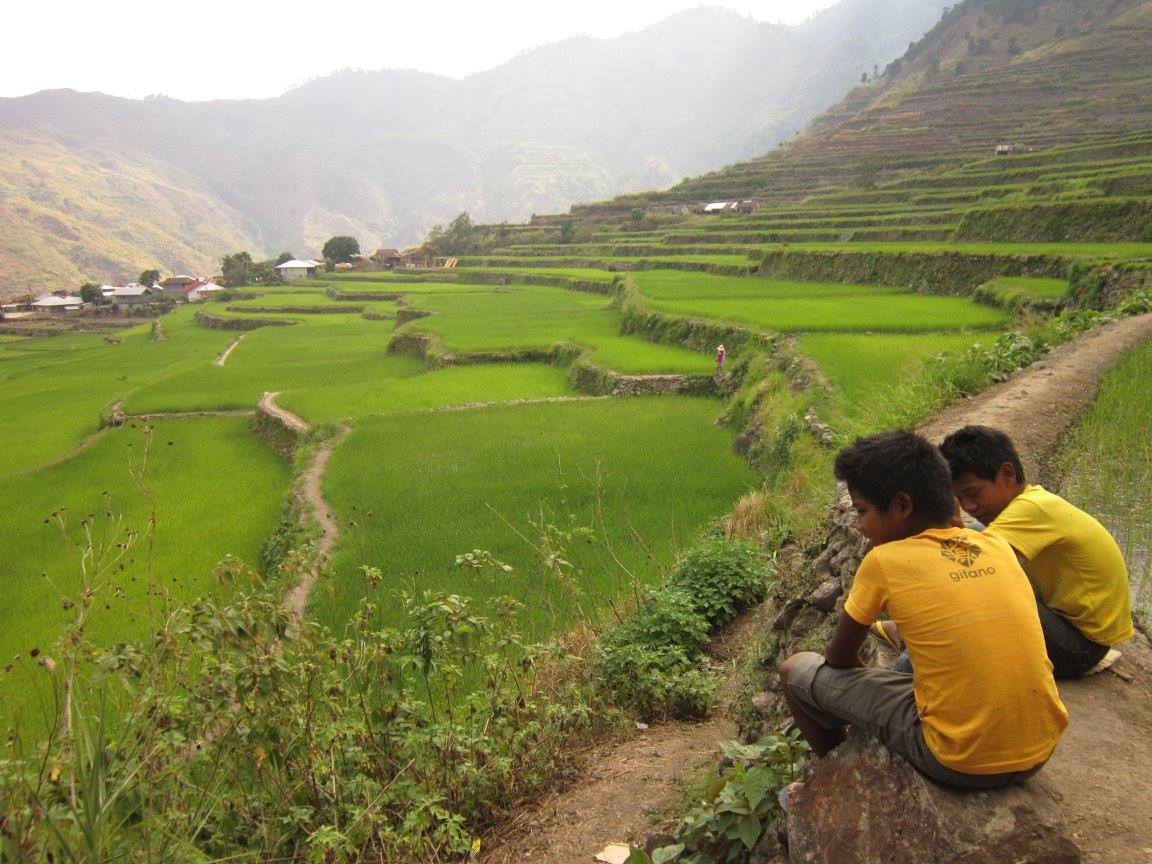
This Ifugao-led study is a climate vulnerability assessment of the rice terraces of the Philippine Cordilleras, a UNESCO World Heritage site. The assessment establishes why local communities value the terraces, and how these values, deeply rooted in indigenous knowledge, are impacted by climate change. The end goal is for communities to strengthen resilience and adaptive capacity as they position to preserve and protect their cultural heritage.

Data was gathered by several focus group discussions among farmers in Nagacadan Hungduan, Mayoyao, Bangaan and Batad. This approach ensures the collection of critical data that truly reflects the lived experiences and needs of the indigenous Ifugao people. The assessment utilizes modern climate science and indigenous knowledge, as both realms of understanding are complementary and necessary to address the climate crisis more effectively.

The Ifugao Rice Terraces confront a web of climate challenges such as intensified typhoons, erratic precipitation patterns, prolonged droughts and increasing temperatures, which pose imminent risk of soil erosion, reduced crop yield or crop loss, landslides, and structural damage to the terraces. This threatens their ecological integrity, agricultural productivity, amplifies existing vulnerabilities, and can jeopardize the sustainability of this cultural landscape.

๐—ฅ๐—ฒ๐—ฝ๐—ผ๐—ฟ๐˜ ๐—Ÿ๐—ฎ๐˜‚๐—ป๐—ฐ๐—ต ๐—ผ๐—ณ ๐˜๐—ต๐—ฒ ๐—ฃ๐—ฟ๐—ฒ๐˜€๐—ฒ๐—ฟ๐˜ƒ๐—ถ๐—ป๐—ด ๐—Ÿ๐—ฒ๐—ด๐—ฎ๐—ฐ๐—ถ๐—ฒ๐˜€: ๐—” ๐—™๐˜‚๐˜๐˜‚๐—ฟ๐—ฒ ๐—ณ๐—ผ๐—ฟ ๐—ผ๐˜‚๐—ฟ ๐—ฃ๐—ฎ๐˜€๐˜ ๐—ฝ๐—ฟ๐—ผ๐—ท๐—ฒ๐—ฐ๐˜ ๐—ณ๐—ผ๐—ฟ ๐˜๐—ต๐—ฒ ๐—ฅ๐—ถ๐—ฐ๐—ฒ ๐—ง๐—ฒ๐—ฟ๐—ฟ๐—ฎ๐—ฐ๐—ฒ๐˜€ ๐—ผ๐—ณ ๐˜๐—ต๐—ฒ ๐—ฃ๐—ต๐—ถ๐—น๐—ถ๐—ฝ๐—ฝ๐—ถ๐—ป๐—ฒ ๐—–๐—ผ๐—ฟ๐—ฑ๐—ถ๐—น๐—น๐—ฒ๐—ฟ๐—ฎ๐˜€

Donโ€™t miss the opportunity to participate in our Virtual Live Event for the Climate Change Vulnerability Risk Assessment of the Ifugao Rice Terraces, Philippines.

We are so excited to invite you to the report launch. Weโ€™re opening aย ten day countdown registration formย for our live virtual event, to present findings of the year long study Climate Vulnerability Assessment of the Rice Terraces of the Philippine Cordilleras onย June 27, 5:00 PM Philippine time, GMT + 8.

Register today for zoom link here: https://bit.ly/RegisterPLI

How can heritage sites contribute to a sustainable climate future?ย Join us as we exploreย Ifugao traditions in the Rice Terraces of the Philippine Cordilleras and uncover their invaluable lessons on adapting to and mitigating climate change. Discover the synergy between indigenous knowledge and climate science and learn how ancient practices can inform modern strategies for resilience and sustainability. Don’t miss this enlightening presentation on climate vulnerability assessmentโ€”where the past guides us towards a sustainable future. ย This project is a collaboration between National Geographic Society, ICOMOS, and Preserving Legacies.

This Ifugao-led study is a climate vulnerability assessment of the rice terraces of the Philippine Cordilleras, a UNESCO World Heritage site. The assessment establishes why local communities value the terraces, and how these values, deeply rooted in indigenous knowledge, are impacted by climate change. The end goal is for communities to strengthen resilience and adaptive capacity as they position to preserve and protect their cultural heritage.

Data was gathered by several focus group discussions among farmers in Nagacadan Hungduan, Mayoyao, Bangaan and Batad. This approach ensures the collection of critical data that truly reflects the lived experiences and needs of the indigenous Ifugao people. The assessment utilizes modern climate science and indigenous knowledge, as both realms of understanding are complementary and necessary to address the climate crisis more effectively.

The Ifugao Rice Terraces confront a web of climate challenges such as intensified typhoons, ย erratic precipitation patterns, prolonged droughts and increasing temperatures, which pose imminent risk of soil erosion, reduced crop yield or crop loss, landslides, and structural damage to the terraces. This threatens their ecological integrity, agricultural productivity, amplifies existing vulnerabilities, and can jeopardize the sustainability of this cultural landscape.

Fortunately, their traditional values and indigenous knowledge systems make them moderately resilient. However,  they will need additional support from government to develop infrastructure, and develop technical capacities to  build more robust adaptive strategies and sustainable management practices to preserve ecological resilience and secure the livelihoods of the communities that call the terraces home.
Progress Significant in Vigan’s Recovery from 2022 Earthquake

Last March 2024, marked the third quarter of the implementation of the first Heritage Emergency Fund [HEF] granted to the Republic of the Philippines by UNESCO.

UNESCO Jakarta under the leadership of Moe Chiba, Culture Unit Head, and Rizky Fardhyan, Project Coordinator, visited Vigan City to observe and support the activities spurred by the HEF. Their visit coincided with events around Vigan from the 11th to 13th of March, and they witnessed major milestones achieved by expert team, visiting and local students and professors, and the stakeholders of Vigan.

One activity was the HEF capacity-building training program whose audience were the homeowner’s, custodians, contractors, technicians, tradespersons and other concerned stakeholders of the WHS Historic City of Vigan. Not only were they given lectures about Vigan specific topics, but they were also involved in a hands-on workshop to try their hand at mixing lime mortar and also attempting traditional joinery.

Another highlight were the activities at Tadena Hall at University of Northern Philippines where Hong Kong University and University of the Northern students presented their documentation of fifteen priority ancestral vernacular houses that they completed in about a week with the aide of digital documentation.

Lastly, there was Town Hall Meeting where homeowners and local stakeholders had an open forum to discuss the challenges of recovery and also how to move forward as a community sustainably and effectively.

This activity was supported by the UNESCO Heritage Emergency Fund. We wish to thank its donors: the Qatar Fund for Development, the Government of Canada, the Kingdom of Norway, the French Republic, the United Kingdom of Great Britain and Northern Ireland, the Principality of Monaco, the Republic of Estonia, ANA Holdings INC, the Kingdom of the Netherlands, the Slovak Republic, the Grand Duchy of Luxembourg, the Principality of Andorra, the Republic of Serbia.

Concerned stakeholders who are interested in providing in-kind contribution, you may contact Ar. Kenneth Javier Tua, Country Project Director, through kenneth.javier.tua@icomosphilippines.com and cc.: info@icomosphilippines.com. Letโ€™s protect and promote our diverse cultural heritage together.

For more information on ICOMOS Philippines โžก๏ธ https://philippines.icomos.org/

#UNESCO #unescoJAKARTA #ICOMOS #icomosPHILIPPINES #HeritageEmergencyFund #firstHEF #WorldHeritageSite #HistoricCityofVigan #PhilippineHeritage #SustainableHeritageManagement #ProtectHeritage