
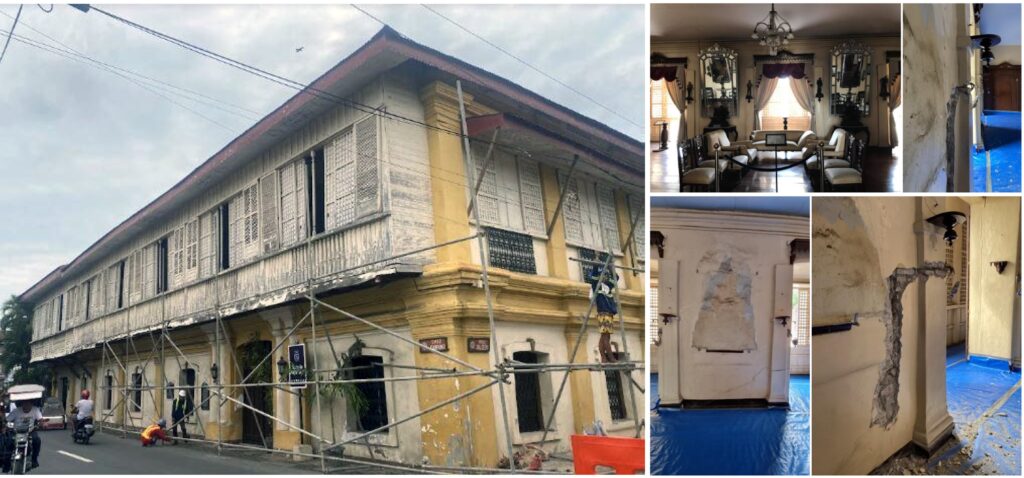
MANILA, Philippines — After the initial report on the damage assessment of the World Heritage Site of the Historic City of Vigan [Post-Earthquake Damage Assessment of Vernacular Building in the World Heritage City of Vigan [PEDAVBV],” UNESCO granted a Heritage Emergency Fund (HEF) for the Post-Earthquake Technical Enhancement of Standards for the Conservation and Protection of Ancestral Vernacular Houses of Vigan that was officially launched on September 14, 2023.
EXECUTIVE SUMMARY (11.3 MB)
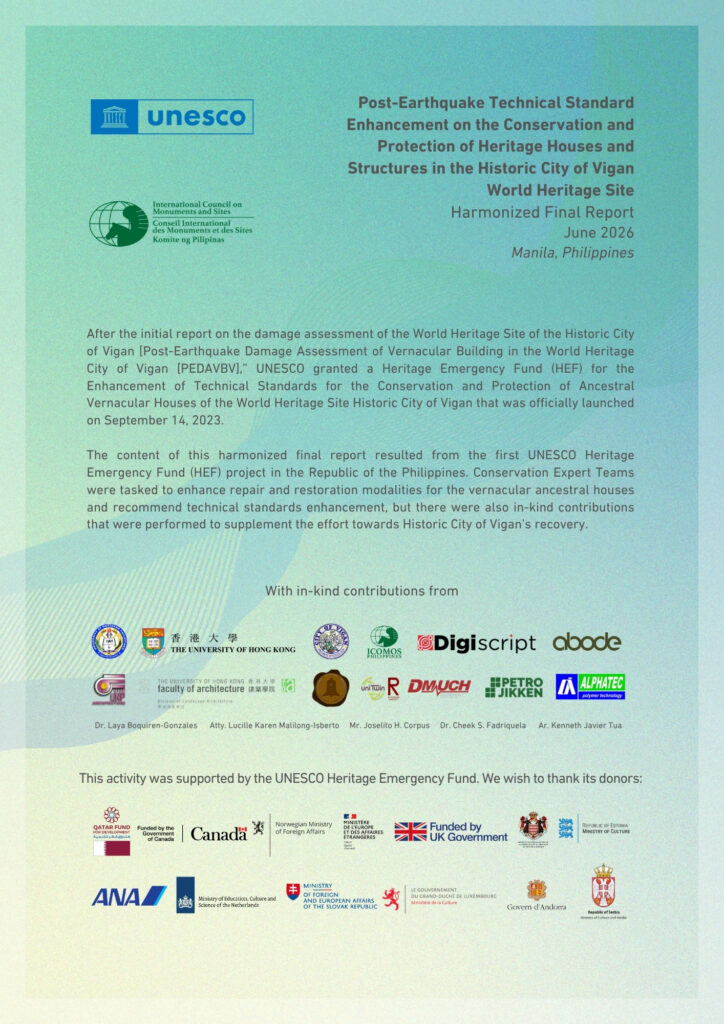
The content of this report resulted from the first Heritage Emergency Fund project in the Philippines. Conservation Expert Teams were tasked to enhance repair and restoration modalities for the vernacular ancestral houses and recommend technical standards enhancement, and there were also in-kind contributions that were performed to supplement the effort towards Vigan’s recovery.
DOWNLOAD THE FULL REPORT HERE. (981.7 MB)
To access the chapter report please download each file below.
Chapter 1 of the report is called “First UNESCO Heritage Emergency Fund (HEF) Project in the Philippines.” This section explains the objectives of the report, presenting the general introduction of the assignment as well as scope and project delimitations. It contains the strategic project framework on awareness raising, knowledge sharing, and collective application.
It also presents the stakeholders involved – the project management teams and expert teams’ delegation, organizational chart, calendar, and a chronological timeline of activities and milestones achieved.
DOWNLOAD CHAPTER 1 HERE. (8.3 MB)
Chapter 2 is the analytical report of the Structural engineering Conservation. This assessment included performing a comprehensive structural investigation, including material testing and characterization, evaluating the structure, and proposing a restoration design based on the evaluation results and conservation principles. Using the results of the assessment, strengthening measures and repair are proposed.
Moreover, the assessment addresses structural safety concerns for damaged areas by providing a shoring design.
DOWNLOAD CHAPTER 2 HERE. (43.6 MB)
Chapter 3 of this report documents the Architectural Conservation Analytical Report. Highlights of this section of the report are the morphological analysis of the two pilot sites. Utilizing remnant design features, and architectural and structural components, the Architectural Conservation Team was able to forensically reconstruct the evolution of the two houses: its materials, design, and construction techniques.
Comparatively, this analysis considers the typologies of Filipino houses termed Bahay na Bato to the versions found in Vigan. This study also aims to analyze the kinship networks and ownership of these houses and how that affected their massing, form, function, and use.
DOWNLOAD CHAPTER 3 HERE. (165 MB)
Chapter 4 details the analytical report on the Materials Conservation investigation of two ancestral houses, emphasizing the importance of studying construction materials for effective restoration. This ensures compatibility, minimal intervention, and reversibility while respecting original materials and ensuring security, protection, and disaster risk management.
Understanding materials helps conservators find suitable replacements. Specialists in timber and masonry conservation, along with a forester, a materials scientist, and a chemist, began their studies in October 2023, and this report presents the results from their onsite visits and lab tests.
DOWNLOAD CHAPTER 4 HERE. (213.6 MB)
Chapter 5 outlines the addendum for the Heritage Homeowner’s Manual of the Historic City of Vigan. This update incorporates suggested technical standards, assessment findings, and the assigned team’s research methodologies. To gather more data for the manual, team leader Dr. Fatima Nicetas Alonzo co-led a project with Dr. Linda Shetabi and Ms Michelle Chelsea Ho from The University of Hong Kong (HKU),
where local team members and 21 faculty facilitators from the University of Northern Philippines (UNP) guided 104 students grouped in 15 teams in documenting 15 heritage structures damaged in the July 27, 2022 earthquake.
DOWNLOAD CHAPTER 5 HERE. (42.5 MB)
Chapter 6 details the Capacity Building Program and Awareness Raising activities that took place on March 11 – 13, 2024 in Vigan, organized by the Pontifical and Royal University of Santo Tomas Graduate School – Center for Conservation of Cultural Property and Environment in the Tropics (USTGS-CCCPET), the Training-Workshop Team of the project. As part of this report is a letter to UNESCO Jakarta that details activities until May 2024;
this is a summary of all the lectures, workshops, programs, and discussions which includes outputs, insights, and recommendations. This section has the following content: project title, technical details, description of activities, highlights, issues and recommendations/ideas, program brochures, and master list of participants with gender disaggregation and affiliation. As part of the project programming, the Local Manual Review (HCLMRE) Team organized a Town Hall Meeting with local stakeholders and homeowners at Tadena Hall, UNP. Furthermore, the USTGS-CCCPET held a series of lectures and training workshops on Vigan as a World Heritage Site which covered Vigan’s history, design, building materials, hazard vulnerabilities, and conservation strategies. Workshops by Master Mason Shiela Soliveres and Master Carpenter Elvin Alexon Ferrer at the Vigan Conservation Complex, provided by the local government, taught local participants like homeowners, contractors, and craftsmen how to handle traditional materials used in Vigan. These activities helped participants understand the conservation process and gain practical skills for conserving the heritage site.
DOWNLOAD CHAPTER 6 HERE. (20.8 MB)
Chapter 7 is a Disaster Risk Management Plan for Culture Heritage (HDRM) for Vigan. A disaster risk management plan for Vigan focuses on protecting and preserving the site against natural and human-made hazards. This plan includes assessing vulnerabilities, implementing early warning systems, and developing emergency response protocols to ensure rapid and effective action during disasters.
It also involves training local communities and stakeholders in disaster preparedness, conducting regular drills, and integrating traditional knowledge with modern techniques for site conservation. Additionally, the plan emphasizes the importance of collaboration with government agencies, non-governmental organizations, and international bodies to secure resources and support for ongoing risk reduction and recovery efforts.
DOWNLOAD CHAPTER 7 HERE. (45.2 MB)
Chapter 8 is a summation of the major project documentation and visibility outputs. Major project documentation and visibility outputs include detailed reports, visual records, and public presentations showcasing the project’s progress and results. These outputs ensure transparency and accountability, featuring comprehensive assessments, photographs, and videos of key activities.
Public exhibitions such as those tied with the closing ceremonies, press releases, and social media updates helped increase awareness and engagement among stakeholders and the wider community.
DOWNLOAD CHAPTER 8 HERE. (27.3 MB)
Chapter 9 reports donations or in-kind contributions for the HEF VIgan Project. In-kind contributions provided valuable resources and services without monetary exchange, significantly aiding projects and initiatives. For the UNESCO Emergency Fund, in-kind contributions from individuals, organizations, and partners were crucial in the recovery of Vigan after the earthquake.
These contributions varied and included investigation, expertise, lectures, and workshops, among others, which were essential towards the restoration and preservation efforts in Vigan. By supplying professional services, and volunteer work, these in-kind contributions augmented the project’s outputs, paving the way towards a more efficient recovery process. Their importance cannot be overstated, as they not only filled funding gaps but also fostered community involvement and ownership, ensuring that the conservation efforts were both comprehensive and sustainable.
DOWNLOAD CHAPTER 9 HERE. (7.5 MB)
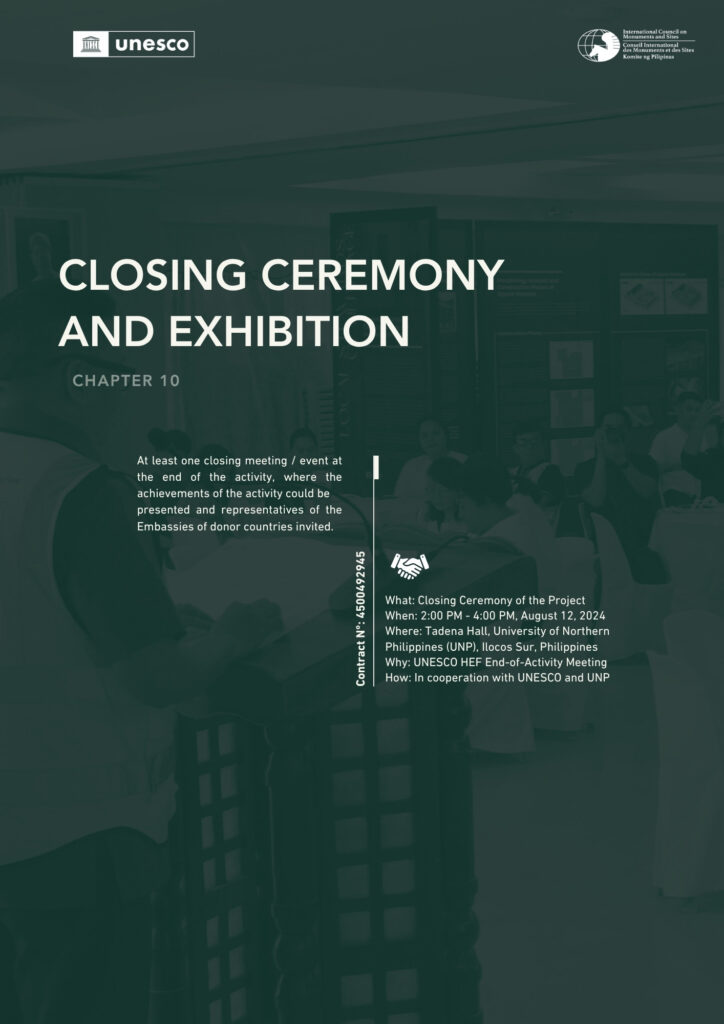
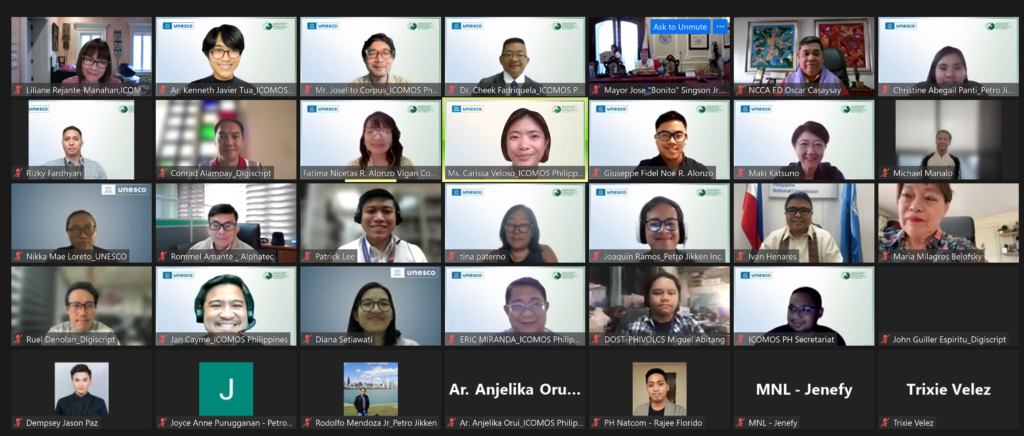
Chapter 10: Closing Ceremony Summary Report. This portion of the report includes the summary of the closing ceremony activities that took place at Tadena Hall at the University of Northern Philippines at the World Heritage Site of the Historic City of Vigan on August 12, 2024. This momentous event provided the opportunity for all stakeholders, participants, and in-kind contributors to the HEF Vigan Project to celebrate its milestones and accomplishments in person and online in a hybrid session.
Eighty persons composed of homeowners, masons, carpenters, local and national government, in-kind contributors, partners, the academe, and the HEF team attended the ceremony. Individuals or representatives of organizations were asked to give a few words about the project’s impact and significance. The conclusion of the project marks the shared commitment to conserving the cultural heritage of Vigan. However, this event does not conclude the activities for the recovery of Vigan; from the HEF Vigan Project, testing and investigations and recommendations are available for use to rehabilitate damaged buildings still remaining.
DOWNLOAD CHAPTER 10 HERE. (20.2 MB)
Chapter 11 describes the initial project funded by the UNESCO Heritage Emergency Fund in the Philippines that had a clear goal: to enhance the conservation efforts for Vigan’s historic houses following an earthquake. With UNESCO Jakarta and ICOMOS Philippines at the helm, the project aimed to support Vigan’s recovery journey.
Experts from ICOMOS Philippines used a comprehensive set of principles and developed recommendations to improve technical standards and bolster the country’s preparedness for future disasters. These guidelines are designed to be flexible, catering to the specific needs of each heritage site. The overarching aim is to elevate conservation practices nationwide, ensuring a sustainable approach to preserving our cultural treasures for generations to come.
DOWNLOAD CHAPTER 11 HERE. (13.8 MB)
The last chapter of the report, Chapter 12, shares the Key Achievements and Milestones of the First UNESCO Heritage Emergency Fund Project in the Philippines. This chapter brings all of the activities together describing in detail the impact that the project had on the recovery of Vigan. Topics include mobilization of diverse, gender-sensitive, and intergenerational Expert Teams,
Technical Assessment and Conservation Standards Enhancement, enabling stakeholders through Capacity Building and Knowledge Sharing, Knowledge Sharing: Awareness-Raising towards Coalition Building and Collective Application, and centering Heritage as a Public Good to raise In-kind Contributions. A discussion of challenges and prospects for future emergency and related projects follows with an analysis of strengths, weaknesses, threats, and opportunities. Lastly in the third section, desirable outcomes and outputs on disaster risk management and post-crisis recovery are presented, reflecting on implementation of the fund – and how to bring continued recovery activities for the future.
DOWNLOAD CHAPTER 12 HERE. (9 MB)
In conclusion, the initiatives undertaken in response to the damage assessment of the Historic City of Vigan, supported by the UNESCO Heritage Emergency Fund, signify a significant step towards preserving and safeguarding cultural heritage in the Philippines. Despite inherent limitations and challenges, including governmental constraints and funding disparities, the project has created a multidisciplinary approach to conservation, encompassing structural, architectural, and materials assessments.
Furthermore, the integration of in-kind contributions and capacity-building lectures and workshops underscores the importance of community engagement and knowledge dissemination in ensuring the sustainability of conservation efforts.
Ultimately, the comprehensive achievements outlined in this report reflect a concerted commitment to enhancing conservation practices, reaffirming the significance of heritage as a collective endeavor for the benefit of future generations.
To read more, click the image to download.
 @unescojakarta