
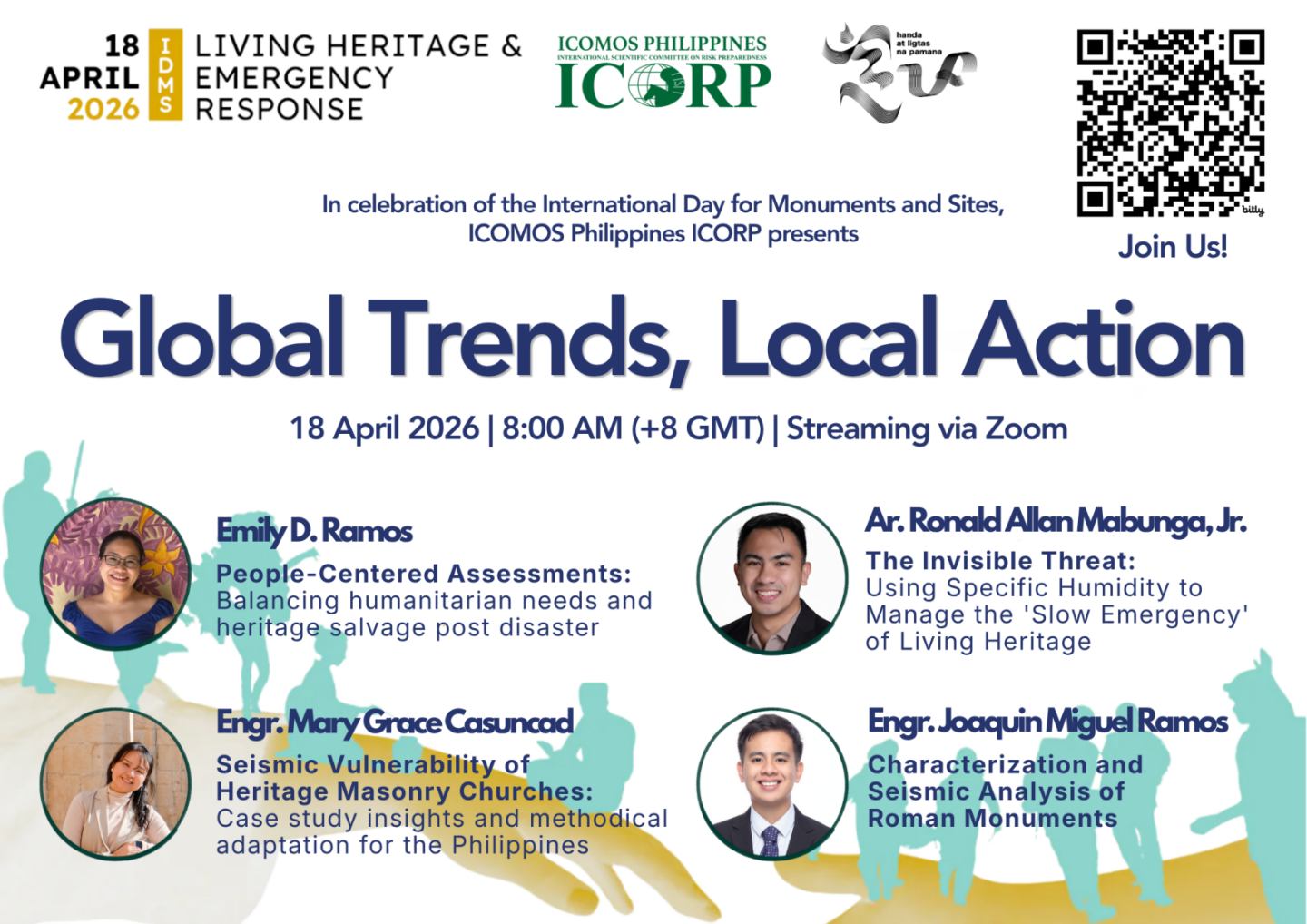
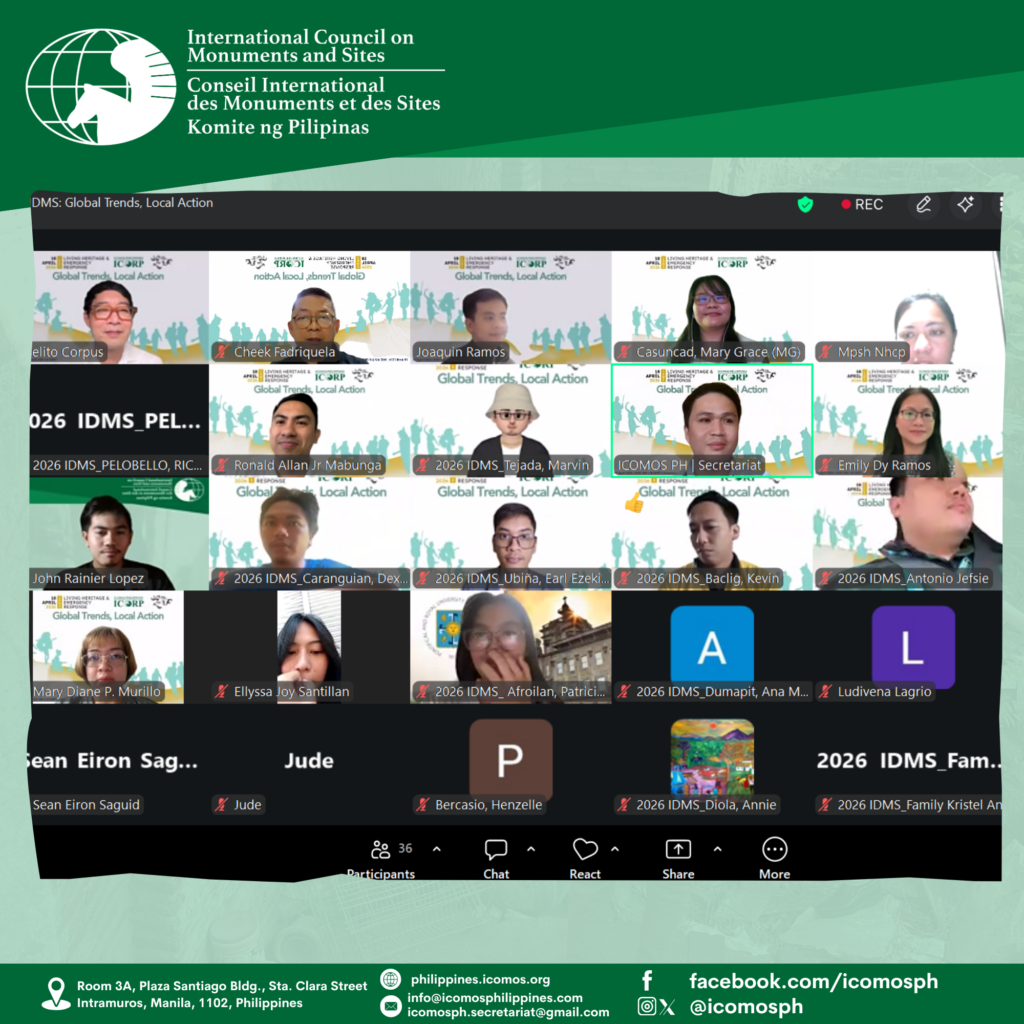
As the world marked the International Day for Monuments and Sites, the conversation around preserving the past took on renewed urgency. On April 18, 2026, ICOMOS Philippines ICORP brought together voices from across disciplines in a virtual forum titled “Global Trends, Local Action,” spotlighting the realities faced by heritage sites in an increasingly uncertain environment.
Behind every centuries-old church, ancestral home, or cultural landscape lies more than just stone and structure. It holds memory, identity, and continuity. This idea shaped much of the discussion, as experts emphasized that conservation must move beyond physical preservation. A key theme that emerged was the need for people-centered approaches, especially in post-disaster contexts where communities and heritage are deeply intertwined. Protecting heritage, speakers noted, also means supporting the people who give it life.
ICOMOS Philippines President Dr. Cheek Fadriquela emphasized the importance of collective action and shared responsibility, noting that the presence of participants from various sectors reflects a common commitment to heritage work rooted in collaboration and shared knowledge. He highlighted that heritage extends beyond monuments to include people, traditions, and communities, while drawing attention to increasing risks such as disasters and rapid development. He further stressed that in the Philippine context, there is a need to remain proactive, responsive, and innovative, grounding global insights in local realities.
The forum featured a diverse lineup of speakers who shared both practical and technical insights. Emily D. Ramos discussed people-centered assessments, focusing on balancing humanitarian needs with heritage conservation in post-disaster scenarios. Ing. Ar. Ronald Allan Mabunga, Jr. examined the “invisible threat” of humidity and how managing it is key to addressing the slow deterioration of living heritage. Meanwhile, Engr. Mary Grace Lim Casuncad presented on the seismic vulnerability of heritage masonry churches, offering case study insights and methodological adaptations for the Philippine setting. Engr. Joaquin Miguel Ramos complemented this with a discussion on the characterization and seismic analysis of Roman monuments, providing comparative perspectives for structural conservation.
Yet not all threats arrive with force. Some, like humidity, work quietly in the background. Described during the forum as a “slow emergency,” prolonged exposure to moisture gradually weakens materials and places heritage structures at risk over time. In a tropical country like the Philippines, this challenge is both constant and often underestimated, prompting calls for more proactive and localized conservation strategies.
At the same time, the forum did not shy away from more immediate dangers. Discussions on seismic vulnerability highlighted the fragile condition of many heritage masonry churches in the country. By drawing comparisons with international case studies and sharing technical analyses, speakers underscored the importance of integrating scientific methods and structural assessment into conservation practices.
Organizers emphasized that while global frameworks continue to guide heritage work, solutions must be grounded in local realities. No single approach fits all, and effective conservation depends on collaboration across disciplines, sectors, and communities.
The successful conduct of the forum was made possible through the support and leadership of the ICORP Head, Mr. JH Corpus, whose efforts helped bring together experts and participants for this timely exchange. In the end, the forum served not just as a space for dialogue, but as a reminder that heritage protection is an ongoing responsibility. As risks evolve, so too must the ways we safeguard the stories and spaces that define who we are. – John Rainier Lopez