
ICOMOS Philippines’ Webinar Series: Rethinking Monuments in the Philippines

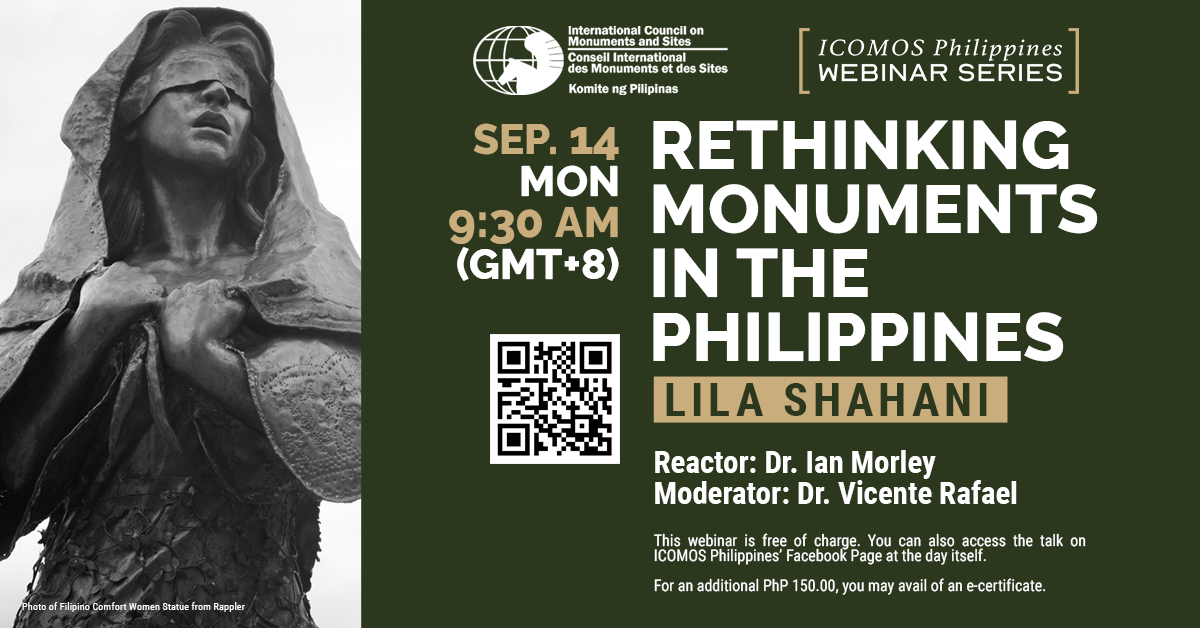
This will be a conversation on the current crisis of monumentality and racial reckoning. Broadly put, what is the relationship between monuments and historical commemoration? Who or what do these monuments celebrate and what do they leave out? This event is the third talk in ICOMOS Philippines’ Webinar Series.

ICOMOS Philippines’ Webinar Series:: Rethinking Monuments in the Philippines

14 September 2020 (Monday) | 9:30 AM Philippine Standard Time

SPEAKER

Lila Ramos Shahani is the former Secretary- General of the UNESCO National Commission of the Philippines.

Under her leadership (and with the help of other agencies), her team succeeded in obtaining 4 UNESCO designations for the country: in 2019, an endangered ritual complex (the “buklog” of the Subanen, an indigenous group in the southern part of the Philippines) was inscribed in UNESCO’s Intangible Cultural Heritage of Humanity in Need of Urgent Safeguarding.

That same year, Cebu was named a UNESCO Creative City of Design. In 2018, the Culion Leprosy Archives in Palawan were inscribed in the UNESCO Memory of the World Asia-Pacific Register. In 2017, Baguio was named a UNESCO Creative City of Crafts and Folk Art.

She previously gave a talk on the same topic, ‘Rethinking Monuments’ exclusively for the ICOMOS PH members and some questions were raised are: What monuments should be kept and which should retire to the museums? How do we rethink of the relationship between monuments and public spaces which the public are being served by such erections? What do monuments subliminally represent?

REACTOR

Ian Morley is an Associate Professor in the Department of History, and Associate Professor (by Courtesy) on CUHK’s Urban Studies Programme.

He has published widely on the design of built environments and participated in TV documentaries. Just recently, he achieved the status of Senior Fellow from the UK Professional Standards Framework and was a recipient  of the Bosma Prize in Planning History Innovation 2020 from the International Planning History Society (IPHS) for his book American Colonisation and the City Beautiful: Filipinos and Planning in the Philippines, 1916-35.

He currently is an editorial board member of the Brill book series Studies in Architecture and Urban History, as well as of Planning Perspectives.

DETAILS

The webinar, “ICOMOS Philippines’ Webinar Series: Rethinking Monuments in the Philippines”,  is scheduled this Monday, September 14, 2020, 9:30 AM (Philippine Standard Time).

Zoom registration is on a first come first served basis. To register, you may fill up this form: bit.ly/ipws200914.

The talk will be streamed on Facebook Live where the speaker will be able to get your questions and respond:  facebook.com/icomosph/live

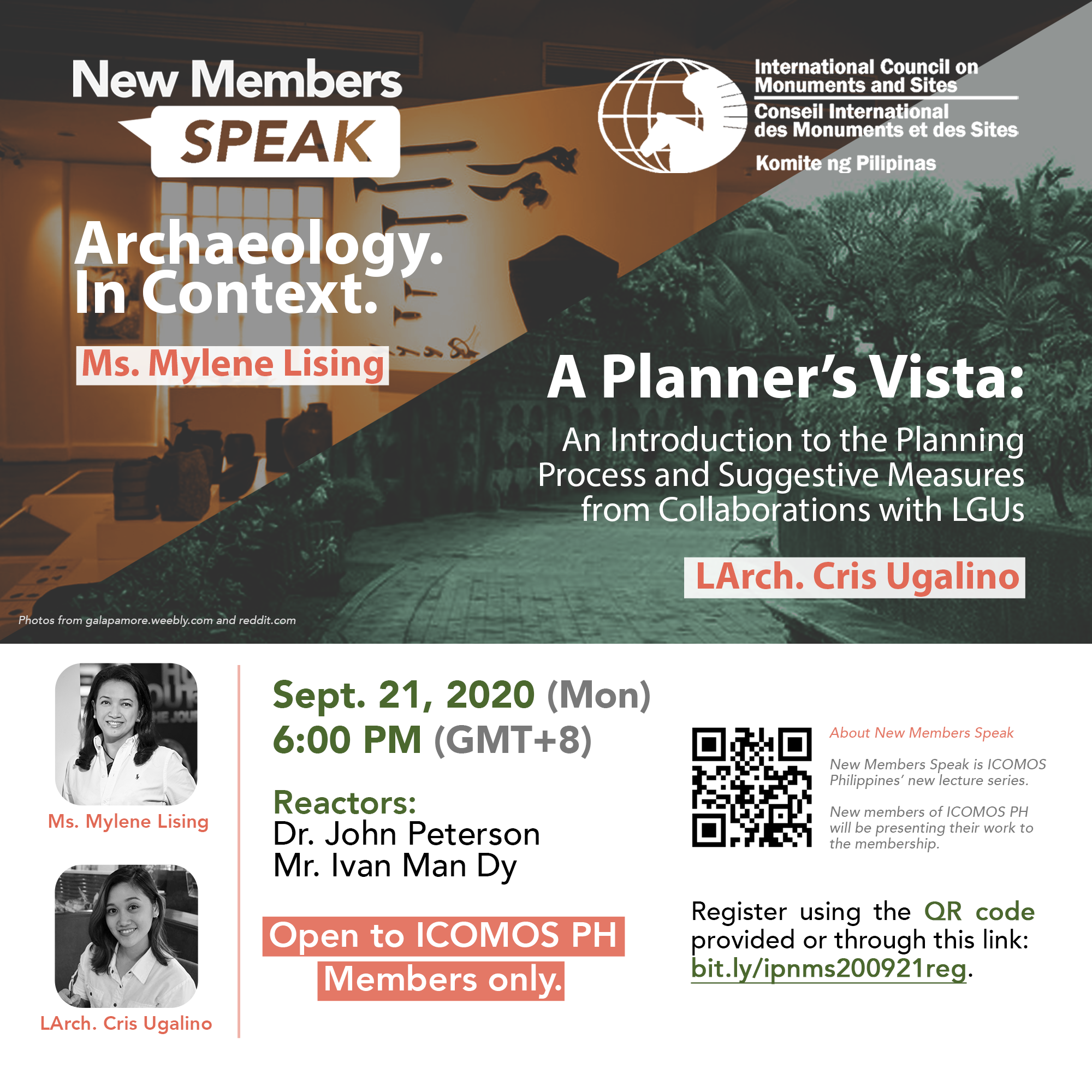
ICOMOS Philippines: New Members 2020

ICOMOS Philippines is very pleased to welcome its new members for the year 2020! Get to know them as we share with you a brief of their profile and expertise.

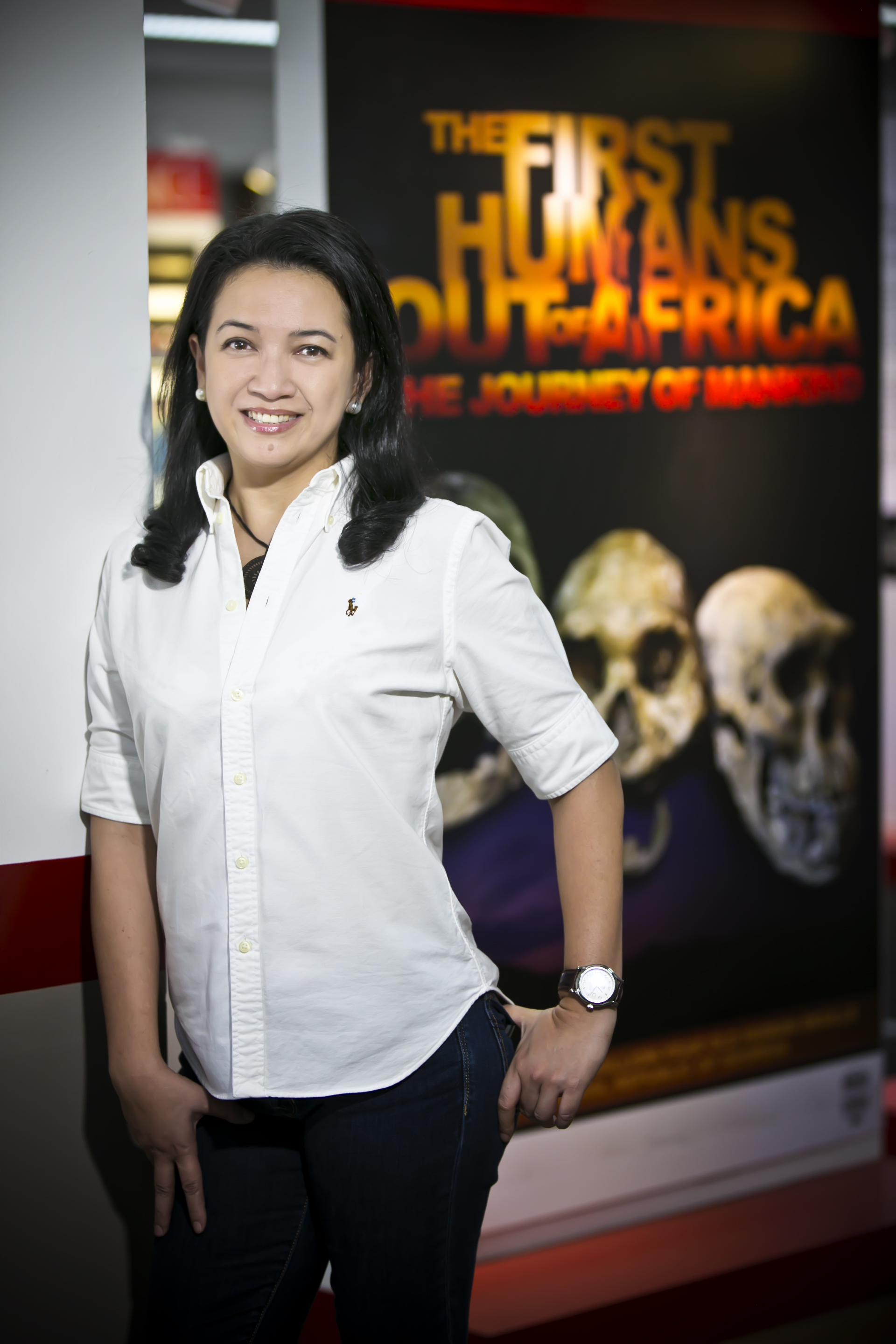
Mylene Lising

Ms. Mylene Lising is an archeologist specializing in the cultural heritage management of prehistoric sites. She received her master’s degree in Quaternary and Prehistory from the Museé National d’Histoire Naturelle, France through the Erasmus Mundus Program (2015) and an MA Archaeology from the UP-ASP (2016). She is currently working on her PhD at the Goethe University, Frankfurt on a grant from the Lisa Maskell Fellowships of the Gerda Henkel Foundation. Her work in heritage management and archaeology focuses on the Cagayan Valley prehistoric sites and materials. Aside from this, she has worked in the media after graduating from Ateneo AB Communications.

Cris Justine Ugalino

Ms. Cris Ugalino is a registered landscape architect, environmental planner, and certified BERDE professional. She received her Landscape Architecture degree from UP Diliman. She was accepted into the UP Diliman School of Urban and Regional Planning, as well as the Department of Science & Technology (Project SPARTA) Data Analyst course. Cris has work experience in project management, landscape bio-engineering, landscape architectural design, consultancy, and research. Her vision in her practice is to share her experiences and enthusiasm in celebrating and preserving Philippine heritage, while giving importance to inclusion between people and places, finding the balance of conservation and people’s initiatives.

Introducing Ruby Descalzo and Gio Abcede, ICOMOS Philippines Intern – August 2020

Through the formation of working groups within ICOMOS Philippines and the formation of communications strategies for the organization, ICOMOS Philippines is happy to share that we will have two new interns working with us for the next three months:

Ruby Descalzo is a recent graduate of the Ateneo de Manila University, with a degree Environmental Science and a minor in Cultural Heritage Studies. She previously served as the President of Baybayin Ateneo, a Filipino cultural student organization. She aspires to pursue studies on ethnoecology and to contribute to the conservation of the Philippines’ biodiversity and traditional ecological knowledge.

Ruby chose to intern for ICOMOS in order to grow as a young professional in the field of cultural heritage. She hopes to use her skills in GIS and statistics for Project Alexandria and under the tutelage of member Claudia Montero, she will help develop the graphic portfolio and database of the organization.


Gio Abcede is a graduating BS Architecture student from De La Salle University, College of Saint Benilde. He has worked with One/Zero Design Co. on the Maestranza Creative Quarters project and collaborated with Digiscript Philippines Inc. with mapping presentations for the Intramuros Cultural Management Plan. He is also a core member and graphic designer for the Heritage Conservation Society.

Gio sought an internship with ICOMOS Philippines to learn how to gather data on heritage structures efficiently and to find solutions geared towards heritage-driven development. He hopes to contribute his current research and thesis focused on the role of typo-morphological analysis and cultural significance assessment in identifying adaptive reuse opportunities in Manila. He will be working closely with the Architecture Committee of ICOMOS Philippines and will be supporting the organization with planned webinars and online courses.

Welcome, Ruby and Gio! We’re very pleased to have your assistance.

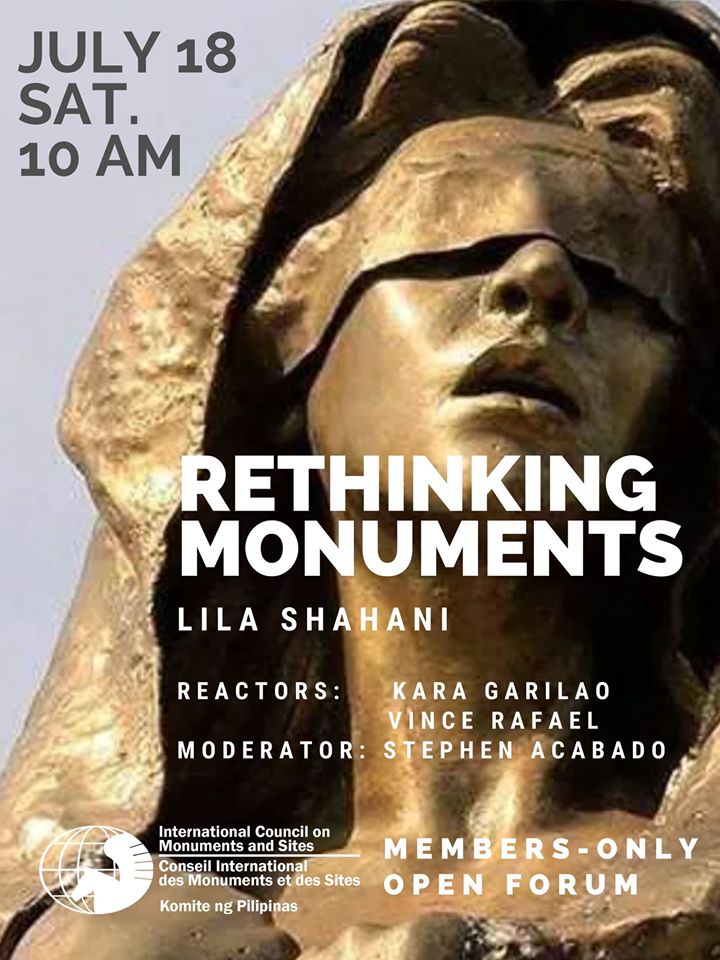
Rethinking Monuments – ICOMOS members discuss

Last July 18, 2020, ICOMOS Philippine members met up to discuss the situation of monuments and the current discourse of politics that surround these objects. The conversation was led by Ms. Lila Shahani, former Secretary-General of the UNESCO National Commission of the Philippines.

Ms. Shahani discussed about the dynamics of politics, national narratives and cultural meanings of monuments. It was then followed by several reactors who discussed the angles of heritage interpretation, plaza development, and cultural politics. An open forum discussion was then facilitated by Dr. Stephen Acabado, Associate Professor of Anthropology at the University of California, Los Angeles

ICOMOS Philippines will be exploring further steps to think about deepening the discourse on the topic in the national context.

ICOMOS Philippines member Gabriel Caballero also participate in the global discourse by ICOMOS International entitled, “Diversify / Decolonise Heritage!” which was held online on July 19, 2020, 13:00 Paris Time. The initiative was started by ICOMOS Germany in collaboration with the ICOMOS Emerging Professionals Working Group.

Check out Ms Shahani’s two opinion pieces on Rappler. The first carries forward from the ICOMOS discussion, Rethinking monuments – “Who or what do these monuments celebrate, and what do they leave out? More pointedly, what do they erase and what do they choose to celebrate and canonize? “. The second is about ‘National’ narratives and the Philippine bureaucracy – “Who speaks (and who is spoken for) in the nation? Whose interests does it serve and represent? What does it encompass? ”

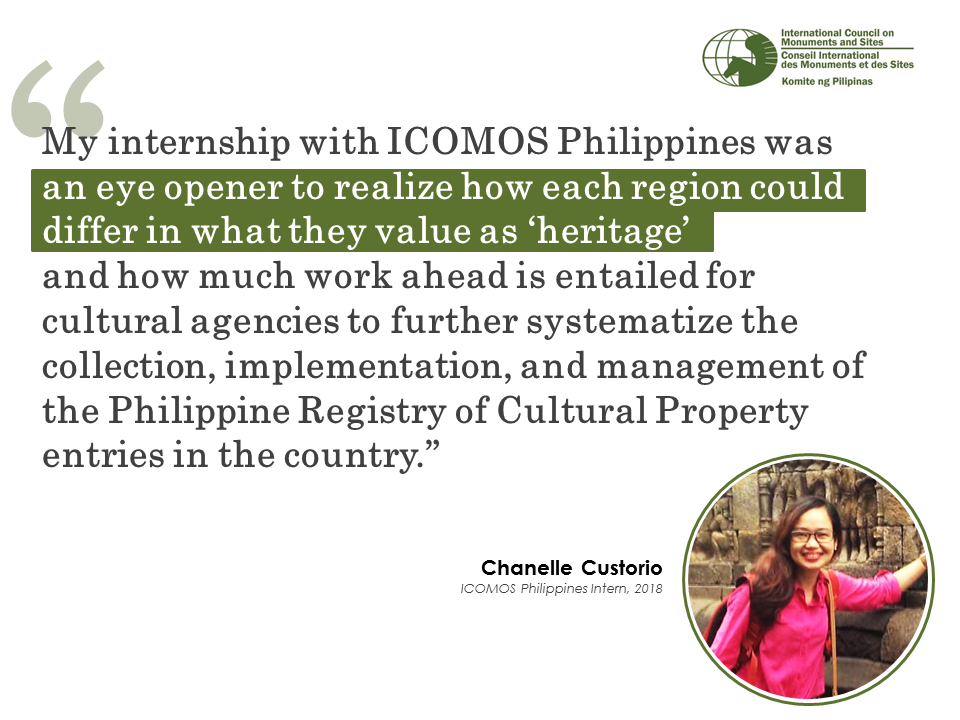
Insights on heritage from the ICOMOS Internship Program – Chanelle Custorio

Back in 2018, when the work of studying the existing spreadsheets of the Philippine Registry of Cultural Property (PRECUP) was given to me and my colleague Carissa Veloso, I got quite excited because the task gave us a chance to have a glimpse of the heritage registry encompassing the whole country. It was a challenge to check and assess over 5,000 entries that led me to uncover the gaps and successes across the different regions.

The analysis gave me headaches and long nights of work, but it was worth the effort. The research was essentially a diagnostic report on the registry of cultural properties across the country. I discovered that even though there were a lot of entries, many regions were underrepresented and numerous listings were problematic, such as listings of corporate establishments as cultural property.

Although I am currently more focused on the mainstream architecture practice, the brief exposure from the heritage field helped me to become more conscious in raising awareness about our built, intangible, and natural heritage in both my designs and in dealing with my clients. I am thankful for ICOMOS Philippines for providing me this opportunity.

For interested students or new graduates who would like to take internship with the organization, please contact info@icomosphilippines.com

Introducing Kenneth Tua, ICOMOS Philippines Intern – July 2020

With more activities online and new collaborations between members and external partners are happening, ICOMOS Philippines is happy to share that we will have a new intern working with us for the next three months: Kenneth J. Tua is a registered & licensed architect and a sustainable territorial development consultant. He is currently taking his Erasmus Mundus Joint Master Degree in DYnamics of Cultural Landscape, heritage, Memory and conflictualities (DYCLAM+) in Europe under the ERASMUS+ Scholarship. Previously, Kenneth worked with HBA and RMDA and at the Office of the President of the Republic of the Philippines – Pasig River Rehabilitation Commission. 

He decided to apply as an intern for ICOMOS Philippines during his summer break from his masters degree to be able to incorporate his ongoing studies in Sustainable Heritage Management and Cultural Landscapes at the Philippine setting. Moreover, Kenneth wants to be of great service in creating advocacies in galvanizing solutions for the Philippine cultural heritage.  In collaboration with members of the International Scientific Committee on Cultural Landscapes (ISCCL), Mr. Gabriel Caballero and Dr. Susan Aquino-Ong, Kenneth will be starting a research that will look into how heritage conservation can potentially be integrated to landscape architecture programs in the country.

Welcome, Kenneth! We’re very pleased to have your assistance.

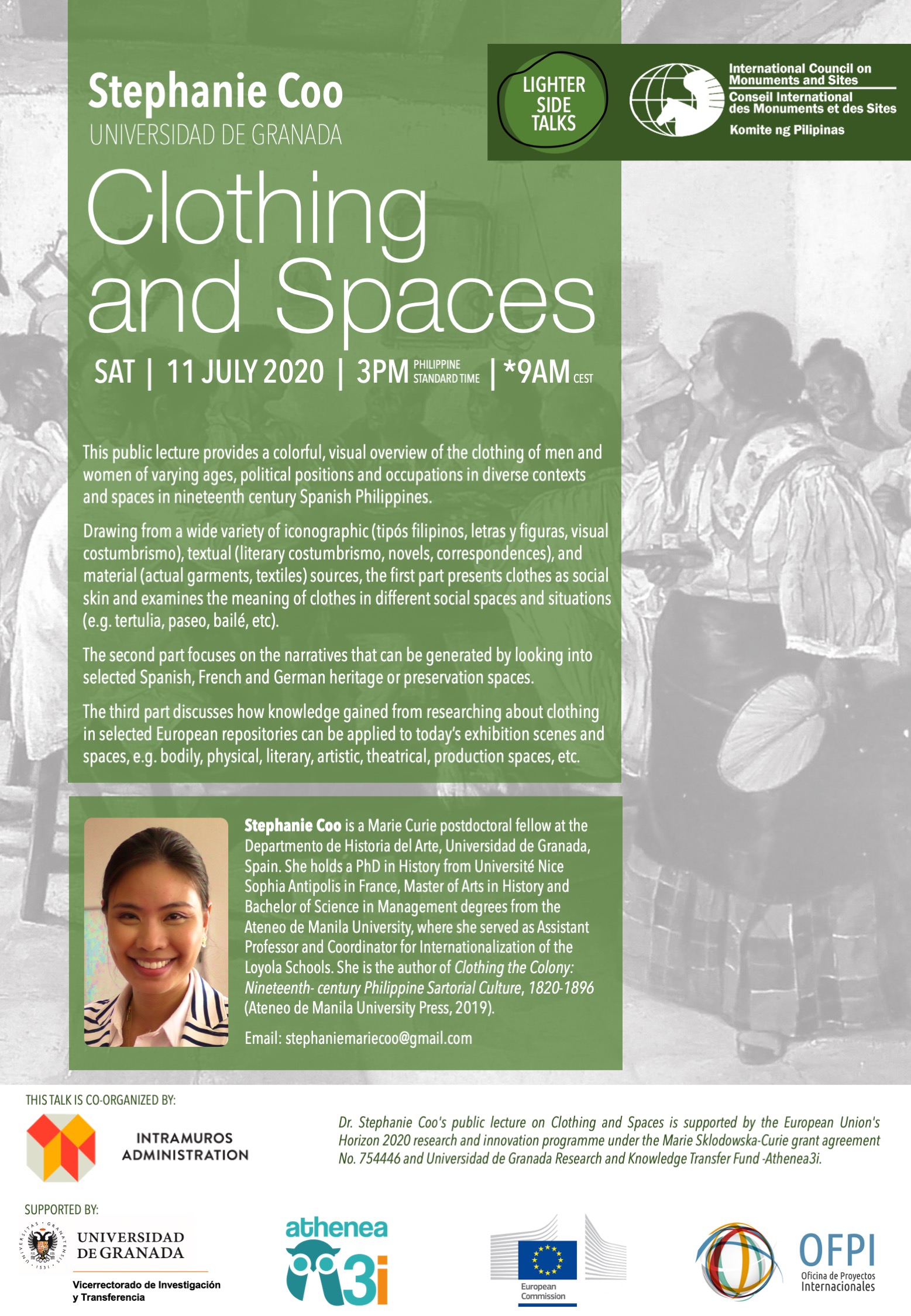
ICOMOS Lighter Side Talks: Clothing and Spaces

This public lecture provides a colorful, visual overview of the clothing of men and women of varying ages, political positions and occupations in diverse contexts and spaces in nineteenth century Spanish Philippines.

ICOMOS Lighter Side Talk: Clothing and Spaces
11 July 2020 (Saturday) | 3PM Philippine Standard Time

Drawing from a wide variety of iconographic (tipós filipinos, letras y figuras, visual costumbrismo), textual (literary costumbrismo, novels, correspondences), material (actual garments, textiles) sources, the first part presents clothes as social skin and examines the meaning of clothes in different social spaces and situations (e.g. tertulia, paseo, bailé, etc).

The second part focuses on the narratives that can be generated by looking into selected Spanish, French and German heritage or preservation spaces.

The third part discusses how knowledge gained from researching about clothing in selected European repositories can be applied to today’s exhibition scenes and spaces, e.g. bodily, physical, literary, artistic, theatrical, production spaces,etc.


SPEAKER

Stephanie Coo is a Marie Curie postdoctoral fellow at the Departmento de Historia del Arte, Universidad de Granada, Spain. She holds a PhD in History from Université Nice Sophia Antipolis in France, Master of Arts in History and Bachelor of Science in Management degrees from the Ateneo de Manila University, where she served as Assistant Professor and Coordinator for Internationalization of the Loyola Schools. She is the author of Clothing the Colony: Nineteenth-century Philippine Sartorial Culture, 1820-1896 (Ateneo de Manila University Press, 2019).

Dr. Stephanie Coo’s public lecture on “Clothing and Spaces” is supported by the European Union’s Horizon 2020 research and innovation programme under the Marie Sklodowska-Curie grant agreement No. 754446 and Universidad de Granada Research and Knowledge Transfer Fund – Athenea3i.


DETAILS

The public lecture, “ICOMOS Lighter Side Talks: Clothing and Spaces”,  is scheduled this Saturday, July 11 – 3 pm (Philippine Standard Time).

Please register to the event here: forms.gle/E1NJzx3PusuEWQ68A

The talk will be streamed on Facebook Live where the speaker will be able to get your questions and respond: www.facebook.com/icomosph

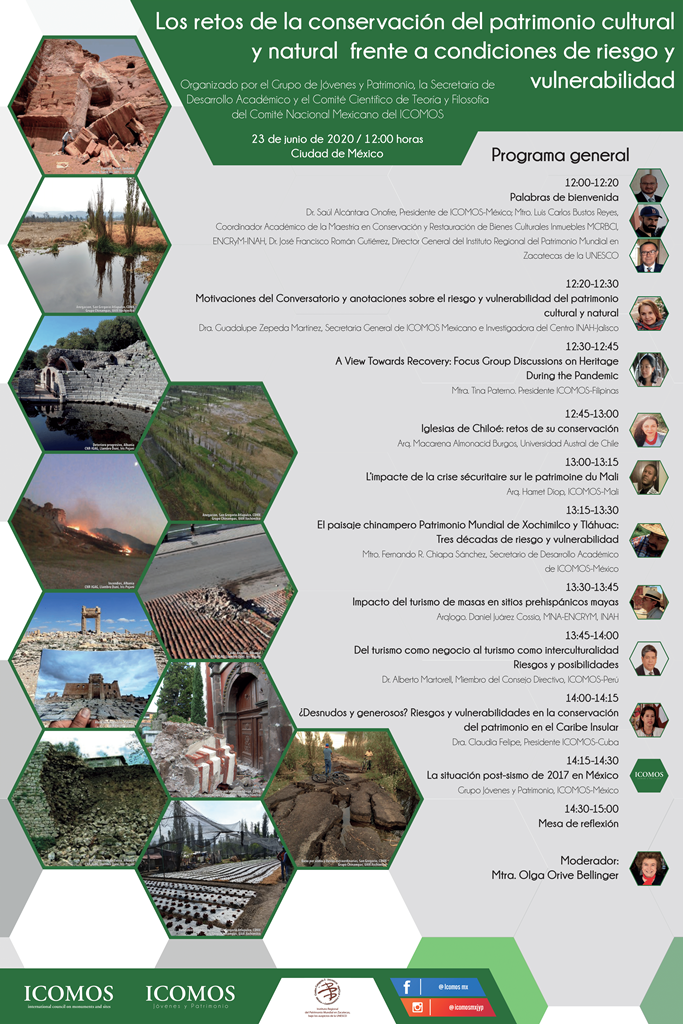
A View Towards Recovery: Focus Group Discussions on Heritage During the Pandemic by Tina Paterno | Conversatorio ICOMOS México

ICOMOS México, through its Scientific Committee of Theory and Philosophy, together with its Secretariat of Academic Development and Youth and Heritage Group, organized last Tuesday, June 23, 2020 an online discussion entitled, “Los Retos de la Conservación del Patrimonio Cultural y Natural Frente a Condiciones de Riesgo”. It discussed on the present challenges of cultural and natural heritage conservation as it faces risky conditions in its continued practice amidst the global pandemic.

The panel in the online discussion included ICOMOS Philippines President Tina Paterno, who shared the current situation of heritage specialists and practitioners in the country on her presentation entitled, “A View Towards Recovery: Focus Group Discussions on Heritage During the Pandemic”.

Ms Paterno  shared findings from several local discussions on how ICOMOS Philippines members are seeing the changes in the heritage practice in their fields of expertise. A common emerging theme was the necessity to explore how heritage can be part of recovery, perhaps by linking it to new national priorities. Generally, many ICOMOS Philippines members saw ideas for continuing a heritage practice amidst Covid 19, during in the mandated pause we are all going through, to re-evaluate where the Philippines is in the practice, and identify where structural improvements are necessary. She also shared two success stories from the past discussions.

“We have a chance to do things differently,” Paterno concluded, “and the accessibility of discussions and knowledge moving online is a great ‘democratizer’ for learning. Our hope is that one day, heritage becomes a more mainstream issue and it happened from a time that there was this major pause and painful time from COVID but it was able to give birth to something truly positive.”

WEBINARS & FOCUSED GROUP DISCUSSIONS

Starting June 2020, ICOMOS Philippines held free public webinars to think about heritage in a differently because of the current global situation. The first webinar was  entitled, “Place-Making and Food Security: Thinking of Heritage Conservation and Food Production,” which explored the mechanisms that shape rural and urban spaces, private and public, facilitating food production and place-making grounded in community-based participation. It provided various perspectives that link food and the understanding of historic significance of particular places.

The online discussion can be viewed on the official Facebook page of ICOMOS México. ICOMOS Philippines would like to thank Mr. Yoloxochitl Lucio of the Grupo Jóvenes y Patrimonio del ICOMOS Mexicano A.C. and Dr. Saúl Alcántara Onofre, ICOMOS México President for the invitation.


https://www.facebook.com/ICOMOSMex/videos/304571427597022/

ICOMOS Webinar Series Episode 2: When Communities Engage – Tools for Community Participation in Heritage

This webinar discusses community engagement that is applicable to built heritage and landscapes, using perhaps the most abstract form of heritage that seems most removed from our lives – archaeology. 

To communities, the site is invisible until digging begins, and relics unearthed are from so long ago that few can relate to it. Explore these archaeologists’ stories in their journeys to empower local communities to own their archaeological heritage. Work includes public consultations, community discussions, collaborative research and interpretation, and on-ground educational activities as methods that lead to better public learning and heritage protection. 

ICOMOS Webinar Series Episode 2: When Communities Engage – Tools for Community Participation in Heritage
7 July 2020 (Tuesday) | 10AM Philippine Standard Time

The webinar will focus on providing answers to two main questions:  

  • How does archaeology improve the lives of communities that live in and around these precious cultural sites?  
  • What are the tools and approaches in archaeology that are used for learning and public engagement and are these tools still valid given the pandemic?   

SPEAKERS

Dr. Stephen Acabado is an ICOMOS Philippines member and Associate Professor of Anthropology at the University of California, Los Angeles. His archaeological investigations in Ifugao, Northern Philippines dispute the commonly held theory that the Cordillera Rice Terraces are at least 2,000 years old. Dr. Acabado directs the Bicol and Ifugao Archaeological Projects and co-directs the Taiwan Indigenous Landscape and History Project at UCLA. He is a strong advocate of an engaged archaeology where descendant communities are involved in the research process.

Mr. Marlon Martin was born and raised among the Ifugao community. He heads SITMo, the Save Ifugao Terraces Movement,  non-profit heritage conservation organization. He works with local and international academic and conservation organizations   in the pursuit of indigenous studies integration and inclusion in the formal school curricula. Along with Acabado, he established the first community-led Ifugao Indigenous Peoples Education Center, the first in the region. 

Dr. Rasmi Shoocongdej  is a Professor of Archaeology and a director of the graduate program at the Department of Archaeology, Faculty of Archaeology, Silpakorn University, Bangkok, Thailand, and with an MA-Ph.D. in Anthropology from the University of Michigan. Rasmi’s areas of interest include  the collaborative approach between archaeology and ethnic communities, archaeological heritage management, World War II archaeology and decolonizing archaeology.  She has been working intensively on public outreach to the general public and academic communities  on cultural heritages and the role of archaeology in contemporary society.

REACTORS

There will also be 2 reactors who will be providing their perspectives on the topic:

  • Malaya Ragragio, faculty member of the Department of Social Sciences at the University of the Philippines, Mindanao  
  • Angelus Maria Sales, Core Operations Head – External from TAO-Pilipinas, Inc.

MODERATOR

Ms. Kate Lim is an ICOMOS Philippines member who is a Ph.D. student at the Institute of Geographical Sciences, Freie Universitat Berlin. She is also an archaeologist and a development worker who sits as a board member in the Artists’ Welfare Project, Inc., Kapisanan ng mga Arkeologist sa Pilipinas, and Tuklas Pilipinas Society. Her current research involves risk assessment and conservation of maritime and underwater heritage sites in the Philippines given various human activities and coastal hazards. 


DETAILS

The webinar, “When Communities Engage – Tools for Community Participation in Heritage”, is scheduled this Tuesday, July 7, 2020 – 10 am (Philippine Standard Time).  

This forms part of the project, “Heritage Practice amidst the Pandemic“, which is a series of online discussions that delves with opportunities to explore new ideas for the Philippine heritage practice.

ICOMOS Philippines would like to thank ICOMOS Thailand, Tuklas Pilipinas, Tao Pilipinas Inc., University of the Philippines Archaeological Studies Program, and Intramuros Administration for co-organizing the event with us.

Please register to the event here: forms.gle/G75UaVWSdbrzZvDy7

The webinar will be streamed on Facebook Live where the speakers will be able to get your questions and respond: www.facebook.com/icomosph

IN MEMORIAM: Maria Joycelyn Bolhayon-Mananghaya

In Memoriam

The ICOMOS Annual Report for 2019 was recently published and its shows the work of the international organisation of ICOMOS and its various National Committees and International Scientific Committees. ICOMOS also remembers the dedicated work of members and colleagues who have passed away during the previous year. A small tribute to Ms Jocelyn Mananghaya, former Trustee of ICOMOS Philippines can be found on page 37 of the annual report. ICOMOS Philippines further recognizes Ms Mananghaya’s contribution to the organization and the advancement of the heritage practice in the Philippines in this tribute.

Maria Joycelyn Bolhayon-Mananghaya

January 1, 1965 – September 17, 2019

ICOMOS Philippines remembers the passing of Architect Maria Joycelyn Bolhayon-Mananghaya who was a former Board of Trustee of the Philippine Committee of the International Council on Monuments and Sites (ICOMOS). Her heritage advocacy was focused on the conservation of the World Heritage Sites in the Philippines and for several years, she served as the National Commission on Culture and the Arts’ (NCCA) consultant for world heritage concerns. Arch. Mananghaya also served as Secretary to the NCCA National Committee on Monuments and Sites from 2011 to 2013 and was part of UNESCO National Commission of the Philippines.

Joy, as she is fondly called by family and friends, had a deep understanding of the interconnectedness of nature, culture and people. She was a member of the ICOMOS International Scientific Committee on Cultural Landscapes and was part of the global discourse on world heritage issues. She wrote extensively about the living cultural landscape of the Rice Terraces of the Philippine Cordilleras and her contributions to the book, “World Heritage: Benefits Beyond Borders” was well recognized by her peers. She undertook expert missions and provided reviews for cultural/natural heritage nominated properties and was designated as the focal point for periodic reporting of world heritage properties in the Philippines.

A graduate of the University of the Philippines College of Architecture, Joy pursued higher education at the Escuela Nacional de Conservación, Restauración y Museografía Manuel del Castillo Negrete in Mexico with a Masters in Architecture Degree. Throughout her life, she generously mentored and nurtured countless students and emerging professionals, many of whom have become respected practitioners of heritage conservation in the Philippines.  Architect Mananghaya’s passion and service continue to inspire us, and we will miss her very much.