
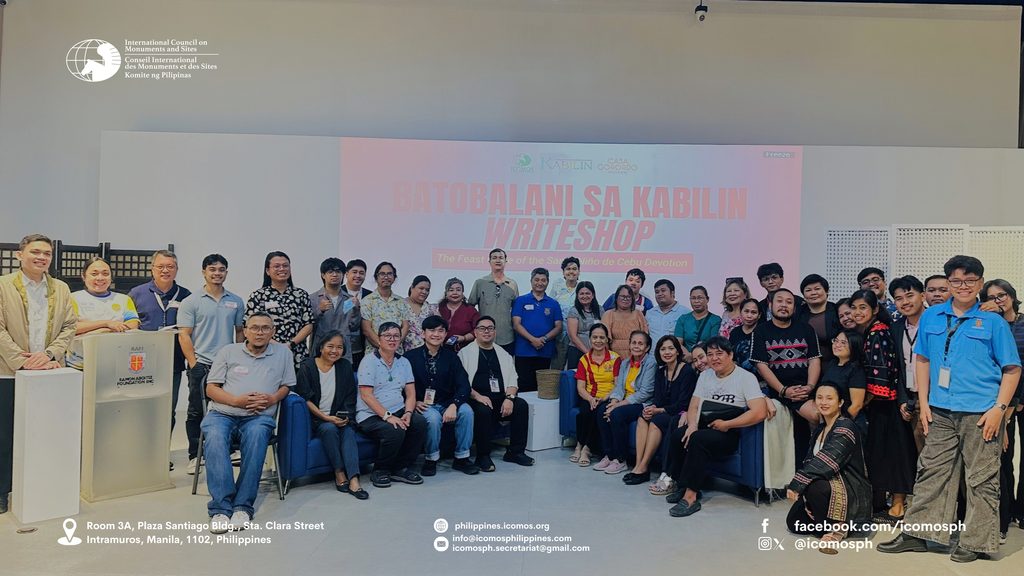
CEBU CITY —The International Council of Monuments and Sites (ICOMOS) Philippines and the Ramon Aboitiz Foundation Inc., through the Kabilin Partnership Program, successfully conducted the Batobalani sa Kabilin Writeshop: The Feast Cycle of the Santo Niño de Cebu Devotion last September 26, 2026, at The Kabilin Center Gallery. The event opened with welcome remarks from Ms. Desiree Gestiada, Program Director of Cebloom Operations, Ramon Aboitiz Foundation Inc. The project team was supported by Trustees of ICOMOS Philippines, Mr. Phillip Medina and Architect Timothy Augustus Ong. Following the opening, Dr. Laya Boquiren-Gonzales, Project Director of ICHSN, presented key safeguarding takeaways gathered from community consultations and focus group discussions, outlining existing good practices in safeguarding intangible cultural heritage, alongside critical gaps that stakeholders themselves identified.
A major highlight of the morning session was an insightful roundtable discussion featuring esteemed discussants Fr. Brian C. Brigoli, Dr. Delilah Labajo, Ar. Melva Java, and Dr. Jose Eleazar Bersales. The discussion was moderated by Dr. Boquiren-Gonzales. Ar. Java talked about how Legazpi wrote to the King that the “Lord waited for us here” where the image was found and “here” for her is kahawanan, space, the place called Sugbu. Furthermore, for Ar. Java “space is ephemeral but when it is inhabited it is invested with meaning and values and it becomes a place.” The panel examined how Cebu’s built environment and spiritual traditions inherently support each other. When the discussion shifted to the idea of a potential UNESCO Intangible Cultural Heritage (ICH) recognition and which register, Dr. Bersales recommended focusing the nomination on elements that are distinctly folk Catholic, with unique, living community practices alongside miracle stories and outside Cebu City. Dr. Labajo mentioned that the ICHSN Project Team shares updates on community consultations, referring to how the feast is celebrated differently in locales outside Cebu City, such as in Oslob. Moreover, Sirong sa Poro, as practiced in Camotes Islands, was also mentioned by Dr. Labajo. Ar. Java recommended highlighting the continuity of the folk and the religious aspects. Fr. Brian Brigoli clarified that “faith is always rooted in culture” through inculturation, a process where the core devotion remains constant while its outward expressions continuously adapt to convey the people’s deepest stories and longings. Explaining that “the dossier is not something dogmatic but cultural,” Fr. Brigoli reassured that the Archdiocese fully supports safeguarding these living traditions within a social system that honors shared memory.
When determining the focus and priorities for the nomination, the panel emphasized living traditions anchored in physical and social geography. Ar. Java suggested the importance of nominating the spatial landscape of lived spaces, such as the maritime and processional routes linking San Nicolas, Mandaue, and Pier 1, noting that these interconnected routes bind sacred places together and sustain the devotion’s long-term perpetuity. When asked to strategically prioritize ICH elements, Dr. Bersales argued that that specific practices carry immense standalone merit, pointing out that “the dance alone, the Sinulog dance* outside the Magellan’s cross is in itself worthy of a single nomination.” Dr. Labajo concurred that the candle vendors’ traditional sinu’og as distinct due to its early pre-colonial origins and the way its traditional chants adapt to reflect modern societal challenges. However, the “Kinampilan” continued by the Mabolo troupe was also mentioned, urging efforts to actively enliven and propagate these dances rather than letting them freeze or fade away. Other than these are the songs that need to be documented and archived. To guide this selection, Fr. Brigoli outlined three essential criteria: (1) deep historical memory rooted in pre-colonial origins, (2) a vibrant communal life with an unbroken line of intergenerational transmission, and (3) shared stewardship that keeps this living heritage ethically visible.
The afternoon session transitioned into hands-on collaborative work, starting with a workshop orientation led by Ms. Chelsea Kaye Mara-Cabahug, Local Researcher for ICHSN. Participants then broke into specialized clusters guided by esteemed Subject Matter Experts from ICOMOS Philippines. In Cluster 1, participants examined Living Devotion and Intergenerational Transmission under the guidance of Mr. Phillip Medina, while Cluster 2 addressed Rituals, Cultural Settings, and Risk Reduction with Ar. Timothy Augustus Ong. Simultaneously, Cluster 3 tackled Documentation, and Interpretation through the expertise of Ms. Kara Velez Garilao, and Cluster 4 explored Social Infrastructure, Inclusive Participation, and Community Partnerships with Dr. Laya Boquiren-Gonzales. Following these productive cluster discussions, the session concluded with each group presenting possible initiatives in response to what they believe to be needs for safeguarding intangible cultural heritage in cultural sites connected to the Santo Nino de Cebu devotion.
The writeshop ended on a celebratory note with the awarding of certificates to all participants, experts, and core team members. RAFI and ICOMOS Philippines both extend their heartfelt gratitude to every partner, advocate, and participant whose dedication continues to drive this crucial initiative forward.
Read more about our initiative and access the project briefer here: https://bit.ly/ICHSNProjectBriefer
*The ICHSN Project Team has previously engaged the candle vendors of the Basilica United Vendors’ Association or BUVPA in community consultations and in-depth interviews.