
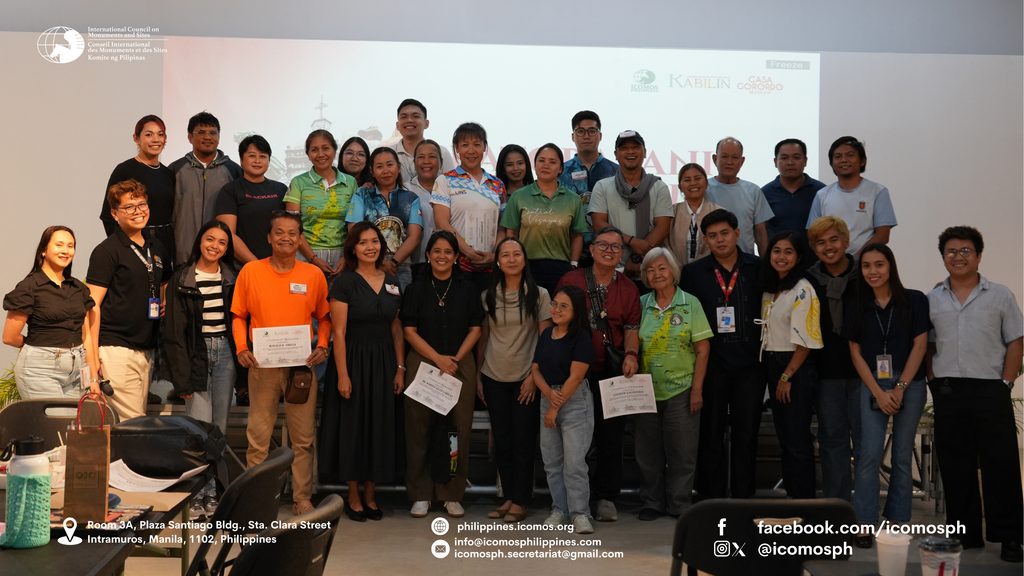
CEBU CITY- The Batobalani sa Kabilin Workshop: Interpreting Devotion, Place and the Living Heritage of the Santo Niño de Cebu began with the usual participant registration, then moved into the formal preliminaries. Ms Desiree Gestiada, Program Director of Cebloom Operations at the Ramon Aboitiz Foundation Inc. (RAFI), opened the session. Mr Philip Norbert Ahmad L. Medina, Treasurer and Board of Trustee of International Council on Monuments and Sites (ICOMOS) Philippines, followed with a statement on the importance of collaborative frameworks. He noted that this kind of workshop bridges institutional conservation with people’s history, so that devotion to the Santo Niño is not preserved in a sterile, institutional way but remains authentic, deeply rooted, and passed on in a way that is meaningful to the community across generations. Dr. Laya Boquiren-Gonzales, Project Director of the Intangible Cultural Heritage of the Santo Niño de Cebu Devotion (ICHSN), then gave the workshop’s rationale by answering the fundamental question: “What is heritage interpretation?” She said interpretation is not simply the transmission of facts about history or religion. It is about creating links between heritage and people, and between heritage and their lives. The end game, as she put it, is to see the feast as a way of caring for our communities and common home.
The workshop, facilitated by Subject Matter Expert Ms. Kara Velez Garilao, opened with a 15-second introduction exercise to highlight the importance of brevity and precision in tour guiding. This activity showcased the group’s diversity, which included professionals from tourism, museums, and heritage sectors, from newcomers to guides with experience dating back to 1987. Participants represented multilingual guides for Spanish, Japanese, and German tours, as well as members from the Local Government Unit (LGU), CEBloom TPG, the Yap-San Diego Ancestral House, The Kabilin Center, Casa Gorordo Museum, Cebu Association of Tourguides, Inc. (CATG), and Frontliners Lectures Academe and Guides Guild (FLAGG). During the session, participants discussed real-world challenges, such as addressing cultural sensitivity in Japanese-language tours about World War II, an Ilocano guide’s efforts to learn Cebu’s history, and another guide’s commitment to the Santo Niño. Through these shared experiences, the group aimed to move beyond reciting facts by deepening their understanding of Cebu’s heritage, developing meaningful narratives, and addressing complex historical topics to foster appreciation among visitors and local communities.
The workshop held on November 9, 2026, was the first in a series. Additional online follow-up sessions will lead to a co-developed “Batobalani Walks” with participants in April 2027. Participants who complete all sessions will receive a HEART certification from Ms. Kara Garilao.
In the workshop, participants learned that heritage interpretation is a mission-driven, ethical, and evidence-based way of communicating. It goes beyond entertainment, lectures, or cultural tourism to encourage deeper understanding, appreciation, and protection of sites. The session looked back at the field’s beginnings, from the founding of Yellowstone National Park in 1872 to the work of pioneers like Anna Botsford Comstock, Enos Mills, and Freeman Tilden. It highlighted that good interpretive planning starts with a clear purpose and uses frameworks like the 5Ms (Management, Message, Media, Markets, Mechanics by Lisa Brochu) and the HEART model, which stands for Holistic, Engaging, Appropriate, Rewarding, and Thematic. Through hands-on activities and group discussions, participants practiced linking physical objects to deeper meanings and universal themes. They applied these ideas to everyday items, historical markers, and Cebuano heritage sites such as the Basilica Minore del Santo Niño de Cebu, Casa Gorordo Museum, and Parian. The workshop also gave guides practical tools for creating meaningful guest experiences. These included checking sources for accuracy, using multi-sensory techniques to avoid information overload, asking questions that encourage reflection, and using the “authority of the resource” approach to enforce rules respectfully. The session ended by stressing that while sensitivity and careful research are important when dealing with complex histories, the main goal of interpretive guiding is to move beyond amusement and create real engagement, sparking curiosity and leaving visitors changed for the better.
As the day drew to a close, Ms. Marie Sol D. Gonzalvo, Executive Director of the North and Central Portfolio at RAFI, offered a heartfelt reflection on the collective journey to reconnect with Cebu’s living heritage. She distilled the spirit of interpretation into the acronym CEBU: Create a connection with your audience; maintain an Educational and developmental perspective that embodies the Cebuano spirit; Be present, adaptive, and true to yourself as a guide; and ultimately, craft an Unforgettable experience that lingers long after the tour ends. The group came together to celebrate a day dedicated to nurturing heritage through understanding, appreciation, and genuine human connection.
Read more about our initiative and access the project briefer here: https://bit.ly/ICHSNProjectBriefer
#RAFI #ICOMOSPH #cebloom #parasaatongkabilin #CebuanoHeritage #BantayKabilin #DRMCH